Key Takeaways
- →AI's job isn't to make you faster—it's to make you unnecessary to everything except three things.
- →Keep relationships, problem-solving, and selling human. Hand everything else to AI systems.
- →Build the three-layer stack: AI that senses, sorts, and ships while you sleep.
Three things should never touch AI.
Everything else should.
Most executives have it backward, and it's why they're still drowning.
Walk into any boardroom, and you'll hear the same three sentences.
"We rolled out Copilot."
"We built a custom GPT for the sales team."
"We automated our weekly reports."
Cool. So did everyone else.
This is AI productivity theater.
The corporate equivalent of a Peloton you ride twice. You feel busy. You haven't moved an inch.
A small group of operators is doing something else. They're using AI to disappear from email entirely. To run the pipeline at night. To onboard customers without lifting a finger.
The rule nobody wants to say out loud:
AI's job isn't to make you faster. Its job is to make you unnecessary.
Unnecessary to everything except three things.
Relationships.
Problem-solving.
Selling.
Not email. Not status meetings. Not whatever's blowing up your Slack right now.
Relationships, problem-solving, and selling are the only places a human founder or executive creates irreplaceable value.
A handshake your AI can't make. A judgment call only you've earned the right to make. A pitch only you can close because you built the trust to close it.
Everything outside those three is a candidate for an agent, an automation, or an offshore team.
→ Hand AI those three, and you've cut your own legs off.
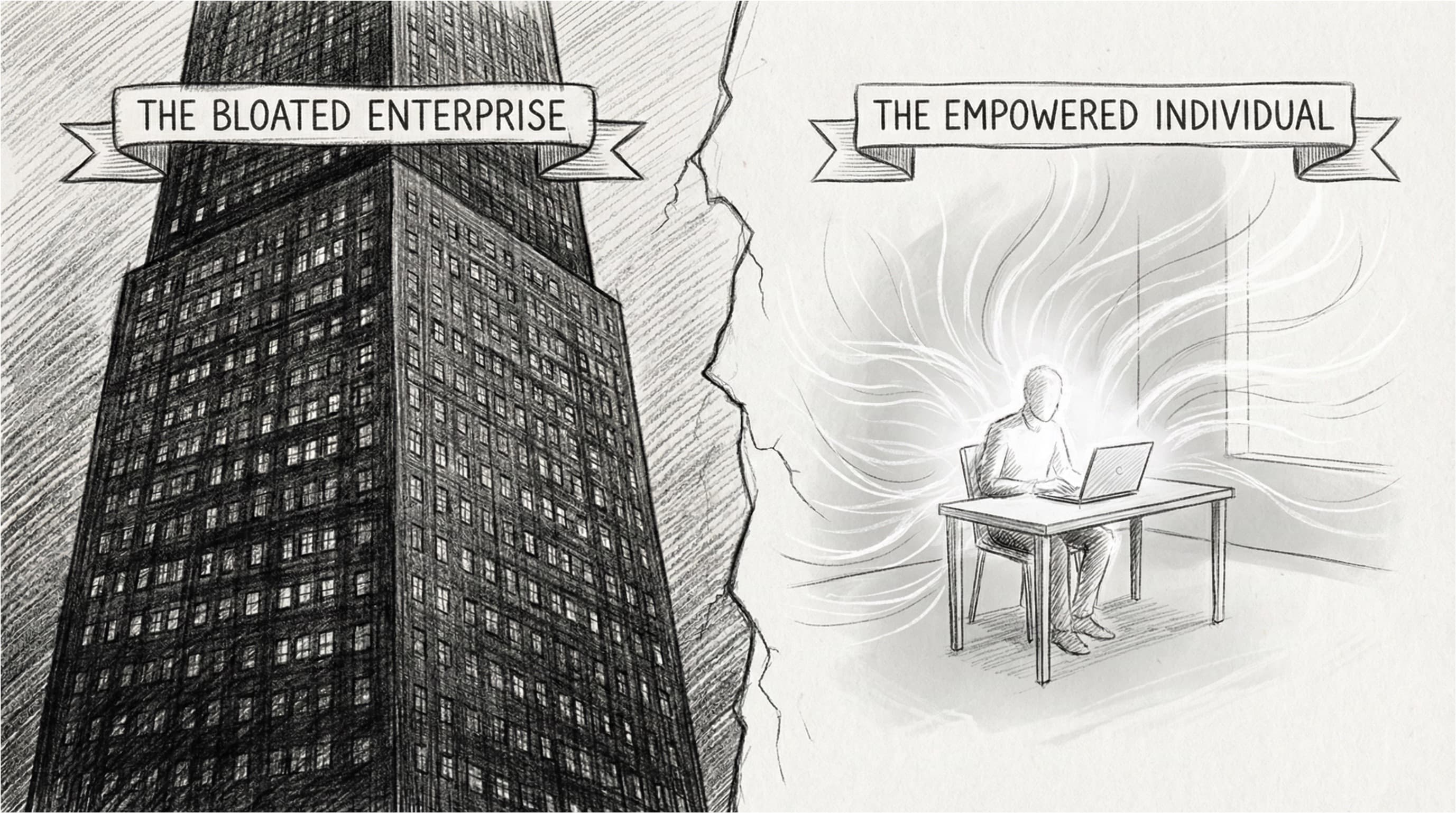
→ Hand AI everything else, and you've built a business that doesn't need you in it.
Watch what happens in every "AI-forward" company that's still drowning. The CEO saves six hours a week with AI. Then he fills those six hours with more meetings, more inbox, more reactive work. He didn't reclaim time.
He bought himself a bigger plate.
Speed at the wrong layer is just running into a wall faster.
So what does the real game look like?
I run a media brand called Finding Peak. I run a high-performance coaching practice on top of it. I help build an AI company called Linqura. I just crossed 400 episodes on the podcast. I have a book coming out called Easy Mode. I have two boys at home, a girlfriend, and the same 24 hours you have.
The only reason any of it functions is an AI Chief of Staff I built. His name is Max. Maximum Effort. He runs on OpenClaw.
Max works while I sleep.
He sorts inbound podcast requests while I'm coaching my son's baseball game. He drafts contracts while I'm recording a podcast. He preps me for every guest. He manages content calendars across multiple platforms. He helps me research and organize my book writing.
He doesn't pick up the phone when a client needs me. He doesn't solve the hard problems. He doesn't close deals.
When I sit down at my desk, I choose what matters.
That's the ballgame.
I see the same pattern in every executive I work with who's actually pulling ahead right now. The ones still trying to be the smartest worker in the company are stuck. The ones building systems that work without them are compounding.
So if Relationships, Problem-solving, and Selling stay with you, what do you hand AI?
Three layers. Odd on purpose, because four would be filler.
Layer 1: Sense.
Your AI's first job is to see what you don't have time to see anymore.
Market signals.
Customer churn patterns.
Pipeline weirdness.
Competitive moves.
You can't read the internet for eight hours a day, and you shouldn't try. Your AI reads it for you and hands you a daily intelligence brief shorter than this paragraph.
If the brief takes more than ninety seconds to read, you built it wrong.
Layer 2: Sort.
This is where most leaders fail.
They use AI to generate more output when the bigger win is filtering input. Sorting decides three things for you every day: what deserves your attention, what can be answered without you, and what can be killed entirely.
Most executive inboxes are mostly noise.
Sort the noise out, and your calendar opens up overnight.
READ NEXT: AI Will Not Change Everything
Layer 3: Ship.
The last layer is execution by something other than you.
Agents that complete tasks end-to-end. Workflows that close loops without you. Decisions are made at the edge, so you never see them in your inbox.
Ship means done, without you in the room.
Sense. Sort. Ship.
That's the stack.

"But my customers want me. My team needs me."
Fair. Read the rule again....
Relationships stay. Problem-solving stays. Selling stays. These are the "Sacred Buckets."
Your customers aren't paying you to manage a content calendar. Your team doesn't need you babysitting the ops.
The three sacred buckets are protected. Everything else is on the table.
Run that stack for ninety days, and your operating reality changes.
You stop confusing motion with progress. You stop drowning in work that doesn't require you. You spend your hours on the three things only you can do, and your business stops being held hostage by your calendar.
Call that freedom, and you'd be right.
The CEOs who will win the next decade are the ones who built the system that creates while they sleep. They're better orchestrators of better systems.
This is the shift nobody on LinkedIn is going to teach you.
The skill set of the next era is designing systems that execute without you in the room.
Not doing the work. Not even delegating it. Designing the system that owns it.
Do this today:
Audit your last seven days. Highlight every task you did that wasn't a relationship, a problem only you can solve, or a sale. That list is your AI build queue for the quarter. Nothing else qualifies.
Pick one recurring meeting and kill it. Replace it with an AI-generated summary, a Loom, or nothing at all. If the business survives the week, you have found a permanent candidate for removal. Most calendars are full of meetings that exist because nobody had the guts to cancel them.
Build one real agent this week. An agent that owns one task end-to-end. Inbox triage. First-draft proposals. Content calendar management. Lead enrichment. Pick one. Ship it. Tomorrow.
Your competitors are still teaching their AI to write better emails.
...and you're teaching yours to run the business while you sleep.
This is the way.
Hanley.
P.S. I help founders and executives generating more than $10M in revenue find their Easy Mode. If you're ready to stop being the bottleneck in your own company, click here to learn more.