Key Takeaways
- →AI adoption isn't about technology readiness. It's about overcoming the addiction to waiting.
- →93% of AI leaders say human factors, not technology, are the primary barrier to adoption.
- →The same thinking that killed Kodak and Sears is playing out in every established business right now.
I've had the same conversation 7 times in two weeks.
Different industries. Different revenue numbers. Different org charts.
Same sentiment...
"We're watching AI closely. We're just not ready to go all-in yet."
These aren't small operators.
These are middle-market CEOs running $10M, $30M, $50M+ revenue businesses.
Smart, thoughtful people who built real businesses over decades.
...and they're all making the same mistake.
Not because they're behind on the technology. Because they're addicted to something that feels like leadership but is actually its opposite.
I'll get to what that is in a second.
But first...

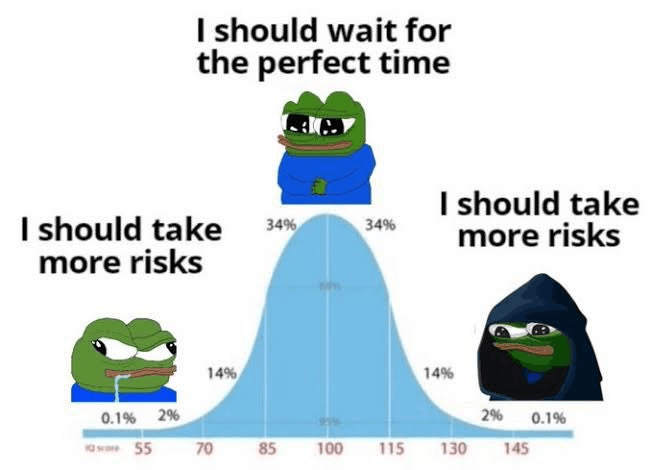
The people at both ends of the curve say the same thing:
"I should take more risks."
All those smart, thoughtful entrepreneurs and leaders in the middle?
"I should wait for the perfect time."
I laughed when I saw this meme on X...
...but honestly, it's not funny.
Every one of those 7 CEOs is living in the middle of that bell curve and what's keeping them there isn't caution.
It's fear disguised as risk management.
READ NEXT: Every New AI Tool Is Making Your Business Dumber
The Quiet Competitors
Why are so many leaders hesitating on AI?
They scroll through X and LinkedIn and see 23-year-olds losing their minds over Claude Code and AI agents.
It looks immature. Something for tech kids and venture-funded startups, not operators running $50M family businesses with real payroll and real consequences.
So they wait.
Not aware, the most dangerous competitors in their space aren't posting about AI.
They're using it.
Quietly.
Every single day.
I know this because I talk to entrepreneurs and business owners every day who are building in silence.
Creating competitive advantages that compound while the "wait and see" crowd builds PowerPoint decks about what they might do next quarter.
The Addiction
I recorded an episode of the podcast earlier this year called "4 Step Protocol to Stop Hiding in 2026."
The thesis was simple: hiding lets us feel special without being seen.
We tell ourselves, "I'm still figuring it out" or "I'm waiting for the right time."
That's not a strategy. That's an addiction to hiding.
"Waiting and seeing" on AI is the executive version of the same addiction.
It protects your potential from judgment. It lets you feel responsible when you're actually afraid.
HBR published a study last month that made this painfully clear. They surveyed global AI leaders and found that 93% said the number one barrier to AI adoption isn't the technology.
It's human factors.
Fear of looking stupid.
Fear of breaking something.
Fear of not being the smartest person in the room anymore.
Their exact quote:
"Anxiety was particularly pronounced among experienced professionals whose authority had been built on deep expertise."
That's every middle-market executive I know.
People who built something real over 20 years and now feel the ground shifting under their feet.
I get it. I respect it.
...but it's exactly the kind of thinking that killed Kodak.
Thoughtful Didn't Save Them
In 1975, a Kodak engineer named Steve Sasson built the first digital camera.
His boss looked at it and said, "That's cute. But don't tell anyone about it."
Kodak spent the next 35 years suppressing the technology that would destroy them.
Not because they were stupid.
They were protecting a business model that generated billions in film royalties. Every photo taken anywhere in the world was a royalty payment to Kodak.
They knew digital was coming. They hired consultants. Built task forces. Published transformation roadmaps.
Sound familiar?
In 2012, Kodak filed for bankruptcy.
The company that invented digital photography was killed by digital photography.
I wrote a thread on X about this a few weeks ago.
One line keeps coming back to me: "We're being thoughtful about AI adoption." Translation: we're protecting the current business model until we can't anymore.
Kodak was thoughtful, too.
Thoughtful didn't save them.
The Sears Playbook
Sears ran the same playbook a generation earlier.
By the time Amazon launched in 1995, Sears had everything Bezos needed. Nationwide logistics. Millions of customers. A century of catalog operations. A trusted brand.
They failed because they couldn't imagine a future that looked different from their present.
That's not a Sears problem.
It's a human problem.
It's playing out in every established business right now.
The Gap Is Becoming Permanent
McKinsey's 2025 data makes the gap visible.
Only 6% of companies have meaningfully scaled AI to the point where it moves the needle on EBIT.
But the ones who have are pulling away so fast that the gap is becoming permanent.
Companies over $5B in revenue are already twice as likely to have scaled. Not because they're smarter. Because they started experimenting earlier.
Marcus Sheridan said it plainly on the podcast:
Businesses that win right now are Fast, Frequent, and Fearless.
Those waiting for certainty are already behind those who moved.
Your Concerns Are Valid. Your Inaction Isn't.
I get the hesitation.
You've got compliance concerns. Data security questions. A board that wants ROI projections before you've even run a pilot. A team that's skeptical. All legitimate.
But HBR also found something else worth sitting with:
When leadership over-indexes on short-term ROI, people stop bringing forward ideas altogether.
Those concerns aren't reasons to stand still.
They're reasons to experiment small.
AI is the ultimate fuck around and find out (FAFO) technology.
A bad experiment costs you $20 in Claude API charges on a Tuesday afternoon.
Another year of "watching closely" costs you market position you can't buy back.
RSM's Middle Market AI Survey found that 88% of organizations that adopted AI said they had a more positive impact on their business than they expected.
Eighty-eight percent.
The fear is almost always bigger than the reality.
The Rub
Pick one workflow that annoys the hell out of you.
Give an AI tool 30 minutes with it.
See what happens.
Tell your team, "We're running experiments, not making commitments."
Kill the pressure of getting it perfect.
Stop reading about AI. Start talking to it (I recommend Whispr Flow).
The feedback loop is your teacher.
You don't need permission.
You don't need a committee.
You need 30 minutes and the willingness to feel like a beginner.
That bell curve meme isn't a joke.
The hungriest newcomers are moving. The sharpest veterans are moving. The middle is drafting a strategy document about moving.
The perfect time was six months ago.
The next-best time is today.
This is the way.
Hanley
P.S. I help founders & executives generating more than $1M in revenue find their Easy Mode. Contact me if this is you.
♻️ Be sure to share this article with a friend that needs to see it!