Key Takeaways
- →Passion and drive are psychological risk factors that cause you to neglect everything else in your life.
- →Action creates passion, not the other way around—start before you feel passionate.
- →Schedule your personal life like work or it will get consumed by work.
Listen to the full episode: https://linktr.ee/ryan_hanley
You've been lied to.
Not by one person. By the entire culture.
We've all been sold the same story: passion and drive are the ultimate virtues. Grind hard enough, care enough, push yourself to the absolute limit, and you will win.
But what if that exact mindset is the thing quietly tearing your life apart?
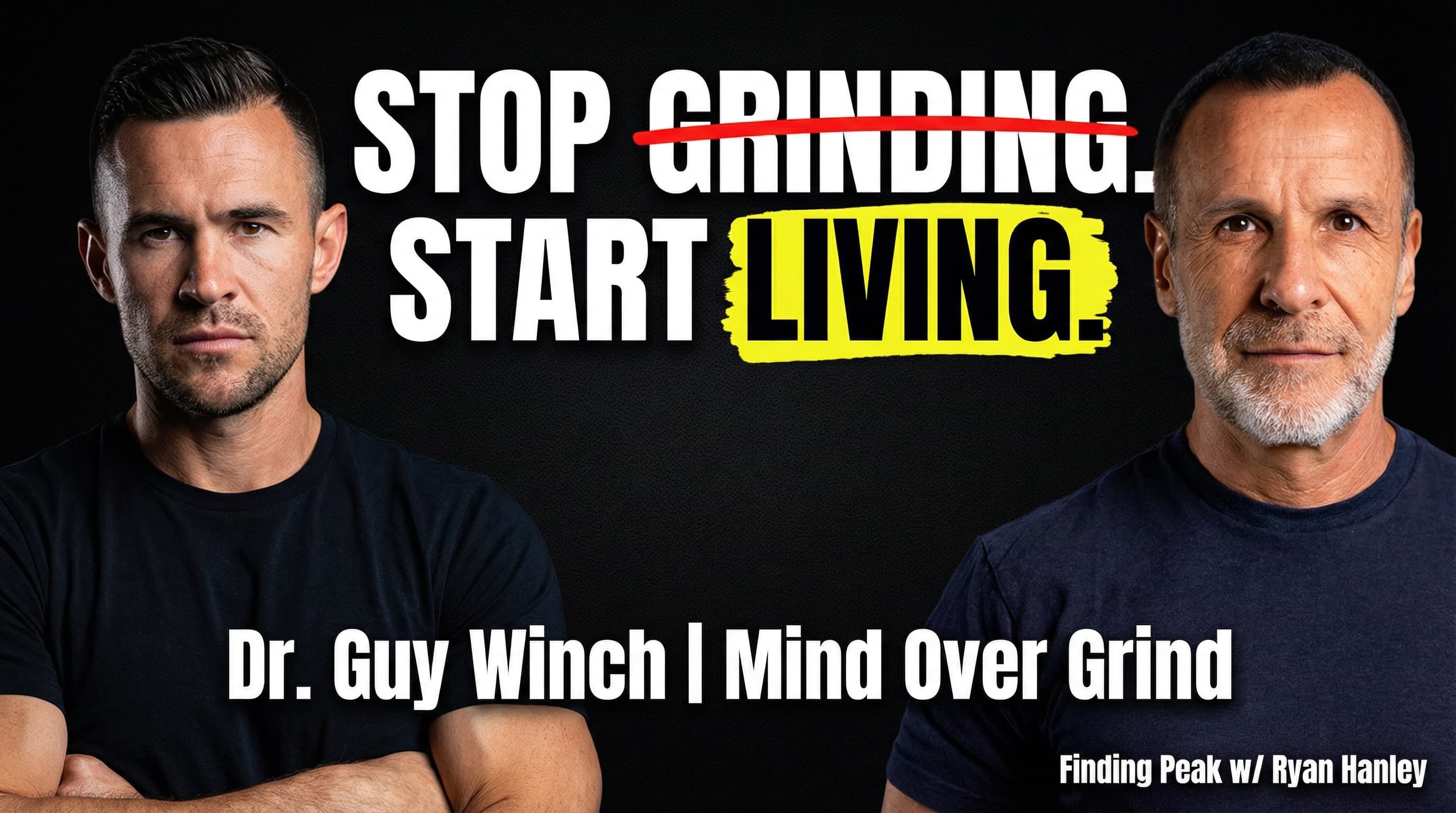
In the latest episode of Finding Peak, I sat down with Dr. Guy Winch — internationally renowned psychologist, three-time TED Talk speaker with over 35 million views, and author of the new book Mind Over Grind: How to Break Free When Work Hijacks Your Life.
...and he said something in the first five minutes that I had never heard in 500+ episodes of this show: Passion and drive are psychological risk factors.
Let that sink in.
The very traits that make you a great entrepreneur, a relentless leader, a person who gets things done — those are the same traits that put you at the highest risk for burnout, self-neglect, and a slow, quiet loss of who you actually are.
Here is why. And more importantly, here is how to fix it.
Connect with Guy Winch
Get Dr. Guy Winch's book, Mind Over Grind: https://amzn.to/4dfXCBJ
Learn more about Dr. Winch: https://www.guywinch.com/

The Amputation You Don't See Coming
When you are deeply passionate about your work, it obscures the warning signs.
You are excited. You are animated. Everything feels like good stuff.
So how could any of it be bad?
Because when you are hyper-focused on one singular goal, everything else gets pushed to the margins.
You skip doctor's appointments.
You stop seeing the friends who bring out your goofy side.
You abandon the hobbies that used to light you up.
You stop making music, or building things in the garage, or playing golf, or whatever it was that made you feel like a full human being.
As Dr Winch says...
It's like amputating parts of your personality one by one.
You do not bring your whole self to work. You bring a very specific, highly optimized version of yourself.
...and if that is the only version of you that gets any oxygen, you eventually become a very narrow, very fragile person. Fine for a week. Fine for a month. But passionate, driven people are at it for months and years.
...and then one day you wake up and your relationship is in a bad state, you barely know what is happening in your kids' lives, and you cannot remember the last time you did something just for you.
The worst part? You never saw it coming. Because the whole time, it felt like good stuff.
READ NEXT: You're White-Knuckling Your Way Through Life for a Feeling That Doesn't Exist
The Post-Exit Void (And Why It Hits So Hard)
I know this firsthand.
After I sold my startup, I expected to feel triumphant. I had built something real, fought through a pandemic, and made it out the other side. Instead, I spiraled. Hard.
I fell back into terrible habits, felt completely rudderless, and experienced a level of shame I had never felt before, because even my kids, as much as I love them, were not enough to pull me out of it.
Dr. Winch sees this all the time. Whether it is selling a company, finishing a marathon, or retiring after a long career, when a massive, singular purpose is removed, it leaves a terrifying void.
Here is the psychology: if your entire life was oriented around that one goal, and you neglected everything else to achieve it, you have nothing to fall back on when it is gone.
Your "driven" energy has nowhere to go. So it turns inward. And that is when bad things happen.
The fix, according to Dr. Winch, is to start planning for what comes next before you get there.
Not after.
Because once you are in the void, you are too demoralized to think clearly.
The time to build the next chapter is while you are still in the current one.
✔️ Subscribe to the Newsletter
Why Action Creates Passion (Not the Other Way Around)
Here is the most counterintuitive thing I took from this conversation.
Most people wait to feel passionate before they take action. They want to find the thing that lights them up, and then they will go all in. But Dr. Winch flips this completely on its head.
Investment creates attachment. Action creates passion.
You do not have to fall in love with the next project before you start. You just have to start.
The more you apply yourself to something, even something that seems only slightly interesting, the more you will care about it.
The more you will want to do it well. The more it will feel like yours.
This is true in careers. It is true in relationships. It is true in every domain of life.
You did not wake up at 15 years old dreaming about your industry. You ended up there. You applied yourself.
...and then it became yours.
The same process works for finding your next thing after a loss. You do not wait for lightning to strike.
You pick a direction, take action, and let the investment do the rest.
How to Stop the Bleed Right Now
So, practically speaking, how do you pull yourself back from the edge?
Dr. Winch offers three concrete moves.
1) Schedule your life like you schedule your work.
Your brain takes your calendar seriously. If there is a blank slot in your evening, work will invade it. Every time.
You have to actively schedule time for rest, for your partner, for your kids, and for yourself.
Not as an afterthought. As a non-negotiable appointment.
2) Take control of your coping mechanisms.
When you are overwhelmed or paralyzed, your brain defaults to easy, short-term relief — scrolling, avoiding, numbing out.
These are automatic coping mechanisms. They feel productive but they are not. You have to consciously override them. Sit down.
Write out your goals. Identify three small actions you can take right now to move forward. Who can you call? What can you do today?
Start making lists.
3) Do the audit.
Not just a time audit, but an honest self-assessment.
When is the last time you spent two hours at home without checking work messages?
When is the last time you were fully present with your kids — phone out of sight, not just out of hand?
When is the last time you did something that made you smile that had nothing to do with work?
If you are scratching your head on any of these, that is your answer. Start scheduling those things. Now.
The Rub
No one I have ever spoken to, in 700+ conversations with some of the most successful people on the planet, has ever told me their greatest achievement came from grinding 20 hours a day for years.
Not one.
If they did that, they talk about the regret. Every single time.
Success is not about grinding until there is nothing left of you. It is about building a sustainable system where you can perform at your peak without sacrificing your health, your relationships, or your soul.
Stop letting work hijack your life.
Take back control.
This is the way.
Hanley