Key Takeaways
- →Information blindness kills speed.
- →The information asymmetry is widening daily.
- →90 minutes a day changes everything.
There's a lie people love to tell themselves.
"I just don't have time to keep up with what's going on."
Bullshit.
You have time.
You have more time than any generation in human history.
What you don't have is discipline.
What you don't have is a system.
What you don't have is the self-respect to admit that staying ignorant in 2026 is a choice and a dangerous one.
Let me tell you what happened last week.
Iran started laying mines in the Strait of Hormuz. If that sentence means nothing to you, congratulations, you just proved my point.
One-fifth of the world's crude oil flows through that waterway. Within days, oil prices spiked 40%. Gas prices jumped 17%.
Analysts started throwing around $4 and $5-a-gallon projections.
...and somewhere, a business owner was sitting in a meeting, blindsided, wondering why their shipping costs just exploded.
That's the cost of not knowing.
The world is too connected and moving too fast for you to bury your head in the sand.
A chokepoint in the Persian Gulf changes what you pay at the pump in Tulsa by Friday.
A tariff announcement reshapes your supply chain before lunch.
A regulatory shift in Washington rewires your entire compliance system overnight.
Speed and adaptability aren't nice-to-haves anymore.
They're survival skills.
...and you cannot be fast if you are blind.
The Andreessen Framework
Marc Andreessen, the guy who literally invented the web browser and now runs one of the most influential VC firms on Earth, recently posted something on X that should make every leader stop and think.
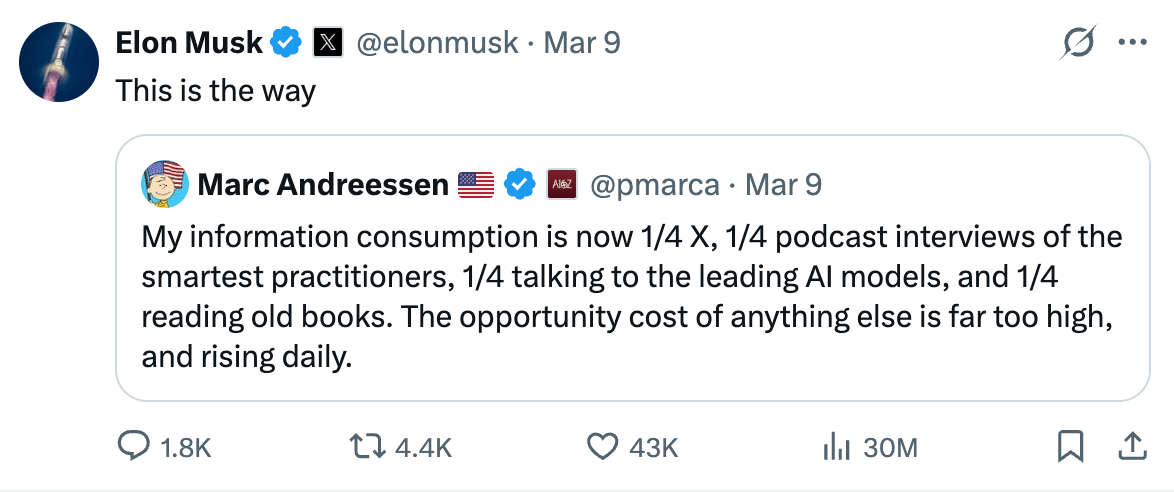
Andreessen said his information consumption is now split into quarters: one-quarter X, one-quarter podcast interviews with the smartest practitioners, one-quarter conversations with leading AI models, and one-quarter reading old books.
...and then he dropped this hammer: the opportunity cost of anything else is far too high and rising daily.
Read that again.
The opportunity cost of consuming information poorly is rising daily.
Elon Musk piled on immediately, noting that articles on X are growing fast and announcing that Grok will soon add article summaries to improve the rate of information consumption.
This isn't a casual aside.
It's the owner of the platform (X, formerly Twitter) confirming that the entire architecture of X is being rebuilt around accelerating how fast humans can process signal from noise.
These are two of the most powerful and polarizing figures in technology.
Like them or not, they are telling you something critical about where the world is headed.
The infrastructure for staying informed has never been more efficient nor more important to sustainability and growth.
Your excuses have never been less legitimate.
The Fifths: A Framework for the Rest of Us
Now, Andreessen is a billionaire running a venture capital empire. His framework is calibrated for his world.
I respect the hell out of it, but I think there's a missing piece for operators, for the people actually running businesses, leading teams, making decisions in the trenches every day.
You may be able to guess, but I consume a massive amount of information.
I run on fifths.
1/5 — X (Real-Time Signal)
X is the fastest wire service on the planet. It's messy. It's loud. It's occasionally a dumpster fire.
...but when Iran starts mining the Strait of Hormuz, you'll know on X before CNN's chyron updates.
When a CEO gets fired, when a deal breaks, when a policy shifts — X is first.
With Grok now summarizing trending stories and articles directly in the feed, the platform is becoming something more than social media. It's becoming a real-time intelligence layer.
You don't need to doom-scroll.
Instead, curate your feed with intention and let the AI do the heavy lifting.
Connect with me on X: @Ryanhanley_com
2/5 — Podcasts (Practitioner Depth)
Andreessen is right about this one.
Not the celebrity interview pods. Not the "what's your morning routine" nonsense or even the ancient civilization and conspiracy theory shows (although these can be fun. I'm looking at you Why Files).
I'm talking about practitioners, the people actually doing the thing — breaking down how they think, how they operate, how they make decisions under pressure.
This is your commute. This is your gym time. This is your edge.
If you're not big on podcast but want to give them a try, here are a few I recommend:
If you start with these shows you'll have a great mix of both macro and micro information on what's happening in the world, culture and business.
3/5 — AI Tools (Your Research Team)
This is the one that changed everything for me.
ChatGPT's Pulse feature now does asynchronous research overnight and delivers personalized briefings every morning based on your conversations, your interests, and your connected apps.
You wake up, and your AI has already scanned the landscape and surfaced what matters to you.
Grok has real-time access to what's trending on X and can synthesize breaking developments in seconds.
Every morning I receive briefs from both OpenAI and Grok on the economy, AI, insurance and other topics that I want to stay current on. I scan these briefs for relevant stories while I'm drinking my coffee.
Claude, which I use for strategy and building (including this website and CMS) can analyze documents, challenge your thinking, and help you connect dots you'd never see on your own.
This isn't the future.
This is your morning.
The idea that you need a team of analysts to stay informed is dead.
The tools are here. Most of them are free or close to it.
4/5 — Niche Newsletters (Curated Industry Intelligence)
This is my addition to the Andreessen framework.
...and I think it's the one most people are sleeping on.
There is a newsletter for every industry vertical, every investment thesis, every operational discipline you care about. Written by practitioners. Curated with intention. Delivered to your inbox before you finish your coffee.
Commodity markets. Insurance technology. AI implementation. SaaS metrics. Defense procurement. Energy policy. Pick your poison.
These aren't mass-market media plays.
These are specialists writing for specialists.
...and the signal-to-noise ratio is extraordinary.
If you don't have three to five niche newsletters in your rotation, you're leaving intelligence on the table.
Here are a few I recommend:
Contrarian Thinking (Codie Sanchez)
...and if you're not subscribed to my newsletter, Finding Peak, click here now.
5/5 — Books (Timeless Principles)
Andreessen reads old books.
So do I...because the patterns don't change.
Human nature doesn't change.
The principles of strategy, leadership, negotiation, and power are the same ones that governed Rome, built empires, and destroyed them.
Current events tell you what's happening. Books tell you why it's happening and what's likely to happen next.
This is the long game.
...and the long game is the only game that matters.
The Real Problem
The excuse used to be "there's too much information."
That was valid for about five minutes in 2015. Now?
AI has solved the curation problem. Tools like OpenAI's Pulse, Grok, and Claude exist specifically to filter, summarize, and surface what matters.
The new excuse is "I don't have time."
Also invalid...
If you're like most Americans:
You spent 47 minutes on Instagram yesterday looking at reels of people cooking food you'll never make.
You binge-watched three episodes of a show you won't remember next month.
You mindlessly broke colored blocks on some free phone game that added zero value to your life.
The time exists. You're just spending it on noise instead of signal.
And here's where it gets real...
The world is not going to slow down for you.
Iran doesn't care about your content calendar. The Fed doesn't wait for you to finish your Netflix queue before adjusting rates. Your competitor doesn't pause their AI implementation because you haven't gotten around to reading about it yet.
The people who will win in 2026 and beyond are those who know what's happening across four dimensions: World, Economy, Industry, and Community.
They see the Strait of Hormuz story break and immediately start running scenarios for their supply chain. They catch a regulatory signal in a niche newsletter and pivot before their competitors even know the rules changed. They hear a practitioner on a podcast describe a framework and implement it before the episode is two days old.
That's speed. That's adaptability.
That's how you capitalize on opportunity instead of getting crushed by it.
Listen to my conversation with Carol Roth of the economy today and what's coming tomorrow.
The Framework in Practice
Here's what this actually looks like on a random Tuesday:
Morning (15 minutes): Check your AI briefings. Pulse or Grok has already done the overnight research. Scan the cards. Dive deeper on anything that touches your world.
Commute or Gym (30-45 minutes): One podcast episode. A practitioner you respect, talking about something you're trying to get better at.
Midday (10 minutes): Scan your niche newsletters over lunch. Two or three will have landed. Read the headlines, deep-dive on anything relevant.
Evening (20 minutes): Scroll X with intention — not recreation. Check the trending stories. See what Grok is summarizing. Bookmark what you need to process later.
Before bed (15-20 minutes): Read. An actual book. Something that's been relevant for decades and will be relevant for decades more.
That's roughly 90 minutes a day.
Don't you have 90 minutes?
Yes, you do.
You just don't want to admit where those 90 minutes are currently going.
The Rub
The smartest people in the world have reorganized how they consume information.
Andreessen split his into quarters. Musk is literally rebuilding X's infrastructure around accelerating information consumption. OpenAI (Sam Altman) built a feature that researches while you sleep.
These aren't coincidences. These are signals.
The asymmetry between people who are informed and people who aren't is widening every single day. And the tools to close that gap have never been more accessible, more powerful, or more free.
So the next time someone tells you they "don't have time" to know what's going on in the world, in their economy, in their industry, in their community, understand what they're really saying.
They're saying they don't think it's important.
...and that tells you everything you need to know about whether they'll be ready when the world shifts under their feet.
It already has.
This is the way.
Hanley.