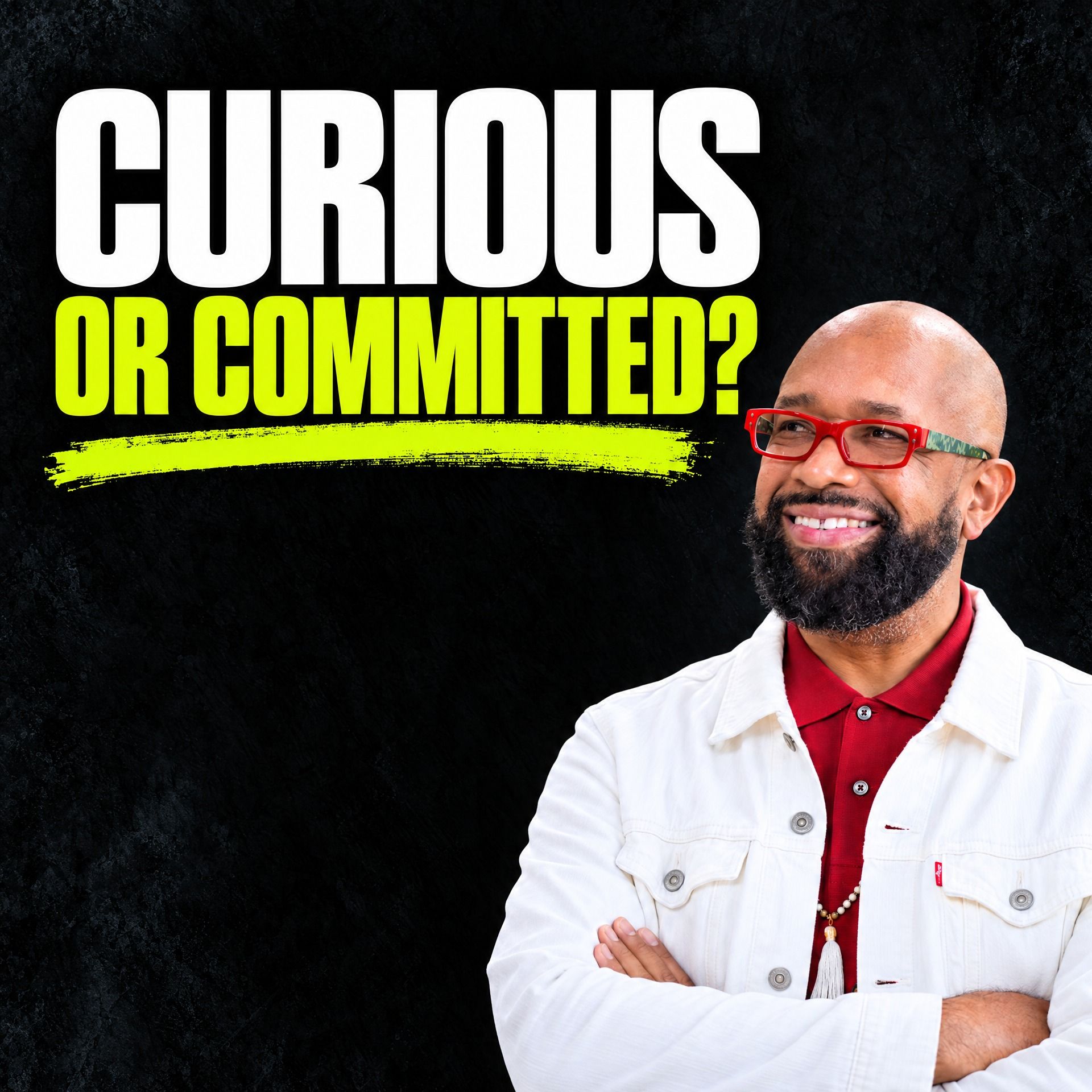
George Bryant on Being Seen, Survival, and the Cost of Hiding
Episode Answer
George Bryant on Being Seen, Survival, and the Cost of Hiding is a Finding Peak podcast episode hosted by Ryan Hanley. The conversation explores leadership, performance, entrepreneurship, and the work required to build with clarity under pressure.
Read the Conversation
Show the full transcript
We are capable of choosing catastrophe simply because we know how to survive it, versus choosing success because we just don't know how to survive it 'cause we've never experienced it. Vulnerability became a manipulation tool for me instead of actually being vulnerable. And I realized that I had created this prison that I couldn't get out of for all these things that I thought was gonna happen, where none of it actually was true. And it took me a couple of years to realize there's a big difference between authenticity and intimacy. So I don't normally start my show with someone's, like, origin story, but I think you have such a unique and dynamic origin story that I, I want the audience to understand kind of who you are, where you've come from before we start to really get into stuff.
Because, you know, we've had-- this is probably our third or fourth time we've chatted, and every time we talk, I feel like I learn something new and dynamic and that has incredible depth. And, uh, I just wanna level set for the audience so they know before we, we get into everything. Yeah, man, I would love it. And I'll give, I'll give the elevator version or else we would have to do an eight-part series on this. Uh, I've learned, you know, to give, to give the, the cliff notes if we're going back to our childhood, right?
I never read the books. I wanted the cliff notes. So I'll start with this, that I never set out to be who I am today. It feels like the man I am, the life I live, the business I have was a series of accidents which I now know were just God keeping me aligned. But if we go all the way back, you know, rough childhood growing up outside of Boston, drug abuse, physical abuse, sexual abuse, and so trauma galore, coping mechanisms.
I bullied only white kid in my class. I was a hundred pounds heavier than I am now. I was just a fat kid. And so I did what any-- I thought any sane person would do. I was like, "How do I get the hell out of here?"
And, you know, college wasn't an option. I was working three or four jobs through high school. Social services. I was avoiding my caseworker like the plague 'cause I was trying to emancipate myself. So I saw a marine recruiter walk into my school and I was like that.
Sure, why not? And uh, I tried to join the Marine Corps and they told me I was too fat. And so it's what I needed though to have a goal. And I started working and then, you know, fast-forward, I ended up July, actually holy moly, next week July twentieth of two thousand and two, um, they shipped me off to the Yellow Footprints in Parris Island and I've never been more scared in my life. That was the first flight I'd ever taken.
I had no idea what I was doing. And I was just a scared little boy, but I was more scared of going home than I was of facing anything that was in front of me. And so end up at Parris Island as a marine. Uh, and shockingly enough, I spent most of my childhood just feeling like garbage, just trash. I'm worthless.
I'm not good at anything. I don't know what to do. Like all the survival instincts. And then fast-forward and somehow after thirteen weeks I was selected as the honor graduate out of eight hundred people. Uh, and they're like, "You, you, you win."
And I'm like talk about dissonance, no idea whatsoever. So then leave for Marine Combat Training, get selected first. Go to my job school, get selected first and I got my pick of duty station. So I get sent to Cherry Point, North Carolina and uh, I'm there so quick and I'm like well, I found something I'm good at, right? If I work hard, if I keep my head down.
And then that got me a fast track deployment to Somalia, uh, you know, in two thousand and four. So on my twenty-first birthday I turned, uh, I turned twenty-one in Somalia but I almost lost both my legs and so that became another hurdle for me. I had what's called bilateral exercise-induced compartment syndrome simultaneously. Don't Google it if you have a weak stomach. I just promise you don't do it.
And so they ended up medevacing me and I came home and they're like, "We're gonna try to fix it." They did a surgery, it didn't work and they're like, "You're gonna lose both your legs." And I was like, "Wha-wha-what? Come, come again?" And they're like, "Yeah, the surgery didn't work.
This can't be fixed." But because the military did the first one, I got to ask for a second opinion. I called every single doctor I could find in North Carolina. I found a sports orthopedic surgeon that worked on sports teams and he's like, "I'm be honest with you. I can fix this.
I can relieve the pressure but you're gonna have to get out of the Marine Corps. You're never gonna run again. You're, you know, gonna struggle walking." And I was like, "Okay." So he did the surgeries which was hell.
That's where, you know, my life started to really struggle where I was bulimic as a kid. I struggled a lot. You know, my parents were addicts and so I ended up in a wheelchair for about twelve months. I had six surgeries, got addicted to opioids, gained a hundred pounds again and ended up, you know, in a wheelchair for a long amount of time popping thirty to forty hydrocodone a day when I didn't have a PCA pump into my spine. And that was the first time that I attempted my life.
Um, it was probably September, October of two thousand and five and I was living alone in my barracks room completely medicated, bulimic, binge eating and one night I took the whole bottle of pills and I was like, "I don't wanna wake up. I'm done." And I mean the whole bottle to the point where I just basically drugged myself into a coma and the next morning when I woke up I actually didn't think I was alive. I was so dissonant, like so unaware of what was happening around me and it took me a while to realize that I was alive and something shifted in me but not to a degree. Like I was avoiding my childhood, you know, my parents' legal issues with each other, you know, getting divorced, suing each other, the abuse, the trying to burn each other alive, the things that I witnessed.
And I didn't know what to do but I was so angry and that's actually when I started self-harming. And so I was just in this like- cesspool spiraling. And I remember my boss was like, "Hey, listen, you have three more months left before we have to start your medical separation." And something shifted in me because I was like, "Where am I gonna go? What am I gonna do?
What is gonna happen?" And I was like, "You're not separating me at all." And he's like, "You've been in a wheelchair for nine months. If you can't pass a physical fitness test in the next 90 days, you're out." So I went from wheelchair to eight hours a day of physical therapy, having to learn how to walk again, how to function again, and literally by the skin of my teeth, Ryan, I'm, I'm not joking, I had to run three miles in under 28 minutes.
I ran it in, like, 27:50. And my boss was like, "I'll give you six months to lose the weight. You're an incredible Marine. I believe in you." His name was George, too, uh, George Kronk.
Still thank that guy every day. And that external pressure kind of created new meaning for me. And so I just became addicted to working out, addicted to, you know, re- recovering and repairing. I had to relearn how to walk, how to run, all that stuff. And the premise was simple, "If I don't use it, I lose it."
So, like, fitness became my new addiction. I replaced the opioids with fitness. I replaced the bulimia with fitness, and then it was just basically orthorexia all day. So I ended up back on full, full duty, and like everything in my career, I pursued it as hard as I could. I was like, "I need to be the best at everything because it's the only way that people will accept me."
And so that Napoleon complex was, like, my whole life. Like, I'm gonna be a black belt martial arts instructor. I have to have the best rifle scores, have to be a rescue swimmer. And it served me in my career to where it fast-forwarded me 2009, 2010, ended up in Afghanistan and dealt with other situations I'd never thought, like one of my Marines sticking a loaded rifle in my mouth at 2:00 a.m. in the middle of Afghanistan 'cause he had a mental breakdown. And then ended up having seven traumatic brain injuries over the s- span of, like, two, three years.
And so when I came back from Afghanistan, I was pretty broken. Um, my dad had just died, which I didn't really have a relationship with him, uh, outside of, you know, me being his friend, 'cause all the childhood trauma. I hadn't talked to my mom in 15 years. And Afghanistan broke me, and it broke me in all the best ways, but I didn't understand. And so when I was out there, I was like, I had to face the fact that I was doing everything in my life because I swore I didn't wanna end up like my parents.
The only justification that I had is that I chose different drugs. I made them wrong for heroin and coke and all of that, but I chose opioids and fitness, and I was running from all the same things. And losing a couple Marines and seeing the things that I saw really kinda, like, broke me, and I had to accept the fact that I was too afraid to take my life, so I was trying to slowly do it, so I didn't have to be responsible for it. And so when I came home from Afghanistan, I was like, "I need to fix myself." And I don't know where that desire comes from, where that drive came from.
Now I can just give full credit to Jesus because it just feels like every single time I was close, some miraculous thing would shift. Something would fall into alignment, and I was like, "I can't do this anymore." Well, this was 2010. Turns out, you know, gluten wasn't the popular thing to remove from food back then, but I found out I had celiac's disease, and that's where a lot of, like, my hormones and dysregulation was coming from, plus all the stuff on top of it. So I was like, "I'm gonna teach myself how to cook, but I need accountability, so I'm gonna document it on the internet."
Well, I didn't go to college. The only internet that existed in tw- 2010 was blogging and Facebook. So I made a fake college email to get a Facebook account, and then I just started posting recipes that I would cook, I would learn, and I would tell a story of. And every time I posted one, I'm like, "The world doesn't know they're holding me accountable to eating clean and healing." And then after about a year, someone's like, "You should start a blog."
I'm like, "What the heck is a blog?" Went to blogger.com, started a blog, and the only reason I was doing it was to have some level of accountability to me wanting to, like, really heal myself. I started studying psychology 'cause I was eating therapists for breakfast. Like, you could have made Good Will Hunting about me. I was like, yeah, whatever.
I would play games. I would turn it all that me-- 'cause I, I didn't really trust anybody, and I didn't want to really be healed. I had this, like, chip on my shoulder that I had to do it alone. Well, in that process, 'cause I was planning on doing 20 years in the Marine Corps, right around year 12, my new boss was like, "Hey, by the way, we're gonna have to separate you." Now the traumatic brain injuries were spiraling out of control.
I would pass out at my desk. I was having, like, complete blackouts from bleeding on my brain. I was getting stem cells. I was getting Botox injections for the pain. I was medicated beyond belief, and they're like, "You can't stay in anymore.
Like, we have to do this." Like, there's no... I'm like, "I'm near the end of my career. I got seven years left. I can put me at a desk," and they're like, "No, no, no."
And so they started this process, and something shifted in me, and I was like, "Well, I'm just gonna keep running this blog." And so turns out, like, right around the same time they were like, "Hey, we're done with you," was right around the same time, uh, that blog had started to, like, take off. And so then I basically leaned all the way in to becoming an entrepreneur. I didn't know anything. I didn't know what marketing was, websites, SEO, affiliate marketing, any of it.
But I was like, "I have to figure it out." My first ever digital product was an e-book, and it made a million dollars in, like, six days. This is like 2012. Like, I hadn't made a million dollars my whole life, and something in me shifted. But then entrepreneurship became my new addiction, and I had this pattern my whole life of never dealing with anything and just moving forward, right?
Just dragging the whole past but pretending it wasn't there. So then I was like, "Well, of course I'm gonna be the best at this." Get 6 million people a month on my blog, millions of social media followers. Then I met my ex-wife and Hit a point where basically everything spiraled out of control. I was suicidal again, and I checked myself into a psych ward.
You know, this was 10, 12 years ago. And I basically ran out of gas to run, and I ran out of hiding places from myself, and that's when the real work kind of began. And so I had, like, this midlife crisis. I ended up in the jungles of Costa Rica, and I had my first experience with God, and God told me to give away the company. And so in 24 hours, I gave away the entire company, and I disappeared off the internet.
I changed my email, changed my phone number, deleted social media, and I disappeared for three years. And I started to actually, like, work on myself. I started to actually, like, feel my feelings and unpack what was there. And that went on for about three years until one day I kind of came back on the internet, and I was like, "I need to help people with this stuff." Like, I've learned a lot, I've done a lot, and I was blessed that when I gave away that company, all the companies that knew me, the affiliates I was working with, were like, "How the heck did you do it?
How did you build a business so big? What were you doing?" And I was like, "I'll just show you." And so I kind of accidentally became a marketing strategist and consultant, and the first couple of companies I touched went to a couple hundred million or a billion, and then it was a whole new career path. And that's what kind of led me till today, where I have the podcast, I do my coaching, I do my consulting, and, and I kind of use my story as the way to help other people avoid making the mistakes.
But that is the probably shortest version I can give you. When did you become aware of the internal commentary that you're able to give us today, right, as you're telling that story? When did you become aware, self-aware enough and grounded enough to be able to give the rational commentary around these moments that were m- most likely not rational in any regard while you were going through them? That is the most incredible question anybody's ever asked me. No one has ever asked me that before.
I use the term dissonance a lot because I figured out what cognitive dissonance was. I was the king of gaslighting myself, Ryan. I'd read a book, and I'd pick up a concept, and like, "Oh, I got it figured out," right? And the more that I pursued the knowledge, the more that dissonance became, the gap between what I actually was and what I thought I was. And it wasn't till there was an external catalyst, which happened to be my ex-wife being pregnant with my son, where I was basically, like, three weeks away from bankruptcy from all the self-sabotaging behaviors.
But when I looked in the mirror, that's not what I told myself. I was like, "You're doing the work. You have the answers. You can answer every question. You can justify everything," right?
Like, I could psychoanalyze myself at a level that I can't even explain. But the psychoanalysation was the hiding place. It was me advocating myself from taking any action. So it was do as I say and do as I can explain, but zero do as I do. And it wasn't until I got to a place where nothing would allow me to not actually start doing the work that I understood, which was around, like, 2016.
And that's when I was like, "Oh, finally, there's this place where all these things I understand, I can apply them." And I thought it was as simple as, "Well, I get the concept, so that just changes everything in my life, right? It's just-- It's gonna come easy, right? I'm gonna go to the gym for one day, and I'm gonna have a six-pack." Turns out, not really there.
I was missing the whole lesson in vulnerability, in humility, in meekness. And there was this wound of where I felt entitled my whole life because these things were done to me, or this is what my childhood was like, that, like, somebody was gonna come save me. And I got stuck in that pattern forever. And then what happened tactically is there was that moment where it all kind of hit me. And Ryan, I swear, I couldn't speak for a couple years because I realized that every time I was speaking, I was lying to myself, and I was just hiding in the lies.
And it even-- It says it in Matthew, that you judge a man by his fruits, not his words. I didn't find that till, like, seven years later. But I was so afraid of trying to produce fruits because I was so much more comfortable identifying with all the wounds. They were known to me. They were predictable.
I could meet you, and I could tell you my whole story, and I could get you to feel bad for me, and then you liked me. And then I didn't have to have a fear that you would leave me. I didn't have to have a fear that you would abuse me. And so I was so comfortable in the story that I refused to pick up a pen and write another one because I actually had to be willing to let go of my comfort zone. And as hard as it was, knowing it was easier than stepping into something I didn't know.
And it was probably one of the most, like, humbling experiences ever. And so it was only when I actually started doing the work, right, that I was able to realize how much I had gaslit myself. And for me, there was empathy too because it was a survival mechanism to some degree. It was how I had to go to cope to basically being on my own from 11 or 12 on, right? Like, that's when I moved out, and that's when I was living in friends' basements and trying to survive, like, basically homeless, Lord of the Flies.
But it was no longer serving me. And it cost me everything. Everything. It's scary and, and I would say that pound for pound, I have not dealt with as much trauma as you have, but I-- there are pieces of my story which I see in yours. Uh, certainly aggressive male abuse, stuff like that.
Um- It's scary to think that we are capable of choosing catastrophe simply because we know how to survive it versus choosing success because we just don't know how to survive it 'cause we've never experienced it. And that whether consciously or unconsciously, we will choose self-destruction because we've survived it before versus taking the path that you- that's gonna lead to success because you've just never been there before. Um, you said psychoanalysation was a hiding place. I think that may be a foreign concept, but I think it's incredibly powerful and important to unpack because so many of us do this. So what exactly do you mean?
And maybe explain psychoanalyzing yourself and how that became a hiding place for you. That's a incredible... Dude, you're so good at asking questions. Holy moly. I figured out as a survival mechanism that if I could get to the analysis before you, you wouldn't dig any deeper, right?
So vulnerability became a manipulation tool for me instead of actually being vulnerable. So how I summarize this is I would give you enough vulnerability for you to be convinced I was being vulnerable, but I was hiding behind the story. So if I could beat you to the punch, if I could explain why, if I could justify why, and even go so far as like, "See, I'm aware of it, I'm working on it," nobody would ever push any further. And so I lived in a shell. Everybody thought they knew me, the guy who could tell the story.
I've been on 9,000 podcasts since 2011. I'm embarrassed by about the first 7,000 of them, but they're a part of my story. If you go back, it was similar to this one, but you asked for the context without asking. It'd be like, "So how'd you get into this?" It was like a rehearsed Oscar performance.
"Well, it started here, and I was abused here, and this is what happened, and this is why I do everything." It was like, "Oh my God, you're so strong." I'm like, "Yeah, aren't I?" Well, on the inside, I am miserable, unseen, depressed, anxious because I didn't trust men or women. Didn't trust men because of my father, didn't trust women because I was sexually abused by women, so I wouldn't let either in.
And so I used my self, quote-unquote, self-awareness with words to keep you at a safe distance to where you couldn't hurt me or help me. There was always a moat between the two, and it became a tool, and a tool that in entrepreneurship is rewarded, right? Trauma bonding. "Oh, if he's overcome this, he's gonna teach on mindset. He was a Marine.
He went to war," X. And then the dangerous part comes, is that the dopamine comes from all of it, and then the embellishment starts because you stop getting the same response to the same story, and then it just further creates that distance. And so for me, I couldn't handle silence. I couldn't handle stillness. I would, like, crawl out of my skin.
And so if there was an empty space, I'd fill it. If there was somebody making-- asking a, a line of questioning that would lead to my story, I would take it over. If there was somebody getting too close, I'd flip the table on them, and I'd be like, "Here's where this shows up in your life. Don't you hear this? Don't you..."
And it became this massively dangerous tool because I was just petrified to be seen. And so when I say I was the master at psychoanalyzing myself, it made it so nobody got to see the real me, and that was the safest place I knew to be. Dude, there's so much of what you're saying I relate to. Um, I've done a lot of the similar-- I've done a lot of similar things in my life and, you know, I can, I can, I can hear echoes, uh, in my own story. And what's, what's...
What I found is if I-- and, and I'm very interested if, if this is what you did, and I have a feeling it is. If I can hit you early in a conversation with some tragic shit that happened in my life, you can't question me now. What are you gonna do? You're gonna call out the guy who had a dad who went to jail for three years when he was in high school and left him in the lurch and you didn't see him for the first six months that he was away? You're gonna, you're gonna call me out 'cause I went through that, right?
Like, no, you're not gonna do that. You're gonna now softball me questions, and now I get to look like a rock star and never actually have to address the stupid shit that I did. It becomes-- It's, it's wild. And, and I wanna dig into this idea of being unseen. One, m- maybe just break down in a little more detail what that means to be unseen to you.
Mm-hmm. And what I really wanna know is what was the moment when you decided to be seen for who you really were? What-- Was there a, was there a... Was it something that happened over time? Was it a specific, uh, uh, inciting incident that you said, "You know, I'm now aware that I have been this unseen person operating with a shell, and it's time for me to start to poke my head out and, and, and show the world who I really am"?
Yeah. Oh, I love this question. So for me, um- Just to say in the psychoanal- analyzation lens, 'cause I have clients that are psychologists and they're like, "Did you go to school?" I'm like, "No." And they're like, "You know this better than some of our therapists."
And I'm like, "Well, I lived it." Um, I had a story because as my, in my childhood it seemed that no matter what I did, I wasn't accepted. Just legions and legions of notches in the bedpost of being hurt, being left, being abandoned, being abused. Like, my front teeth were knocked out four times. My nose was broken three times.
By the time I was a junior in high school, because I just wanted to be accepted, so I learned very early on that the only way to be accepted was to be the version of myself that everybody else wanted, not the version of myself. And I had no identity whatsoever. I can tell this with utmost integrity that I did not know who I was or even was curious about who I was till I was 35 years old. It was eight years ago. Because not once had I ever even asked the question.
And so I've-- Th- the analogy that I use, Ryan, is I was the best chameleon that you've ever seen in your life. You could put me in any room with any person of any political side, of any life side, any age, any level of success, and I would find common ground to be the best version of me for them. I never once was willing to tell you what I thought. I wouldn't even end sentences with periods. I would only end them with question marks 'cause I was reading the room.
And it was like a master of trying to blend in and fit in, but there wasn't a this is what I believe. This is what I feel. It'd be like, "Oh, it's interesting you see it that way. Like, tell me more about what you feel. I think I see it that way, too."
It killed me because it's the biggest version of living a lie, and eventually what happened is I started losing track of all the lies, and I couldn't manage them anymore. I wasn't sleeping. It was spiraling with my PTSD, and there was a moment, and this is hard to say, but I've talked about it before. I was on a New York Times bestselling cookbook tour teaching people how to eat healthy and love themselves by choosing things that support them, and I was b- binging and purging before I gave every one of those keynotes or every one of those talks or every one of those media appearances. And I was in Austin, Texas.
There were like 4,000 people in the audience, and full kudos to my ex-wife. She looked at me in the eyes, 'cause we were not in a good place, and she said, "Are you really gonna go up there and lie to them again?" That's all I needed to hear. I knew instantly, and I'm, I'm not, I'm not joking. I was nervous for the first time in my life because I didn't have control over what was gonna happen.
Because I knew that if I went up there and gave that talk, I don't have my son. I knew if I went up there and had the honest talk, there was no more hiding and everything was gonna come down. And I remember this like it was yesterday. I-- The title of the keynote was Three Ways to Use Food to Create Breakthrough Results in Your Life. Because where else do you get to practice something three times a day that affects everything else you do?
Show me how you eat, show me how you love yourself. Show me your consistency and I'll show you your goals. I, I, I remember it like it was yesterday, and I had a, a check-- uh, a striped shirt on. It was blue and white, and before I even got on that stage it had been, it had turned dark purple. I was sweating out of every orifice in my body that I can't even tell you that I knew existed.
But I had done the work, Ryan. I knew how to be authentic. I knew how to do X. I was a personal development coach, a breathwork teacher, all of it, and all of it went out the window. I couldn't see any of it.
It was only a God moment. I-- Like nothing. I didn't know what to do. So they introduce me and I walk up on the stage and I'm staring at all these people. There's people on their phones.
There's people standing up. I'm having living, like, 50 lifetimes in this 30 seconds. Like, I'm gonna lose my book contract. I'm gonna lose my business. No one's ever gonna talk to me again.
I'm gonna be shunned forever. And I was replaying all of it. They introduced me, and I stood on that stage, and I just stood there in silence. I could not speak. There was not a word that could come out.
I couldn't give my talk. I couldn't give anything, and the only thing that came out is I said, "I've been lying to all of you." And I paused, and I basically full confessioned. You might have had an au-- You should have just had an audience of Catholic priests, and I just started . Felt like seven hours, was probably more like three minutes.
And I remember I was-- I would describe it as empty. I got to a point where there was nothing left. Like, I had for the first time disclosed everything and I didn't know what to do. I'm standing there drenched in sweat, bullets everywhere, staring at these people, and it was probably a minute of silence. Nobody moved.
Nobody left. And then somebody screamed from the audience. I'm, I'm-- I choke you not. They're like, "Thanks for sharing. Are you gonna give your talk now?"
I don't mean to, I don't mean to laugh, but- You should laugh. I laugh. Yeah. And I realized that I had created this prison that I couldn't get out of for all these things that I thought was gonna happen, where none of it Actually was true. And that person deserves full credit for giving me the biggest breakthrough of my life.
Because I was like, "Wait, what? What? No one, no one's killed me, no one's shot me, no one hates me." Maybe they do, I don't know. And I went on to give that talk.
I don't remember any of it. After that talk, I answered questions and had conversations for, like, eight hours. And I felt like I knew what it was like to be seen for the first time, and some of those conversations were like, "I'm glad that you shared that, but, like, we're never gonna work together again." I'm like, "Okay." But there was this peace and freedom in me because I was fully expressed to my Father, God.
It was like, "Hey, this is me. Like, this is all of me. Like, I'm so sorry I'm all of this." That talk changed my life. Like, changed my life.
And I'm gonna tell something I haven't told anybody before. It changed my life in the lens that I now knew that I could express myself, but I had 30 years of playing that game in a different bucket. So for the next three years, that became my new strategy. I taught every keynote, every meeting, every client session with full disclosure. And I had convinced myself that it was me being unapologetically authentic, and it took me a couple of years to realize there's a big difference between authenticity and intimacy.
And I didn't know intimacy because I wasn't willing to know myself. But that moment is what started everything, and it took me about three years of practicing it to realize, like, I don't need to tell you the explicit details of what happened to me when I got abused. It's completely okay to be like, "Hey, I was abused, and this is what I learned from it." And there were things that belonged with a therapist or with a partner or with a best friend that I was just crucifying myself to the world with as a new way to be accepted and a new way to be loved. And that's where I started that journey of like, who am I?
Who do I wanna be? How do I show up? But that moment is what made me feel seen for the first time and be okay with how you saw me. If we talked again, we talked again. If we didn't, we didn't.
But I felt like I was willing to show myself and to show the skeletons in the closet, you know, do a little eight-mile action. And, uh, and that was what started all of it for me. You found God in the jungle in Costa Rica. Yep. Talk to me about that.
Oh, this is a good story. This is a good story. Right after that talk, there became this hyper obsession with growth, right? But I was really struggling with PTSD. The night sweats, the night terrors were killing me, and the amount of medication I was on was not helpful.
I was basically, after that book tour, I was basically, like, bedridden. Like, I wouldn't leave the house for, like, weeks at, at a level of depression that I can't even explain. And I had been through every form of therapy you can imagine, from cognitive behavioral therapy, prolonged exposure, group therapy, IOT, psychology, psychiatry, and I was just, like, ready to throw in the towel. And then someone was like, "Have you tried plant medicine?" I wish they'd never asked me that question.
Um, you know, now I'm on the other side of it. And I was like, "No." And I was like, "But at this point, I'm losing it all, so what do I have to lose?" So that led me down a very, very dangerous path, and I ended up going to Costa Rica four times to do ayahuasca 16 times. And on my, like, 12th ayahuasca experience was probably one of the hardest days of my life.
I thought I was dying on the medicine. Like, I actually thought I was physically dying. It was the most physical pain I'd been in, emotional pain. I met the devil, and I was an atheist. Yes, on combat, I'd, like, pray to God.
I hid in Christian youth groups when I was a kid because they would always let me in and never ask questions, right? Like, I was surrounded by it, but I didn't know Jesus. And I'll never forget that night. I thought I was physically, physically dying. And in that moment, I was burying myself alive in my father's grave as my way of, like, healing my addictions.
But the devil was there at a level I can't even explain. And I'll never forget, I was so done and so ready to die that I screamed out at the top of my lungs, "God, save me." And everything stopped. Everything stopped in its tracks. And this flood of what I can only describe as the Holy Spirit, like, washed over me at a level of bliss and safety and love like I can't even imagine.
And I swore that night I would never do plant medicine again. Except I did. And so I came home and I'm like, "I'm such a changed man." Everything was easy. I committed to going back because I got it logically.
Nothing had changed in my life, and it got to the end of my relationship, and a lot of things were really bad, and one last-ditch effort, I'm like, "I'm coming back." And there was a new shaman there. His name was Brad. And I remember I sat down with him and he's like, "Okay, so what's the purpose of your life?" And I looked him dead in the eye and I was like, "That's why I'm here.
That's for you to tell me." Gotta give a shaman credit. He looked me dead in the eye and he said, "Son, that's not my job. That's between you and God." And I was like, okay.
And I got angry. I was yelling. I was screaming. I was like, "Help me, help me, help me." And he's like, "I'll help you when you can answer that question."
And I said, "Well, where the hell am I supposed to find the answer to that question?" And he said, "Your problem is you've never been quiet enough to hear God's whispers. You're just not interested in listening." And he sent me away with a pen and a paper, and he said, "You can come back and see me when you can answer that question." And I went back to my room, and I spent two days not sleeping, processing every emotion I've ever had: anger, sadness, grief, joy, self-harm, everything.
And I ended up passing out from exhaustion, and I woke up the next morning, and I had an answer to that question. I'll never forget what I wrote down on that paper, because the question was, "What is the purpose of my life?" And the answer I wrote was, "To stand with structure in the face of resistance to create possibility," which means a lot to me and probably not much to anybody else. But it was a way that my whole life started to make sense, of like, I know why I lived the way I lived, I know why it happened, but it doesn't do me any good to make it about me. Like, this is for me to help people, to meet them in places they don't think people can meet them, to relate to them in ways that they don't think people can relate to them, because they don't deserve to go through this.
And I remember I walked up and saw him, and he said, "Amazing." And I looked at him and I said, "I'm going home." And that was the last time I ever touched a psychedelic in my life, and it's also what started a deep commitment to myself. And one of the things I say to people when I'm, I'm coaching and speaking is that we spend most of our life avoiding the one relationship we're guaranteed to spend the rest of it with, which is ourself. And I became obsessed with stillness.
Every morning, every afternoon, every night, driving in silence. I even went three years without consuming content. No music, no books, no TV shows, because all of them were hiding places for me. The world had been telling me who I should be. The world had been telling me how I should feel.
The world had been telling me what I should say. And it took about six months of not consuming before I finally realized that it was time that I had a voice, and that's actually when I came back on the internet. And that's the one practice that I haven't let go of since, and in that practice is where I truly, truly found God, and I truly found Jesus, and I gave my life to Christ. And, you know, when we read in the Bible, like he'll always leave the 99 to get the one, like, God's gonna make me work this off, 'cause He chased me for a long time, and I was very resistant, and I was very hesitant, and I couldn't explain why I could see the things in Somalia I saw, and see the things in Afghanistan I saw, and have the childhood that I saw. And I fought every which way, the logical side, the emotional side, and eventually I ran out of places, and there were just too many coincidences and too many Holy Spirit moments.
And then what I realized is that it was never about me having my own identity. It was about me accepting the identity I already had through Christ, and it was time that I learned how to be a son. And it started my now rest of my life's mission, which is, like, learning how to accept the love of the Father that's been there the whole time, even though my earthly father wasn't. And that was the moment that did it for me. Do you think the moment where that experience of spending those two days figuring out what your purpose was, did that-- Was that the first moment in your life that you were actually and genuinely working for something bigger than just yourself?
Yeah. And that's the first moment in my life that I can remember where I ever actually made a decision for myself. That day was the day that after I answered that question, God's like, "You need to give away that company." Now, I made a couple phone calls. My ex-wife, my coach, my business partners, and Ryan, they all told me I was crazy.
They're like: "You can't give away a seven-figure company. You ca- you can't, you can't, you can't. We're gonna run out of money. We're gonna run out of X. No, no, no, no."
And I was like, "I wasn't asking for your permission. It's happening." I called Josh Trent, who owns Wellness Force, 'cause he's the name that popped into my head. He's who I gave Civilized Caveman to. I had no backup plan.
I had no idea what I was gonna do. Nothing. But I was so convicted, because I was like, "I'm choosing this. God told me to do this." We got to the skin of our teeth, and I mean the skin of our teeth.
I'll, I'll never forget it. It was like yesterday. Maybe like a week's worth of runway left before it was like, okay, assets are being sold, everything's being done. I get a phone call from Sean Stephenson, big one, not little one, Model Health Show, and he's like, "Hey, man, I miss you." I'm like, "I, I miss you, man."
Like, "But you're in St. Louis." He's like, "No, no, no, I'm gonna be in LA next week. We're all ga- at Jim Kwik's house. We were thinking about you.
We wanna invite you up." I was like, "Okay." I had nothing to lose. I drove up to this-- Now it turns out it was a mastermind, Jim Kwik, Aubrey Marcus, Tucker Max, you know, Michael Fishman, all these incredible human beings. And everyone's in this room, and they're all, like, celebrating.
Life is amazing, blah, blah, blah. And I'm like the exact opposite. I had peace, but I was like, "It's all falling apart, all shambles, all done, nothing." And then we moved into, like, the business component, and somebody asked a question about marketing on Facebook. Somebody answered it.
I'm like, "If you do that, it's not gonna work." And they're like, "What would you do?" And I was like, "Well, I won't-- I don't know what you should do, but I'll show you what I did." And I got up on the whiteboard, and I mapped this out for, like, 15 minutes, and I sat down. Nobody said anything.
And they're like, "Why'd you sit down?" And I was like, "Well, 'cause none of you responded." They're like, "No, no, no, it didn't make sense. Do it again, but take longer." And I mapped out, like, basically marketing and scaling and all these things that I had learned.
There were 22 people in that room, Ryan. Within a week, 20 of them hired me. I didn't know what they were hiring me for. I was like, "What do you mean you wanna pay me?" They're like, "To do this, to teach us this."
I was like, "I can get paid to teach you this?" They're like, "Yeah, 'cause we'll have our team do it. We'll do it." And it, like, broke my brain, and that was actually the day I became a consultant. But it only came from obedience and surrender, not from control.
And what I joke is God calls all day, every day. He's constant. It's whether I choose to pick up the phone and tune into what he's saying, and that moment is the moment that changed everything for me. It's literally what started what I'm doing now. But the difference was is that you nailed it.
It was not only the first time that I chose to do something for myself, but it was the first time that I chose to do something that had no benefit to me whatsoever and was for something deeper, that truly, truly was service and not self-service or not ego service or not identity service or not performance service. And a lot of those people like, "We need your help. I can't afford to pay you. I'm losing my business." I'm like, "I don't need you to pay me.
I just wanna help you." Turns out, doubled their business. They profit shared and wrote me a $100,000 check. What? And then that became the, my job is to help.
And until I ever read that book, The Go-Giver by Bob Burg, who's been on the podcast, I never got it. But, like, that's what happened, where I was like, none of this matters. Like, my bank account balance isn't gonna be on my headstone. As a father, like, I'm never asking for another dollar. I'm asking for another moment, and it shifted and changed something in me at a drastic, drastic level, and that's what started my mission now, which is I think we can biblically do business, and everybody wins.
If you haven't found yourself and found God, how do you operate in that room differently? Are you hiding? Are you quiet? Do you not even go? What does it look like?
What does the contrast look like if you hadn't had that experience and you showed up? If I hadn't had that experience showed up for me personally, I would've been posturing the whole time and pretending that I had done things that I hadn't done. I would've been shaking hands, kissing babies, "I can do this, and I can do this, and I could do this, and I've done this," and ah, ah, and all just trying to belong. Um, I was never comfortable hiding because hiding meant I had to be with myself. So I would hide very outwardly, like very extroverty of, like, become the center of attention, be the loudest one in the room, have the answers to everything, cut people off in conversations, and that room was different 'cause I was quiet.
I was quiet at a level I can't even explain. And some of the people, like Sean Stephenson, who I love, and, and a few of them just came up to me and talked to me and became friends with me, and it was the weirdest thing because it broke everything I knew about relationships, about acceptance, about all of it, um, because it was based on me, not what I could say, what I had done, what I couldn't do, my ability. It was, it was really based on my character. But that was probably the first time that I've ever truly let out my character because everybody was doing their shares, right? They're like, "Oh, these are the updates," and mine was real.
I was like, "We are on the outs. Things are incredibly hard. I don't actually know the answer. I've never struggled so much in my life." And nobody responded to it.
Nobody wasn't like, oh, placating me and, like, pandering to me. They just let me share, and it was so similar to that keynote years prior. And it was like, wow, like, I get to be a human and also get to pursue something different, but it always starts with me. And I realized, and, and I-- it's taken me a lot of my life to realize that, like, if I lie to the guy in the mirror, there's nothing in the world that's gonna help me, that's gonna change me, that's gonna shift me. If I'm out of integrity before I leave the house, there's not a place outside of the house that I'm in integrity.
How did your relationship to being a parent change when you became seen? The short answer is it shifted me from, "Here's all the things I don't want to happen to my son," to, "Here's all the things that I wanna give my son." And instead of it being reactive and victim-based and, you know, blame-based, it went to, like, abundance and grace and gratitude-based, and it was like the shedding. And I know for me as a father, my son just turned nine. God gave me my son not so that I could parent him, but so I could re-parent myself and break the patterns.
And it has been the hardest and most fulfilling journey of my life. But my son helps me more than I've ever helped my son 'cause every moment and everything, I, I snap back to that age of where I was and what I was living in, and it shifted. Instead of trying to recreate or stop something from happening- To go truly into like, what do I want to create? Like, how do I want him to live? Like, how do I want him to feel?
How do I wanna communicate with him? And it changed everything for me. I mean, he's my best friend, and he's the best emotional support I've ever had without even trying or me needing it. He just-- He's snappy, he's extremely facetious, and he's extremely right all the time, and he calls me out more than I call myself out on the littlest things. He'll be in the car, and I'll send an audio message to you about business.
I'm like, "Yeah, man, like I, I'm really struggling. Like, I'm kind of an idiot sometimes." And he'll be like, "Dad, delete that. You don't get to send that. You're not an idiot.
Is that how God sees you?" And I'm like, "Uh, you are so right. Let's talk about how you're right and daddy's wrong." And there's humility in there. And it's been the greatest gift, but it's also been the most grounding force ever and the deepest why because, you know, I, I say this all the time, you know.
Like, you and I have similar careers. I was traveling all over the world. I was keynoting, I was speaking, and I was convincing myself I was doing that for my son. And I ask my son what he wants. It's not Daddy on another plane on another stage.
It's like, "Daddy, tickle me." Right? And it, it's this level of accountability. It's just like the deepest keel in the water to keep me honest, but to keep me honest for the right reasons. Not to keep me honest for my ego, not to keep me honest for performance, but to keep me honest for, like, what truly, truly matters.
It's been the greatest gift I could have ever asked for. You said something in there that I think is incredibly powerful and I don't want to get lost. And it is the simple reframe of trying to protect your tri-- trying to protect your child from the things you don't want to happen to building the life that you want your son to experience. And while it seems maybe trivially different, the mindset, I think, is, is... it's one of the core aspects of living a satisfied life. Um, I don't believe in balance and happiness.
I, I think those things are derivative. Um, if you can find harmony and satisfaction, then you can pretty much negotiate anything that comes your way, and that shift is so incredibly powerful in how we approach our day and how we show up in the world. Um, we have a few minutes left, and, and I wanna leave the audience with wherever you wanna take this question. I think this has been an incredibly powerful conversation and one of my favorite conversations I've had in a long time. And I know, uh, 'cause, 'cause I live this and fight these demons as well, that probably everybody who's listening either is at this moment or some portion of them or has in the past felt incredibly unseen.
If you could, if there was a way to begin the journey to being seen, obviously we can't and everyone's specific, but if, if there was a thing, an idea, a philosophy, something that the person sitting here listening to us going, "Oh my God, George, I am literally swimming in this lake of unseen right now," how do they start to course-correct that journey? What's the first step they take to the path to being seen as you feel today? I love this question, and I also feel like giving a pre-mortem to this. I've shared a lot today, and I have-- My heart rate right now is like one twelve. Okay?
So I sit here, I'm drenched in sweat. Sometimes I cry, sometimes I don't. There's emotions attached to all of this, and I think that's the greatest gifts that we have as humans is feelings. They're our body's check engine lights. God just asks us to pay attention to them.
But I say this because I don't wanna come across like I have this all figured out, that I know all of the answers. This has just been my journey and things that I wanna share for you to take what are yours or what lands or, or what resonates. But I also think it's an important caveat that we live in a world that convinces us that numb is the goal. No. Feelings are the goal, and there's a range of them.
And even before I was a Christian, I read a quote from Carl Jung that said, "The tips of your branches can only touch up to heaven to the depth of your roots in hell." And we have to know ourselves, but more importantly, we have to be willing to be with ourselves. And the answer to this question is no one in the world will ever be able to see you if you can't see yourself with grace and mercy. Seeing yourself is not being like, "Oh, I'm so inconsistent. I'm such a failure."
That's fault, blame, guilt, and shame. All it is is a piece of information. But you can never be seen until you fully see yourself. And it's gonna sound so silly, but when was the last time you looked in the mirror and actually looked in the mirror? Like, stared at yourself left eye to left eye in the mirror without judging your skin, your appearance, your weight, your hairline, your motives, your stories.
Like, no judgment, but, like, looked curiously. Like the way that you look at your kids or the way a kid looks at you. It's a muscle, and we live in a world that convinces us not to flex it because if you flex it, you're impressionable. And if you're impressionable, you're controllable. So if you think you're broken, if you think there's something wrong with you, then you can be marketed to.
You have to fall in love with yourself. For some of you, that's affirmations. For other of you, it's journaling. For me, Ryan, I used to actually have a rule that if I was having bad thoughts of myself, I had to record it in an audio and send it to the person I loved the most. The challenge was once I started recording, I could never have those thoughts anymore because I didn't want my partner to hear what I actually thought about myself, so the act of recording it made me reframe it.
And ironically, you can go back, up until, like, three years ago, I couldn't even listen to my voice. A video of me popped on, a keynote of me popped on, a po- I couldn't listen to it. Now I love them, and I'm, like, proud of them, but it's a muscle. You have to practice seeing yourself. Seeing yourself is not making you bad.
It's not making you wrong. It's nothing more than being a triage nurse for where you are in your life. It's just information. But force and negativity and all of that, there's enough of it in the world, but if you do it to yourself, you're just inviting the world to do it more. So you have to see yourself, and you have to accept yourself at the deepest level.
Just like when I was 100 pounds heavier, like, the fork didn't make me fat. I picked the fork up, I shoved it in my mouth, and I wouldn't put it down. Me beating myself up for that doesn't change it. Now I'm just fat and angry and sad instead of just fat, right? So you have to practice this, and it's different for each and every person.
I know for me, one of those was sitting in silence, and the reason I wouldn't sit in silence is 'cause I wasn't ready to feel the feelings that I had. But then on the other side of feeling those, there's nothing but grace. And think about it. Anybody listening to this right now, if you've ever had a, a hard moment in your life and you're like, "The only thing I can do right now is, like, go for a run or go for a workout," and you're, like, rage working out, right? You're, like, angry.
You're like, whatever. There's a moment in every one of those where the anger goes to tears. The tears get released, and then on the other side of that is pure bliss and clarity. That moment is what's on the other side of our feelings. I read this in my son's book, Bear Through The Woods.
You can't go over it. You can't go under it. You have to go through it, but you have to go through it with yourself. Nobody can do that, no coach, no partner, no friend. That's what breaks relationships is expecting other people to be able to guide you through that.
And so for me, it's an invitation for all of us because also I probably haven't said anything that none of us have thought, and there's probably one area in our life that we refuse to look at. Maybe we have shame for our relationship. Maybe we're struggling with the business. Maybe we're telling everybody we're consistent, but in actuality we're inconsistent. We're portraying something to the world, and we're not doing it behind closed doors.
The goal isn't to crucify yourself in front of the world. The goal is to crucify yourself in front of God and make sure that your words match your behaviors behind closed doors before you ever let them out into the world. That's how you actually start to be seen. And ironically, I heard this at church the other day, but I feel called to share this right now. There's a guy, Dr.
Kent Keith, and he wrote The Paradoxical Commandments, and I heard these and I cried. And he said, "People are illogical, unreasonable, and self-centered. Love them anyway. If you do good, people will accuse you of selfish, ulterior motives. Do good anyway.
If you are successful, you will win false friends and true enemies. Succeed anyways. The good you do today will be forgotten tomorrow. Do good anyways. Honesty and frankness make you vulnerable.
Be honest and frank anyways. The biggest men and women with the biggest ideas can be shot down by the smallest men and women with the smallest minds. Think big anyway. People favor underdogs but follow only top dogs. Fight for a few underdogs anyway.
What you spend years building may be destroyed overnight. Build anyway. People really need help but may attack you if you do help them. Help people anyway. Give the world the best you have and you'll get kicked in the teeth.
Give the world the best you have anyway because at the end of the day, it's never between you and them. It's only between you and God, and He's the only one watching." George Bryant, ladies and gentlemen. This has been one of my favorite conversations I've ever had on the show. I, I know the audience is gonna wanna know more about you and your world.
Where's the best place for them to do that? Yeah, the best place is... By the way, my favorite color is pink. I'll own that all day. Looks like a Care Bear threw up on my website.
It's mindofgeorge.com. It is pink and pink and pink, but I have a podcast where I talk openly about all this plus business strategy and tactics, and Ryan will be on and I'm sure many, many more. But my mission is to help. If any of this landed, if any of this resonated, get ahold of me. You can contact me on my website, or I will give you my personal email right now.
It's really easy. It's George Bryant. The it's is included or else it goes to an 86-year-old realtor in Michigan. Do not go to georgebryant@gmail. It's georgebryant@gmail is my personal email.
I'm the only one who checks it. If there's something you wanna share, a question you wanna ask, any perspective, anything I can help you with, please slot into my inbox because I can't reach through the screen. But if you initiate, I will support you the best that I can. I appreciate you, my friend. Thank you so much.
Thank you, brother