Michael Bernoff: Why Capable People Stay Stuck (The Language Fix)
with Michael Bernoff
Episode Answer
Michael Bernoff: Why Capable People Stay Stuck (The Language Fix) is a Finding Peak podcast episode hosted by Ryan Hanley with Michael Bernoff. The conversation explores leadership, performance, entrepreneurship, and the work required to build with clarity under pressure.
Read the Conversation
Show the full transcript
Why do capable people not get what they really want? For some reason, they don't follow through. Most people try to change their lives through their actions. In my world, there's problem-based communication and solution-based. The second you talk in solution and not in problem, A, you're more attractive, and B, it triggers a different part of the brain.
It doesn't go after cortisol, it starts going after serotonin, which is the neurotransmitter that makes you feel like you're making a good decision. Work hard and be a good person. That's a shitty plan for a business owner. Dude, so I found a question on your website. I was scrolling through, and I found this question and, and it, it grabbed me and it's where I wanna start.
Why do capable people not get what they really want? I'd say capability is, is wonderful. I, I... We look at a lot of people who are very capable. There's a difference between capable people and people that have actually done the thing before.
And a lot of confusion comes in. We look at people, Ryan, you've been frustrated by somebody going, "Dude, what's wrong with you, man? You, you, you got more gifts than me. You're totally capable. Why are you not doing that?"
How many times have you said that? Hundreds. Okay. So this is where the confusion comes in in the world. Most people see capability and possibility, and they confuse it with somebody that actually has experience doing the thing they've done.
Because the difference between confidence and competence are two very, very different things. So I come across people all the time with all the bells, all the whistles, all the know-how, all the pedigree, and for some reason they, they don't follow through. And I would say 95% of it is they've got all the exterior stuff that you see, but it's what's going on inside, the little, the wheels going on in here. They're, they need a little WD-40, they need a little lubricant to get them going. And the way that they're running their mind and the way that they're running their vision of their life is radically different than what you see on the outside.
So I know I'm talking philosophically right now, but I am gonna tell you that language, what's going on on the inside, is the part that you and I never see unless somebody gets to talk about it. And that is the determining factor whether somebody gets there or not, is how they talk about, how they communicate with themselves about the thing they want and, and I guess ideally how they communicate it with others. So when you say running their mind and using language, you're talking about, like, negative self-talk, like, you know, not talking about themselves. I saw a clip on Instagram, and I thought you did an amazing job of this. You were speaking in front of an audience and you asked a question, and the woman spoke, uh, negatively, uh, positively about a team member and negatively about herself.
And instead of addressing the actual question that you had asked in the positive about the team member, you focused in on the fact that she was talking negatively about herself, and I thought it was phenomenal. Like, why is that... One, why do we do that? Like, why do we actually have this negative talk track where we wanna so easily talk about all the things that we don't do well, and why does that... H- like, how does that...
Like, that programs our brain, right? Yeah. It, it's, it's pretty interesting. So the way, the way our, the way our programming works, and I've spent 25-something years obsessed with. I'm an ADD guy, I'm an ADHD guy, I've got KGB, CIA, I got it all, right?
I have every, every type of thing that makes you an entrepreneur. And for years I couldn't figure out, like, what would stop me, what would stop other people, and I came across the positive and negative thing. And I, I'm gonna say that's rookie personal development. It's better to be positive than negative. Let's just call that, like, the rookie stuff.
That's, that's, if in baseball, you and I talk baseball, that's, "Let's get a fastball. Let's get a little curveball." When we start talking knuckleballs, sliders, and we talk about, like, precision, like the people in your audience that came here for this, we start getting past positive and negative, and we start talking about what's being effective. And what most people do is they've got a form of communication that was a really, really good idea a while ago. Like, I'm gonna tell you, Ryan, before you had kids, you had some really big plans for your life.
Am I correct? I'm not saying the kids get in the way, but you're like, "Oh my God, I'm never gonna..." You're in college. "I'm never gonna stop doing this again. Oh my God, I love this.
Gotta party with the boys every time," blah, blah. And then eventually your life changes, and what once was a really, really good idea isn't so much of a really, really great idea anymore. So what happens is, for most people is, they say, "Here's what I'm gonna do," and they get very vested in it. And it seems like a really, really good idea. I'm gonna make seven figures, make six figures.
I'm gonna build a company. I'm gonna hire some people. This is the best thing I can do. And we start building an identity around it, and our unconscious mind starts protecting what it is that we already created. So what's fascinating is let's just say you're a line two player, and you really wanna be on line one.
Like, and there's a difference in pay grade. I'm just gonna tell you, like, the difference between the CEO, the own- like George Steinbrenner, okay? And my hero growing up, Don Mattingly. Very, very different if you-- This, I just aged myself. In payday.
George Steinbrenner in the, this day if he was alive, billions. And, and, and, and the baseball players will max out 50 million bucks a year, whatever it is. There's a big gap. But if you wanna go from first line, forgive me, second line to first line or first line to Hall of Fame, it's a radically different talk track that we need, which is really the type of communication we have. So let me ask you, Ryan, do you remember going to kindergarten or first grade?
What's the first grade you remember in school? I remember kindergarten. I remember the letter people. Yep, I remember that. What was the letter people?
What's that? It, so well, I went to Averill Park Elementary School way out in Rensselaer County, New York. And, uh, they had these blow-up letter people that had faces and stuff, and that's how they taught us the ABCs. Fantastic. So taught you ABCs.
Before fifth grade, how many of them sat down and asked you this question: "What do you wanna do with your life, and what kind of life do you want?" Did you ever get that question? Zero. Okay. Zero.
So we were judged in school. By about fifth grade, they started giving us tests. Do you remember tests? Mm-hmm. Tests was based on a concept of how well you memorize information for a short period of time, and then you will be judged on how well you memorize information, not how good you were on it, how well you were...
Like, so let me ask you, how many classes did you take between kindergarten and fifth grade on memorization? Zero. Okay. How many did you take on dealing with pressure for tests?Zero So they asked us to be good at something, but they never taught us how to be good at it. That's right.
Okay. So now let's backtrack. We expect that we should be good at something that we have no experience being able to do. Now, if in kindergarten they would've said, "What kind of life do you want?" And I'd say, I probably would've wanted to be like a mailman or something.
I don't know, it looked kinda cool back then, or wanna be a baseball player. If they wrote a script on how to be... Are you a Yankees fan? I am. Okay.
Who, who'd you, who'd you grow up watching? Jeets. Who? Jeter. Jeter?
Oh, I like Jeter. Yep. Yeah, I like Jeter. Um, I grew up, Kevin Maas was my guy as a kid, and- Yeah, I remember. I remember him ...
Dave Winfield, and- Yep ... I'm a few years older and all these guys. And they said, "Great, you wanna be Dave Winfield, here's the script on how to talk like Dave, act like Dave, deal with things like Dave." But very few of us have actually learned how to talk like, to others and to ourselves, like the person we need to be. So it's like that movie with, um, randomly go- Liam Neeson.
You remember the movie Taken? I do, yeah. Pulls him aside. He, he, k- they kidnap his daughter and he's like, "I've got a unique set of skills, and when I find you I'm gonna kill you." He didn't say, "Yo bro, I got some things.
I'ma get you, dog." He didn't say that. He said, "I have a unique set of skills," in that crazy accent, "When I find you, I'm gonna kill you." The audience immediately buys in and goes, "Got it. I know who this guy is.
I'm all in with them." Because most people try to change their lives through their actions. 99% of it is your perceptions, how you see you and how the world sees you. See, people see A-Rod as a winner. People see, people see like, uh, Messi as a winner, World Cup, right?
I expect him to do good. He expects himself to do good, and he can handle the pressure, correct? Yes. Here's the deal. Can the competent person handle the pressure, and do we expect them to be good, and do they expect themselves to be good?
So if they expect it, we expect it, and we're both on board and they have the script, well, we got a home run. But one of those three things are gonna be off, and that is what I found for most people. It isn't positive thinking. It's learning how to communicate with yourself and others as that person. Yeah.
Y- so you know what's funny? I was, uh, so my kids, I told you before, my kids play baseball, and, um, m- my older son, like throughout his career, has had a hard time with hitting. He's a good player. It's hot and cold, all this kind of stuff, and I know, uh, he struggles with, you know, positive self-talk, confidence, whatever. So we're watching the Yankees game the other day, and I don't know, uh, how, how closely you watch Jazz Chisholm, but every time Jazz Chisholm walks from the on-deck circle to the batter's box, he's talking to himself.
He's talking to himself. He's talking to himself. And they, a reporter asked him one time, "What are you saying?" And he's got, uh, he's like, "I'm not gonna tell you exactly what I say, but I have a talk track that puts me in the mindset so when I stand in that box, I am literally the best hitter in the world at that moment. There is no one better.
I'm the perfect per-" You know, but like setting his brain up so that when he steps in the box, he's not going, "I hope I get a hit," right? It's, "How far am I gonna hit this ball?" Right? "Am I gonna hit it to the moon? Am I just gonna get it over the fence?"
Like, it's a completely different mindset, and I was trying to help my kids with that. But to your point, they are not, unless almost as a parent you train them on this stuff, they get none of that skill development early in life. We have to, and a lot of it comes down to how we language things. So I wanna go there 'cause I would bet a majority of your audience has kids. And, uh, or they're uncles and aunts and they have people they love in their life, or even teammates.
And this is where a lot of people go wrong is we set up environments that don't work. Have your kids ev- and l- let me call you out on this, Ryan. Have your kids- Yeah ... ever said something was hard? Yeah. Yep.
Like g- let's give an example. I'm gonna show you something that if you do this for the rest of your life, you will recondition the people in your life in a short period of time, as long as you confidently say it. So I want you to tell me something that somebody told you was hard. L- it could be your kids, it could be your wife, it could be yourself. Um, I, so I had a startup company I started in 2020.
I started it seven days before COVID. Didn't know COVID was coming. Um- Oh, you didn't? I did. I, I, everybody told me.
I, I, I like woke up that year. I'm like, "Dude, we're gonna have, we're gonna have this crazy BS this year and they're gonna tell me I can't leave my freaking house." Come on. Nobody knew. Exactly.
Except for the people that knew. Except for the people that knew. I was gonna say, some people knew it was coming. Um- Oh, yes they did. Yeah.
That could be a whole nother podcast we can have That's a whole nother podcast. Some people knew it was coming. Uh, I was not one of them. But I was told even before, obviously before the COVID, uh, hit and the challenges that came with that, I was told, "Look, like you're 40 years old. This is gonna be a ballbuster.
Like starting an insurance agency's incredibly difficult. You're doing it this unique way no one's ever done before, so there's no roadmap. Like you're gonna get your brains beat in. You don't have enough money." Like basically everyone in my life told me like, "Don't do this.
You're gonna get the snot kicked out of you, and you're not prepared," on and on and on and all those things. I did it anyways, but yeah. You, of course you did. So when someone tells you something is hard, whether it's that or you get your kid say, "Calculus is hard, Dad. Hitting a fastball is hard," w- how do we normally respond to them, Ryan?
Ooh, that's a good question. How- Let's just pretend I'm your kid. G- l- let, let's role play. Yeah. And listen, folks, if you've got people that want on your team that you wanna be better salespeople, you want your assistant to be better with AI, you want people to win, we've gotta change the way that we communicate.
So I'm just gonna call everybody out. Yeah. So let, let's pr- let's play a game here real quick. So let's just say- Yeah, yeah ... your son- Yep ... w- we don't have to mention a name Let's take, we'll take hitting. We'll take hitting.
So hitting- That, that is hard to hit a fastball. Yep, and what I would say is, "That's something you just need to accept. Like that's, that's a feature, not a bug. Hard, hard, like if it was easy, every, every kid out here would be doing it, and you know, success wouldn't look like three out of 10 if it wasn't hard. It's supposed to be hard, so let's just accept that it's hard and move past it."
That's probably what I would say, something like that. Got it. So you did what we all do. You gave unsolicited coaching, correct? That's right.
Yeah. Yep. How, how much do you like, honestly, how, how much do you really like being coached when you didn't ask for it?Yeah, zero. Yep Zero. And I don't mind I'm giving exactly to them what I hate ...
I give them a lot of money to coach, and when I'm at a dinner table at a mastermind with wealthy people, my buddies, billionaires, people making $100 million companies, dude, they don't wanna be coached. They wanna be empowered, they wanna be inspired, and they would love a new way of looking at things. So I'm gonna give you a really, really better option that I b- I know will assist you. Yeah, please. So watch this.
Your son says to you, "Hitting a fastball is hard." You look at him and go, "Actually, it's not. It's harder than you'd like it to be." See, when you add the E-R it creates motion. Hard is like cement boots in the channel.
You're not getting out. You know, you get dropped in mafia style. You're getting dropped in the New Yorkers, you and I, you get dropped in the river, cement shoes on, you're going nowhere. It's a, it's an anchor. But if you say harder, it adds an E-R, it's a possibility.
Is calculus hard or it's harder than we'd like it to be? See, one creates an opportunity. You hear a mm right there? What that does is gets the mind to look at things differently. Our job is not to beat it in deeper or to tell him, "Yo Bro, you can do it."
It's to get him to see it differently. Perception leads to reality. So I don't think... A lady tells me divorce is hard. I say, "Actually, it's not.
It's harder than you'd like it to be." And okay, you're right, I would like it to be easier. Great. And if you're interested in finding ways to make it easier, that's when things change because in my world there's problem-based communication and solution-based. Solution-based communication is the form of communication where you walk into a meeting in your company and go, "Man, we got a problem."
Dude, nobody wants that meeting, do they Ryan? No. Elon Musk today could be like, "We got a problem. SpaceX is down 30%." No.
"Here's something I'm very interested in solving, and I wanted to have a meeting about it." The second you talk in solution and not in problem, A, you're more attractive, and B, it triggers a different part of the brain. It doesn't go after cortisol, it starts going after serotonin, which is the neurotransmitter that makes you feel like you're making a good decision. So why I'm bringing this up and the importance of this is, is that we as leaders and parents, two simple responses, stop leaving people saying, "Just go do it and just go push harder." If they were gonna do it, they would've done it.
Number two is it's just, it's not hard. It's harder than you'd like it to be, and if you're willing to do things different, you can solve it. If not, it'll always be hard. So we've got to dislodge it from the brain as hard and put it in a different category. And then the second piece of this, and I'll just throw it at you, is this, is like you ever had anybody do something really great?
Yeah. How do we usually respond to somebody that does something like, "Oh my God like that was so good." "Oh my God, Ryan, I closed an $10 million deal," or, "Daddy, I got a home run." Yeah. You're the man.
So I always go like this. I said, "Of course you did. That's what someone like you does." And then they get the Tom Brady shit-eating grin on their face. 'Cause all the girls were attracted to Tom Brady not because of his playmaking, not 'cause he's a good-looking guy, 'cause he has the same thing every great quarterback had. Jeter had.
Jeets had that grin. You know the grin? All the ladies like Jeets 'cause he had that grin. That grin is a serotonin leak like, "I know I'm great." And part of that is conditioning ourselves.
We don't need applause. That's what I do. That's what I'm programmed to do. That's how I am. So instead of waiting for mom and dad to say, "I'm proud of you," imagine we told people they should be proud of themselves.
Think about it, Ryan. So yeah. I will say I do, I am, I do push that message to them, right? Mm-hmm. Right.
So like I, I, I had a mentor that helped me, uh, when I was early in my leadership career coaching salespeople and my sales teams, um, and, and basically what he said is, "Make them proud. Help them be proud of themselves, whether you're proud of them or not." I know whoever this guy is, he's my hero- Yeah ... 'cause I've been preaching this for 20-something years. I love it. Yeah.
That... So the car ride home, it's funny I, I use the kids as a microcosm a lot of times for coaching adults and stuff, um, you know, in the car ride home I try, I try my best not to break down any part of the game other than just saying, "Hey, were you proud of yourself today? Were you proud of the performance you put in, the effort, the attitude?" If the answer's yes, let's go home and get some snacks and go d- go have fun, right? Like, if, if you're not proud of something, then we can have a discussion around why that might be.
But if you're proud of yourself, but whether I'm proud of you or not, I, I say this to him all the time like, "I'm your dad. I'm gonna be proud of you regardless of what you do." But it's, it matters to... What matters is whether you're proud of your effort, and so I, I, I do have that one. Kinda.
No, you got it. So like I, I would say to you, Ryan, this show blows up, goes great, it goes viral, got a clip. You'd say, "Dude, M- Michael, the clip went viral." I'm gonna say, "Of course it did. That's what a guy like you does."
And you see that face? So you're, you... The head went up. That's not just a yes. That is a pride mechanism setting off one more trigger.
Or I could say, "Great job, Ryan. We did it. We got 1,000 views." That just, that, that lasts 45 minutes. That's nothing.
But if you and your brain is like, "Dude, that's what I do," you're reprogramming yourself. So back to your first question from 20 minutes ago about capability, most people are fully capable. They don't believe. They've never seen it. They don't believe it.
They have no context for it. They have no concept for it. They've never done it. They don't believe other people believe them, and they don't see themselves that way. They see themselves as wanting it.
They don't see themselves actually having it. Yeah. Dude, you know what was life-changing for me? So in, in 2017, um, I had a, a health scare. I, I was grinding on a, on a startup business.
Um, we were doing well, but it was 12, 16-hour days sometimes. I was not taking care of myself. I was drinking too much. I wasn't working out. I had no like process for decompressing, all that kind of stuff.
And I'm MCing an event, second day, closing keynote. I'm, I'm about to go out and introduce the guy who's closing the show, and I pass out backstage right to the floor, sack of potatoes. So I- I get home a couple days later from the conference, and I'm like, I'm... At the time, I'm like 35-ish, 34, somewhere in that range, and I'm like, "I should be able to get through emceeing a two-day conference without passing out." Like, this is a problem.
So I started-- This is really when my, we'll call it self-development, physical fitness journey. I'd kinda lost all of that from my college days and the ten years of having kids and getting married and lost it all, and I was like, "No, I'm not going quietly into the night and becoming that humped-over, my back hurts, you know, potbelly dad." Like, I'm not doing that shit. Yeah. So I came across Jordan Peterson, and this is gonna be slightly out of context, but I, I, I think it relates, and I'm very interested in your take.
So someone asked Jordan Peterson, "Do you believe in God?" 'Cause a lot of his work was around religious texts and the biblical corpus and all that kind of stuff. And at the time-- Today, he would tell you that he does. But at that time, he said, "I act as if he does. I act as if he does." Because what I've realized is that, I'm speaking as Jordan Peterson, paraphrasing here, is that the book, the Bible, whether you believe it's connected to some higher power or some bearded white dude in the clouds or not, right?
The book is the best self-development book that's ever been written in the history of the world. And that I've found that if I act as if I believe and I act as if the lessons in this book are true, regardless if I actually f- believe in God or not, my life gets better. And I've s- I've tried, and I've, and I've lost that at times, right? C- Not always perfect. But I found in the moments where even if I don't yet believe on that thing, I act as if I, as if if I'm that person, I get close to the same benefit, close to the same outcomes.
What would that person do? That person would go do ten pushups instead of eating three cookies. I'm gonna do ten pushups 'cause I'm gonna act as if I'm that person, even though maybe I'm not that person yet, if that makes sense. It, it makes a ton of sense, and I, I love that you brought it up. You and I are, are in synchronicity on so many things.
I, uh, first off, I know what Jordan meant by that. I believe I saw that online. And I would, I will bring up, I don't know his, I can't speak for him, but I can speak for me, is when you act as if, and it's like basic Zig Ziglar stuff back in the old days. Act as if you're this, act as if you're that. You're better off putting it out there.
So when you act like something else, it changes your biochemistry, and every-- When your biochemistry physically changes, like when you go for a run. I've never met a depressed person running. I've never met a depressed person pushups. While you're in the middle of thirty pushups, you're not worried about your divorce, you're not worried about your life, you're not worried about your problems, what's going on. And when you brought that up, I, I, I read this thing the other day.
I was at a service the other day, and it, and it said this: "Pray as if everything depends on God. Act as if everything depends on you." Now, I want you to think about that. I'm gonna say it one more time. "Pray as if everything depends on God, but act as if everything depends on you."
Which means you're not gonna lose anything believing, and if it's completely up to you, you might as well just do the work. So what I, what I truly feel is when you believe things can, should happen, and the talk tracks are lined up, it's called congruency. Like, I'll give you a, a great example of this, and I speak in, in, in loops, and I, I believe a lot of people don't realize how real learning takes place. I'll do events start early in the morning, go late at night. Nobody leaves 'cause I've learned how to hold people's attention for long periods of time.
So I'm gonna s- switch subjects here to answer your question. My youngest daughter is a very highly competitive figure skater, uh, to the degree she skates six hours a day, six days a week. And, um, there's a difference between those who do really exceptionally well and those that are very, very capable. There's a judge involved, and I truly believe the world is our judge, and the judge of the world is based on congruency. Does what you're performing, how you feel, and what we see all line up?
So what, what we, what you're saying, what you're doing, and what we're experiencing, do all those three things line up? This is why a con man can, can play for a little period of time. The Bernie Madoffs of the world can play the game for a period of time. Do you know what I'm saying? Until you look behind and you realize the result's not there.
So if you're gonna skate to "Brown-Eyed Girl" and you got blue eyes, it's over. If you're gonna s- if you're gonna perform confidently with confident music and entertain the judges, you win because the people that do extraordinarily well that win the Olympics, they put on a show. They're entertaining a bunch of bored people. You play the same music someone else played, you don't win. So it's not about picking a random Disney soundtrack.
So the question is, what's the soundtrack? Back to the guy in the, in the batter's box. What is the soundtrack in here, and what soundtrack are you sending off in someone else's head? So if you're gonna go out there in life, and the world is judging. They're always judging.
They're not judging you like, do they believe you? They're protecting themselves. Should they listen? Do you do what you say? Do you say what you do?
And to yourself, is what I'm saying, what I'm doing, and how I feel all lined up? And when you're congruent and you're all the same, it's why people love a Gary Vee. He's exactly the same guy on and off camera. Jesse Itzler, I've met him many times. Jesse, another East Coast boy, doesn't live too far away, in, uh, Connecticut half the year and Atlanta half the year.
What's interesting about it is he's, he is who he says he is, right? And, and people love him for it. So why I'm bringing this up, Mike Tyson, you, you're gonna get... He just is what he is, right? So what I have to recognize with people is when people are who they say they are and they really mean it, that's great, but if you're not that person yet, but you run the talk track and you kinda fake it for a bit, you can win for a little while to, in the country club, and once you get in, you better learn how that damn country club works so you get invited back again.
So to answer your question, you might as well believe, you might as well think about it that way, and I'm gonna tell you, top performers They say it, they think it, they feel it, and they can articulate it to other people, not just the vision to themselves. So I believe that answers your question. But yes, I love how Jordan did articulate that. You know, I, I can give you, you know, even feedback from this show. So I'm fairly a reverent guy.
I like to curse, I like obscure examples and stories and conspiracy theories, and I like to talk about all kinds of different stuff. The show in general, because it's where most of my work is and, and I'm very interested in it, is leadership, personal development, growth in general, both personal and in business, is kind of where we tend to focus. But I love obscure stories, and if you wanna talk about the fact that I think their civilization didn't start 6,000 years ago, it probably started 300,000 years ago, and this is like the fourth or fifth iteration of a civilization, I'm into all that shit, all those rabbit holes. And I found with this show, for a period of time, that I, I got some advice that was well-intentioned but bad advice, which was, "Your show isn't professional enough. You, you know, you go off topic too often, you take these little contextual tours," and blah, blah, all this kind of stuff.
And I was like, "Okay." Well, being the type of person who likes to iterate and live in reality and test things, I'm gonna try to do that. And I found, one, I was bored as shit. I thought they were the worst interviews that I had ever done, and the audience stagnated, right? We just, we started to flat line in terms of our, in our download.
And I was like, "This, 'cause this is not me," right? I get that there might be some people that occasionally an F-bomb or something comes through, or they don't like that, you know, I'll go off topic and talk about my kids. I've gotten that feedback sometimes. They're like, "I came here for business advice, and you're talking about your children." It's like, okay, bro, you're not my audience.
I don't know what to tell you. And as I've gone back to, this is my show, I'm gonna do it the way I'm gonna do it because these are the things I'm interested in, and this is how I like to engage with my guests, and this is what I wanna put out into the world in terms of what I believe my specific skill set is and how I like to deliver. Now all of a sudden, you know, all of a sudden we started to go back up, and, you know, the world started to right itself. And it's like, it's like I was pretending to be something that I was not because I thought that's what I should be, right? I thought the, the, the successful podcaster is the, you know, diary of a CEO who's, you know, I mean, he's incredibly smart, but I find a lot of times it to be kind of banal.
Um, you know, no offense. I, I'll come on if you wanna invite me, but, uh, I probably won't get the invite now. You know what I mean? Like, that, I, like, took that as what I should be, and it's like, no, that's his style. And it works really well because that's specific to his personality, the way he likes to ask questions, the way he digests things.
It's not the way I do it, and to be anything other than that seemingly doesn't work. Now, here's my question for you. This is g- this is really great. This is stuff I love talking about. Let's just go deep on this.
This is great. Yeah, okay. So here's, here's my question for you, and I'm gonna try to set this up in a, in a, in a concise way. So I have wh- the raw version of me right here, right? The raw version of me.
Uh, ADHD, contextual, tons of different things that I like, kinda conversation span all over the place. Okay, that's, that's the raw version. And, and maybe, but over h- this might be the, the, the, the version that grows the business the best, right? Now, how do I marry, right, and maybe there's some overlap here, how do I marry the, the pure version of me, the pure raw version, with the version that has the most business success without sacrificing who I am and what I love to do? Does that make sense?
Okay. Yeah, yeah. So if you were hired me and we're having a conversation coaching, first off, I would then coach you, which w- you just asked me to coach you, so I'm gonna coach you right now. Being I'd always recommend only coach people that really wanna be coached. If not, you're annoying.
Uh, just, just point blank, I think that's a good big win from today. So I ask the question is like, what's your outcome? Like, what do you want, Ryan? Before I even get an answer to that question, like, what is your definition of a successful show or a successful life, or what do you want? I would love for this show to be the primary thing that I do for work, for, for, for, for income generation.
It doesn't have to be, you know, this, this is the primary thing. This is where I'd love to spend the most time. Okay. So there's two ways to go about it. One is, if you're gonna play their game, you've gotta play by their rules.
So I'm just gonna tell you how that works. So YouTube's got rules, Instagram's got rules, Spotify's got rules. And I don't mean like rules like don't curse. I mean like things that work extremely well. Now, you can also be your own person and break through some of those rules if you'd like.
So there's two ways. If someone heard what you just said, they're gonna be like, "Oh my God, I got it. I wanna get to where Ryan's at. I'm gonna start cursing and talk about aliens," right? And they're gonna think that works.
But if they're not a person that's into that, so it's not gonna come across as correct to them, so they're gonna copy that. And you got a million idiots out there that are out there cursing just because someone else curses. You got a bunch of people out there trying to copy Gary Vee. You got all the girls pulling their shirts like this because that, that's what works, and that works for a level, okay? The question is, you've gotta marry your vision of what it is you want with who it is that you are, and we've gotta find a way to bring those two things together.
And part of the, part of that, part of that really r- really comes down to, I don't think you need to change, but you need to accept that you're gonna get the results that you're getting doing it the way you're currently doing it. So if you run it your way and talk about alien stuff all the time, you're gonna get that set of results. If you wanna play with the game and the algorithm a- and adjust slightly and mention things, 'cause, like, uh, Dan Martell. Uh, do you know Dan? Yep.
Okay. He was on my show, and my buddy Garrett Gunderson. Do you know Garrett? I do. Okay.
Garrett's been a good friend of mine for years. Looks like the, the, the financial Jesus. We've been friends forever. And he told me one thing Dan told him. We've known Dan a long time.
And he goes, "You know what I started doing? I started pausing before I answered. Take a deep breath, look up, do the same thing Rogan does." And if you do it, you seem a little bit more like you're paying attention and, and it's a little more comfortable for the audience because if you're a know-it-all and you already have all the answers, you're unapproachable. So the question is, what character do you want to design online that works the best?
So I'm not telling you that instantly you... Like Derek Jeter's a character, correct? Yeah. Ryan's a character. Michael's a character.
So we're gonna adjust a few things inside the character that could make you more effective. So there's who you are, and then there's a few things we could do that if you did them, you'd be more effective and you'd hit your outcome better, which means a more enjoyable show within the audience that you have. So like something as simple as, "That's a great question." If you said that, Ryan, and you paused like that, is that really gonna mess up your day and you're gonna think you're a liar and God will strike you down? Nope.
But it's pretty smart, isn't it? Yeah. And if you added in a couple of things in your show that you, like, "I don't wanna talk politics all the time 'cause I think they're very negative, but I, I got my views and I got my opinions, but I'm not gonna sit there and talk it all day." I'm, I'm not gonna do what Patrick Bet-David does, and I'm not gonna- Yeah ... ad make my show that 'cause I don't feel like it's offering good to the world. You said the word COVID earlier.
I don't say that word. I say the, the year that showed up the way that I didn't ask it to. I don't even like to throw the damn word out there. I know. I normally refer to it as the zombie apocalypse, but- I got it ... for some reason I did not today.
You and I are similar, but I, but, but I'm not gonna judge you for it. So what I'm getting at is, how far are we willing to go to adopt a few little techniques into... 'Cause I don't think we have to change drastically. I think you can keep 99% Ryan and adjust maybe 1% of the formula to be more effective as a human being. Like one of my mentors taught me, Jim Rohn was my original mentor. Jim, uh, that was my mentor up there.
I don't know if you know Jim Rohn, but that was... I worked with him from '99 to '09 when he passed. I knew him a long time. And what's interesting that I learned is you gotta learn to pay attention. So another guy that's been mentoring me, he said, "Listen, when you eat, do you put your fork down?"
I said, "Well, what do you mean?" He goes, "In between bites." He goes... I go, "What are you talking about?" He goes, "Yeah, I bet you hold it in your hand."
He goes, "I do." I go, "What do you, what, what are you, like a savage?" He goes, "Kings dine." So I put my fork down in between my meals. He goes, "A, it's good for digestion, but B, dude, it's power play.
Put that fork down Tony Soprano style. Put that thing down and pay attention." I thought about that. Why I'm bringing it up, it's not a major shift, but it's something that gives me an advantage. So here's the thing.
Is what you're doing giving you an advantage, or are you just, "It's who I am, and you don't get it's who I am," and you're just a little whiny little brat? So there's the things that are who you are, and then there's a few things that could give you an advantage that would make a difference. And I would tell you, you're gonna have to weigh those things out and go, "Am I willing to give myself the strategic advantage to be more effective on my show, but I'm not gonna sell out who I am?" Like the guy that told you to stop talking this, he can go find somewhere else. That's not what you're gonna do.
You got a specific audience you're gonna talk about. But there are some little things that you could do to make you more effective. And I don't know if that fully answers your question. No, it does, because I think it applies across the board. It applies to entrepreneurship.
It applies to all kinds of things. And one of the, um, so the industry, I told you the industry that I came out of or, and yeah, I still work a lot in today, is the property casualty insurance industry. And I have a lot of, because I started s- uh, grew, sold, and exited from my own agency, I get a lot of people reach out who are starting agencies. And almost to a T when I get a call is they've been in business about 18, maybe 24 months, and they've tried to follow best practices to a T, and they're going, "It's not working," right? "I'm doing this thing.
They said to do this. I need to have a CRM. I need to blah, blah, blah, blah," and it's not working, right? And to your point, I think b- you know, what I tell them is best practices are, are a good, you know, kinda guide rails. Mm-hmm.
Yeah, so you kind of understand where some of the guideposts are along the journey. But, like, but that's for an agency that doesn't exist. There's no agency that exists that looks like every single one of those boxes on that best practices report. Like, you have to figure out the, the pieces of that where you're unique. Maybe it's you're super into agriculture and farming and whatever, and that's gonna take you down a different path than the best practices.
So I, I think what you're saying is, is, is 100% dialed. I, I wanna dig just a little deeper, and if you kind of already- Yeah, let, let, let's go at, let's go at this 'cause we could surface this and everyone's like, "Oh, he's just..." Like, let's keep going. Yeah, so I guess w- where I get caught, and, and sometimes this is cobbler's shoes kinda thing, where, like, when you're looking at someone from outside, you, you can see it a little better than internally. And, but me personally, is how do I determine what those pieces are?
Like, is there a method, a framework, a, a mindset that allows me to go, "Okay, I'm listening, I'm listening to Michael, and I'm, and I do really like this pausing thing. My... Because I have ADHD, it's not that I'm not listening to you, but my, my body just wants to respond as soon as the last audible noise comes out of your mouth. Like, it's like a..." But I do think it would make for a much more enjoyable show if I was able to give a beat, slow down a little bit in the way that I talk.
I do this on stage. Sometimes I struggle with it when I'm on the podcast 'cause I get so excited. Most of the time I'm just excited to talk to the person. So okay, so I can take that. Okay, that's one thing.
How do I filter the things that are, that I do wanna, uh, well, I'll say improve or adjust or test versus n- knowing, like, that's not me? Like, how do I make those determinations? Okay, so the that's not me thing is a childish behavior that we all have added. So let's just get really clear. There was a time you used to stamp your feet on the ground and go, "You don't get it.
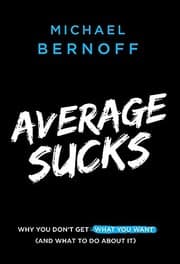
I wanna do what I wanna do, and I'm gonna be an entrepreneur," and blah, blah, blah, "Nobody's gonna tell me what to do." Okay. I've done it, you've done it, and our nine-year-old typically controls our life. My book, Average Sucks, took me nine years to write. I had to sit at Tucker Max's house.
Do you know Tucker? I, I've had him on the show, yeah. Oh, uh, he's a dear friend of mine and, and I had to sit at his couch. He goes, "Brother," I'm not Eddie Curst. "I am not gonna be friends with you."
And he's a big basketball guy. We're watching on TV. He's like, "You see that guy? I cannot have this. I've seen you help this guy, that guy."
I just got done working with Jake Paul at that time in my life. I was helping him with some girlfriend issues prior to, prior to boxing stuff. And he goes, "I cannot have you as a friend if you're not willing to go all in. You got to get this thing done, and we get past your problem." The problem was a nine-year-old boy was trying to write the book.
A nine-year-old boy that had ADD, not a 39-year-old man. So I was gonna do it myself, and I was not gonna let anybody help me, and I was gonna figure it out and prove to my wife and my kids I did it. I'm sitting next to a guy that sold 10 million copies of his freaking book, and I'm not letting him help me. So part of our challenge is outdated programming. So your vision is, "I want the biggest, best podcast in the world.
I want it to be this," blah, blah, blah. Part of it is, have we upgraded our vision? And our vision is this: I wanna make a show that is extremely enjoyable and easy to share. Which you've never said. Now, as soon as you do that, now the context has changed.
So it's like, "I want this to be my ultimate income." That was a childish decision that you made randomly on a Tuesday afternoon when you were pissed off or bothered by something, and you're like, "Sick of the property casualty. I wanna be the next Patrick Bet-David. I'm just, uh, gonna be rich, and Google's gonna pay me." Great.
And then you're like, "I don't know how I'm gonna do it, but I do it" because you're stubborn. You get in there. You say you're gonna do it. And then after a couple of months, you gotta clean up your act and go, "Huh." One of the best examples I have of this is Mike Modano, one of the best American hockey players of all time.
He was good, but in order to be MVP, in order to be, like, one of the best hockey players in the world, he had to change his game. He had to go from not just premier scorer like he could, he had to be able to get into those difficult places in front of the net. He had to put on some size. He had to do some things different. So my question is, do you wanna be an incredible podcast that the world, that, that, that pays your, that pays your bills and introduce you to people and has great conversations?
Or do you want that and it to be extremely enjoyable, extremely shareable, and do you wanna be extremely relatable? The latter. It's very different. Now it's got a different set of rules, doesn't it? See, the hardest part about a guy like you and I is we can wing it.
Dude, you're good enough. You and I didn't even need to do anything other than jump on here, wing it. Because of our insecurities from childhood, you and I could get thrown in a situation, we'd figure it out, get us the date when we were single in the day. Get us the date, we'll be fine. Get me the interview, I'll close the deal.
I'll figure it out. I'll build the ship going down. But that's not how you become that next level of play. So the question is, do we wanna keep on being who we are, or do we wanna play like those guys? We don't have to do what they do, but we do need to make some slight adjustments, not just in our actions, in our approach.
So if you wanna be more enjoyable, what can I do to be more enjoyable? If I wanna be more shareable, okay, what would make it more shareable? Yeah, I wanna be more, um, digestible. What can I do to make it more digestible? Now your mind is like, "Oh my God, I could have a little click sheet that people have.
I could print out a little, uh, PDF that..." You never even thought about that, Ryan. I, I got my brain turning, ADD's going a mile a minute, right? But you could have a little, like, like, little one sheet with a QR code that we could give out, or, or we could, we could do a bunch of different things. So to answer your question, you gotta have the courage and the willingness to realize not that you're wrong, you're not completely right, that you're operating off a plan that was a good idea five years ago.
Your plan got you here, and it's already worked out to the level it is. In order to get where you wanna go, you will have to adjust the plan slightly. Yeah. And because we're stubborn, we're not willing to do that. And people go, " Dude, I'll just keep going.
It'll work out." I used to go to the Short Hills Mall in New Jersey where the rich people lived. You been to Jersey? I have. Short Hills is like, uh, where those people live.
It's like, um, fancy. Fancy. They're Manhattan people. And like Scottsdale here in Arizona. And I asked my dad, "How do I get a car like that?"
And my dad gave me advice. It was a Lexus, and we had Buicks. And he goes, "Work hard and be a good person." That's a shitty plan for a business owner. Yeah.
I'm a good person. I work hard. I'm gonna go broke. What... You gotta be effective.
You gotta offer value. You've gotta make a difference in people's lives. You gotta be needed. There's so much more to it. But work hard is a guaranteed way to burn out and, and to fail.
You're gonna need to work hard, but that's not a long-term plan. So my job is, I would love you to be more effective at the show. What are the most effective podcasters doing, and how can you add little pieces of that and still be you? I don't feel like I'm being stubborn because I, I, like and when it comes to this, I have almost no ego. In, in terms of I, like, I live by this methodology of it's not about being right, it's about getting it right, right?
Every team I've ever had, I always coach, it's not about being right, it's about getting it right, et cetera, on and on. And I believe that. And what I think is really funny, and I'm just kinda... Funny and not in a ha ha way, but in a, in a kind of interesting psychology way, is that I'm not asking the questions that you are recommending that I ask, but I'm not asking them not because I feel like I'm right and I know what I'm doing, et cetera. I'm not sure, like, I'm listening to you going, "Why don't I ask these questions?"
It's not because I think I'm right. It's not because I think this is the best show already and, and it's just, why isn't the audience here? It, it's, it's... You know what I mean? So it's not like that stubborn nine-year-old in that way.
It's a different version of stubborn. It's what was a good idea a week ago, we need to not buy into. We need to realize, got it, that was a good idea when that was a good idea. It doesn't mean it's a bad idea right now. So when I use the word stubborn, it's an extreme word just to challenge you.
I'm not saying you're stubborn like you don't listen. I'm not saying another person's stubborn. Some people are. You and I know stubborn people. Yeah, yeah.
I've met them. That's not us right nowThat's why I'm an ex. That's why I'm an ex-husband and not a husband Yeah. You, you get- I'm- ... you get the concept, right? You get, you get the deal.
So where, where I'm going at with you this is we've gotta look at what our plan is, and we woke up this morning and you had a plan, correct? Yep. Even if you didn't have one, you have one. Yep. And most of our plans are to wing it.
We know what we know, and we do what we do. And then we can ask a question is, how could I do better, and what could I do to be better than I currently am? And in order to be better, we need to admit the hardest question of all: we're not good enough yet. And when life changes for us is when you finally admit you're not where you wanna be. And that's a tough one for us because we look at the wrong version of ourselves.
One of the biggest reasons I do what I do is I spent a long time looking at the wrong group, and I'd look over here and go, "God, I'm doing great. Look how good I'm doing compared to the 97%." What they're doing over here, the 3% that I haven't figured out what they're doing yet, I'm looking at the wrong groups. I'm spending my life going, "At least I'm better than them." And I'm not looking over here and go, "Of course I'm better than them.
I've worked, I've done. God put me here for a reason. I'm doing it. What are these guys doing that I'm not? What could I do that I'm not doing?"
And we wanna get off on this idea of like, "Good job. You don't get how good we've done, how hard we've worked." Dude, that's hard to admit we've just gotten s- we're just getting started. I mean, you're so talented, Ryan, you know this. You're so talented.
You got the demeanor, you got the look, you got the backstory. You played ball to a h- very high level. Most people never make it to the majors. At 13 years old they quit their whole life. You got the kids, you got the boys.
You're gonna train them. You got so many thing. You got, you've been through your shit. Y- you're doing great. But the hardest part to do is it's not enough to get where we wanna go yet, and we gotta look in the mirror and go, "I've done good, but imagine where I can go."
And that's when life starts to get exciting. It's creating that vision of how good the show can be, how good I can get with people, how good I can get with guests, how good I can get at sharing. That's a different, that's a different ChatGPT prompt. How good can I get at creating shareable content that's so ridiculous it's like, like just unbelievable? When I wrote my book, Tucker goes, "What kind of book do you want?"
I go, "What do you mean?" He goes, "You want a book that people actually read or one that makes you feel important?" I said, "I want one that people read." He goes, "Your clients have ADD. Write the book in a way that people will start it and finish it."
And I get so many compliments from people going, "Michael, I picked up your book and I'm onto page 85." And I'm not saying that as a plug for the book, it was like a simple question I never would've thought of. I was gonna write the book to make me feel good and feel important. I wrote the book for them. So now I'm doing this show for the people, not for me.
Screw Ryan. I'm here for the people. Now the show's got a whole different meaning. So what you're doing is open to the idea that we can look at this differently. So e- e- even if this show never broadcasted, I'm doing therapy on myself right now, Ryan.
I think, I'm thinking that this is one of the more valuable conversations I've had in a very long time. Because I've been st- I've been, honestly, you know, and I don't know, you know, I'm hoping the audience is, is still with us at this point. I have definitely struggled with- Struggled or in the process of working on I'm in the- There's two, two different prompts ... Yep. Yeah.
Say it. No, I, no, again, hey, this is, this is, this is beautiful. I, I, I, you know, I'm not... Reframe that again for me. Reframe that again.
I'm in the process of working on. Just say it. Go- It'll hit a different part of your brain ... I'm in the process of working on how to go to the next- How does that feel when you said that? Yeah, it feels, it feels better.
It feels way better. Feels way, way- More useful, right? Yeah. And now you've admitted to yourself you're working on it, and I'm hearing you go, "I'm gonna go tell my wife, 'Dude, I love this guy, Ryan. You know what he's working on that?'"
Versus, "Hey, I got this guy, Ryan, he's fucking struggling." Yeah. No, and I, and I, I love that because it's like I don't... It's funny, I say the words, and this is, this is to your, to your point about how you talk to yourself. I don't feel like I'm struggling.
It's not like I wake up in the morning and like I'm struggling, but I'll also say there are moments where I'm like, "Geez, I, I'm like stuck at about 250,000 downloads a month." Which, which to your point, is better than the vast majority, but not where I wanna be, right? So you- And so like- ... you reposition that. Are you stuck? Or literally I've gotten to a point and I'm excited to get to the next point?
Yeah. See, this is, this is- The reason we say we're stuck, Ryan, I want you to listen. I, my background's a linguist. I've been around. I invented something called human interaction technology.
Th- this is slight change in words changes our lives, right? And when I write copy, I do, um, Chase Hughes and I went back and forth taking notes on each other, if you ever followed his work. And he's a- I love Chase Hughes ... CI ops guy. What's that?
Yeah. I love Chase Hughes. I'll get you guys connected. Um- Yeah ... and, and what's interesting is, where I'm going with this is if you're setting a prompt in your brain, the reason we say, "I'm struggling or I'm stuck," yes, you're being honest, but dude, it gets someone's attention and makes someone listen, and I'm gonna call it childish behavior, and it's also harms another person. So you'll catch me earlier, if you listen to this audio, I did it on purpose.
I said the word, I think. And I did it on purpose so I can get to this point and say this: you'll very rarely have, hear me say that. I say, I know, I feel, and I say. Because the second I say, "I think that this company's good for you," I made you think. When I say I know, I come from certainty.
When I say I say, it's my, my say. When I say I feel, it's different. When I say I think, I just overloaded your brain. I made you an over thinker. I don't wanna say, "I think this will be a good property for you."
No. I say, I feel, I know. It's a different language. So what happens, Ryan, for us, is when you shift your perspective and you begin to be a person that says it like, "You know, here's something I'm doing really well up till now, but here's what I'm considering doing." Like, I watch people say to me all the time, "I am not good at sales."
And I stop them and say, "No, not true. Up until now-" You're not great at sales. 'Cause the second you say up until now reframes everything after, creates a different neural pathway inside of your brain. Are you bad at sales for the rest of your life? If you wanna say, "I'm bad at sales," you're fucked till the end of your life. When you say, "Up until now," it goes, shht, cuts like the tapes back, TDK tape in the old day, and you could add a little 2 Live Crew in the middle of your Skid Row if you want and play the little songs you shouldn't play.
Okay? But the point is, and, and my Gen Xers are gonna love that technique, that's called nostalgia. But the point is, when you frame things for yourself, so dude, I don't think you're struggling. I think you're really good at getting 250 and you're in the process of figuring how to get to 5,000. Yeah.
How nice is that? It makes it accessible, too. Would you rather wake up in the morning and go, "Dude, I'm really good at 250. I'm in the process of working on 500"? It programs your brain to look for something different.
You'll start downloading different audios. You say, "I'm struggling," you go to Google and go, "I'm struggling with 250 downloads," you know what's gonna happen immediately? You're gonna find frigging, the suicide hotline's gonna reach out to you thinking you got a problem. You say, "I'm already got 250 and I'm pretty proud of what I've done. I'm on my way to getting 500," you're gonna get targeted by people that are gonna teach you how to get to 1,000.
You're gonna have, uh, uh, what's her name? Uh, Adley's gonna start calling you and, and working on getting stuff going. You got Martel's gonna try to help you. Gary Vee, Rogan. Rogan don't wanna help you if you're struggling, but dude, you're in the process of getting better, man.
Think about how you, who you'd wanna coach. Think about it, Mr. Miyagi. Mr. Miyagi, "Man, I'm struggling getting beat up," versus, "I wanna learn karate."
This is the most unique podcast I've ever been on. I'm having a blast, too. Yeah. I appreciate it. I, I, I think that- You think or you know?
I feel- Oh, that's it! You did it ... I feel like this is one of the most underserved topics that I've ever had on the show. Uh, I also feel like this is an unlock for everyone that it, it's just simply not, this, this message, I mean, there's just not enough people like yourself out there putting this out. I mean, I've had 500 plus guests on this show, and I had another show.
There was a time, you m- you probably don't know this, I had a previous podcast back in the day in 2011 that I started. It was about content marketing when that was big. And I had all the top content marketers on, and I did, you know, I had, you know, if they were good at content marketing back in the day, I had them on the show, and it was wonderful. And, uh, I made the very bad decision when I took a job, uh, of cl- closing that show down. I was ninth in the world at that time, which was only 47,000 downloads a month, which is crazy to think about back in 2014 that that was ninth in the world.
One behind Ed Mylett, one ahead of Gary Vaynerchuk. Shut the podcast down. Bad idea, right? But through probably 350 ep- uh, interviews there and close to 500 episodes for this show and interviews for this show, I've never had anyone break down the impact of language on how we operate in the world the way that you have, and I mean that with the most respect. Thank you.
So what do you think, what do you think the big thing is? I know that I have been framing how I speak about this show and my desires and, and expectations for where I can get to wrong. I know that for a fact. Just this conversation- Wrong or not effective as possible ... wrong or not, not as effective as possible yet. In language, here's the coolest part about what I teach, or what I share.
I think share is even better than teach. 'Cause share, share and they can do what they want with it. We're already talking. We're just re-opting the words a little bit differently to get a different result. I'd love to walk off the show and go, "Man, this guy Ryan's amazing, man. He's got, he has literally had two incredible podcasts.
He's got one that's doing good and it's on his way to doing great, and he is doing incredible," versus, "Man, I just talked to this guy that's struggling." It's the same reason in AA I, I say step 13 is missing. Um, step 13, step one is I'm an alcoholic. I, I appreciate that for a period of time. I sat literally in a rehab room the other day and said, "Step 13 is missing."
I used to live differently, and now I have figured out how to handle my emotions mentally and emotionally, and I live differently now. That's step 13. Bill W., dig him up from the grave and I would tell him, "You need to have step 13." I used to not have as much power and control over my life. I now have learned how to make my life work the way I want it to.
And I say that to, to say this, is that the way that we language our lives to ourselves and others is how they treat us. So my favorite words, Ryan, are this: the way that I talk to me about me is how I respond to me. And the way that I talk about me to you is how I train you to respond to me. The way that I see me is how I respond to me, and the way I train you to see me is how I train you to respond to me. I train people at hotels to do everything I'd like.
I train them to feel incredible about themselves and give me really great suites. I train... My daughter goes, "How do you get these people to do things for you?" They don't do things for me. They kindly love to feel empowered, and they love to feel, use their power to, to hand me things, to help me through the line.
Whether it's the Secret Service and I'm looking to get into an event with tens of thousands of people. And I've always realized there's a way to talk with people in a way that they just would love to help you. But most people are not doing the code to talk with them in a way that works. And this is my, my favorite subject. And I, I very adv- I've been on thousands of podcasts.
I've had very rare people have the courage and the confidence to ask me the questions, and you're being yourself. So this is, this is the answer. So, like, your kids will start with language. You don't have to, they don't have to be positive. It needs to be, "Listen, is it that we c- it's hard to hit a curveball or we just haven't figured it out yet?"
We haven't figured it out yet. Just start with that. Like, my daughter is a figure skater. She won't say the lose word. She's never lost in her life.
Now, she's not taken first place before, but she wins or she wins, and she looks at it that way. It's not even positive. Everything is a win. She believes it's possible for her. Does she have self-esteem challenges?
We all do. Does she have issues with things? We all do. That doesn't go away. There's no perfect...
Mike Tyson, read his book. Massive self-esteem issues But it's the way he language things. It's what Costamato did where he took him under his wing, another upstate New York guy- Yep ... and taught him this. Albany, right? Was he Albany?
No, Catskill. Yeah, Schenectady. Uh- Schenectady ... no, I tr- sorry, not Schenectady. Troy. Troy, New York.
He literally convinced him that he was a descendant of a Greek god, even though he was, uh, is a Black man. Does that make sense? And, and the reason is that made a difference. So I'll leave it at that, the thoughts. We're gonna have to do this again, too.
I know you gotta pick up- Yeah ... the kids at some point, but we're gonna do this again. Dude, I know my audience is gonna wanna go deeper in your world. Uh, I'm gonna link the book up because I, I wanna get that in front of them. Where else can they get deeper into your world? Where else should they follow along?
So I've got ... I'm gonna make this simple, 'cause I'm very real. This is, you may even borrow this from me after this. There's, there's a few things. One is there's something called Google, Instagram, Facebook.
If you can spell my name, you can find me. I got really cool stuff. At a minimum, if you're a guy that wants to look from the outside, or girl, check me on Instagram. And I'm also old school. I'm gonna literally give you my email address right now.
If you're serious about connecting and you wanna do something, my assistant will handle this, but just tell him we met through Ryan, michaelbernoff@gmail.com. Michaelbernoff@gmail.com. Or, uh, this is nutty, but my assistant too, just send her a text, 480-800-8051, 480-800-8051. If you just wanna check things out, check out Instagram, go to YouTube. But if you're like, "Dude, I wanna do something with you," text my team the word influence.
They're gonna say, "How do we know you?" And we'll set up a time, and I'll freaking talk to you personally. If you got the courage to text, I'll talk to you. And that's odd, but I d- I'll do that until it stops. Jeremy Miner thought I was nuts that I did that, but there you have it, and I'm throwing that out to you.
Text me or email if you're serious. If not, find me online, read my book. And I, I'm gonna tell you, you're a few words away from having the life you want. Used in a very appropriate manner. Michael Bernoff, my friends.
We're out of here. Peace.
Books from this episode