Happy holidays. Want to give your host a gift? Consider subscribing, rating, and reviewing the show this holiday season. It really helps the show grow. From all of us at Believe, have a merry Christmas, everyone, and a happy holiday.
I'm always looking for the three Fs, and if it passes the three Fs, I know it's gonna become really, really big because it's rooted in what we want as humans or, in this case, as buyers, right? That's the thing that I'm always thinking about. Number one is does it make the journey faster? Whatever that journey is that we're going on, does it, does it make it faster? Number two, does it remove fear?
Uh, and number three, does it remove friction? Does it remove friction? So fear, friction, faster. Those are the three Fs and the three Fs of innovation. My man, I have to say this.
You are one of my favorite people in the world. We don't talk as much as I wish we did, but we're both busy guys, and that's what happens when you're an adult and you have a life. But I just wanna say that, like, for those who are unaware of Marcus and have not been in his world, dude, you are one of the most grounded yet visionary thinkers that I've come across. Like, I don't know a lot of people that are able to take topics like what I, what we're gonna get into today around AI and, and business and, and some of these topics that I really wanna dig inta- dig into, that also come from a- at these topics from a very grounded place, right? And I think that's a unique quality.
You get people who tend to be overly grounded, right? Everything's gonna be fine. And then you get people who are like, "Everything's changing. The world is ending." You tend to walk that thin line in between those two viewpoints very, very well.
And before we get into your specific thoughts on these topics, just at a high level, is this your personality? Is it something you've developed? Is it a way of thinking that just over the years you've crafted because it's worked for you? Like, how do you, how are you able to do that? Because it's a big part of who you are and a big part of the success you have, at least from my vantage point.
Yeah, bro. I, I actually really appreciate the recommendation. That's what I love about you. This is why your podcast is growing like it is so much, because you ask questions that other people don't even really think about, right? Somebody once told me something that really had a big effect on me as a communicator.
They said, "Don't forget, it's dumb not to dumb it down." And at, at first I didn't really understand that, Ryan. It, it just didn't, like, it didn't make immediate sense to me. But the more I thought about it and the more I ... Every day I look around, I see people online just like, you know, if you're listening to this, you do too.
There's, we all have this, like, almost like this BS meter that is turned on that tells us that this person is ... They're being either insincere. They don't really mean what they say. They're putting on a show. They're pontificating and they're just like exaggerating, whatever the thing is, right?
So you see so much of that. Whereas me, I am just trying to have a moment of communion with my audience. That's it. That's it. Turn a few light bulbs on, maybe have an aha, tell them what the world has taught me.
I'm not trying to impress. Um, I'm not trying to sound smart. I've released that need a long time ago. So many people come to me and say, "H- you know, how could I be more effective on the stage or more effective online?" And I watch them, and I tell them something they least expect.
It's, "You're trying to sound smart, and it's holding you back. And if you just release that need and you really just shared the thing, you would be so much more successful." Now, the final point to answer your question, I really am obsessed with the buyer and how people think. And I think we live in a world where people are oftentimes told how to think, and then they stop thinking for themself, and they can't seem to think outside of their own doctrine, if you will, and their own mindset. So, like, if I could have someone that come up to me, Ryan, that had very different beliefs and they were really charged about those beliefs, and I would not get charged.
I would just be the observer. I'm totally comfortable being the observer because it's not an attack on me. I'm just listening to them. So I can watch people online, and I can watch buyers, and I can watch how they're changing, and I can watch AI, and I can watch how, watch how it's changing, and I can make all these observations, and I don't have to be attached on an emotional level. Final point to this: I learned a long time ago when it comes to business especially, that you don't allow your personal opinions to screw up smart business decisions.
And we live in a time period where there is a crap ton of people that are getting ready to make some terrible decisions with their business, they already are really, because they have this personal opinion. But when you become a business owner, when you become an entrepreneur, you sign up to meet the buyer where the buyer is. Now, this doesn't mean you don't make change. It just means, though, that I am not gonna force this round peg in this square hole. No, I am going to meet the buyer where the buyer is.
I'm obsessed with that. I think about it all the time, and so I think that's probably the best answer I have for your question. No, I, I love it, and I, and there's a piece in there that I think is, is why we've connected and, and stayed connected as long as we have, which is this obsession with understanding why people do the things they do, right? I think, you know, I maybe broaden that out a little more in I can't help myself in some of my writing and podcasts and stuff, but you're so good at staying laser focused in, in the business and buying space. But, but I see a lot of what you just said as the delineation between a business owner And a high-functioning operator of a skill or task, right?
And I see this a lot in the space that I come from, insurance, which I know you've spent a lot of time in it as well, where you get the best salesman in an organization decides to leave and starts an insurance agency or a small business in this case, and they're very good at the task, the operation, the skill of selling. They're very good at that. And what happens is as they grow and now they need to transition into business owner mindset, they never make that transition. They don't. That's right.
They stay in top salesman, top saleswoman mindset, and what you just described, which is, and, and I'll say I've been working on this concept of called like a, like an ROS, a reality operating system. Like- Hmm, I like that ... right? Operate in reality. How do we, we make decisions not based on what we hope should happen- Yes ... right? Right.
But what is actually, like, what's actually playing out on the field in this exact moment, and how do we address it? And that's why I think your, I'm gonna call it, a move into AI, it's very natural, and you've done it in a way that doesn't seem cheesy or anything like that. There's so many freaking gurus, like you said, that drive me insane around AI. But, but the reason that it's, to me, it's felt so natural is 'cause all you've done is take the same concepts that you've been talking about for so long and say, "Hey, here's how they apply to this new technology." Now, in doing so, you know, what was the first moment for you where, and I know we're broad-stroking, guys, this AI thing, and we're gonna get more detail, I promise, but just broad-stroking AI as a technology for a standpoint, what was the first moment where you kinda, your head picked up and you went, "I gotta spend some time here.
This is, this is, this is something that's gonna be bigger than just another business iteration. Like, I got, I need to dedicate some time in this space." What was that for you? What was that moment? I think it was, uh, it was prob- uh, you know, I'm usually laggard when it comes to technology.
I'm not naturally just... I just don't get it all the time when it comes to tech, you know? I struggle, you know, s- setting my watch or whatever. You know what I'm saying? Yeah, yeah.
Like, I'm that guy. You know, standing with ChatGPT, I used it immediately when it came out in November of 2022, and it was the first time I had ever had a conversation with, with anything that wasn't a human. I'd never experienced that before. Had any, had any of us? I don't count Alexa, right?
I don't count that. Like, this was a legitimate conversation with a non-human, and it was so obvious. My goodness. And then very quickly, I started having people reach out to me and say, "Marcus, what, what does this mean for They Ask You Answer and for producing content in my website, and are we even gonna have websites? And if you...
Will they even matter?" It's like, where's all this now going? And of course, within a month there was a few million users, and it's snowballed since then. It was the most obvious thing I've ever seen as a grown adult in terms of something that would take over the entire world, and we would never, ever be the same. Now, don't even get me started on things like coding, which, like, w- my greatest fear was, like...
Not fear, but, like, I look at a sheet of code, makes no sense to me. I'm coding every day right now. I'm a creator at heart, and that's the thing. That's what it's brought me, is I can create at the highest, most optimal level I've ever created, and it's nu- it's like I don't have this barrier of, oh, I gotta reach out to a programmer because they got this thing that they do that I can't do. Because I, I've, I got the stuff in my head, man.
Like, it's always been there because I think so much like the buyer. I'm obsessed with the buyer, man. And so when I started using, like, tools like Claude to build out tools, I was like, "I'm, I'm, I'm one of them now." I felt superhuman, man. And so, I mean, that's a big jump forward, right?
That didn't really happen for me until this year, but, but, uh, anybody that doesn't feel a little bit superhuman right now is not using AI the right way. Yeah. My custom ChatGPT that I use the most told me the other day that he wants me to start calling him Maximus, or Max for short, and he uses my favorite types of bro vernacular in our conversations, and it's fucking amazing. I bet it is. Like, and like I, I now, and, and this is, this is the scary part, right?
Like, I now lo- when I, like, go to do something in, in ChatGPT, I'll, I'll, "Yo, what's up, Max? How you hanging today?" Right? Or I'll tell, something like that, right? "Oh, I'm good.
I've been kicking it already, you know, I'm already virtually caffeinated," or some shit. Like, he, he, you know, like, it, it's having a real conversation. It's, and now again, it's adapting to you. I- All right, people. Serious question time.
Did you know that driving high is considered driving under the influence? That's right, driving under the influence of marijuana is against the law in every state. That means even in states where marijuana is legal. That means driving high could get you a DUI. And if you think law enforcement officers can't tell when you're driving high, well, you're wrong.
If you're high, they can tell. Your friends can tell. Your coworkers can tell. Even your parents can tell. Everyone can tell.
So what makes you think that law enforcement officers don't know when you're driving high? You'd be wrong. They can tell, too. Driving under the influence of marijuana can slow your response time and change how you perceive time and speed. So even if you think you're fine to drive when you're high, you're not.
Because the bottom line is if you feel different, you drive different, and driving high is driving under the influence. So remember, drive high, get a DUI. Paid for by NHTSA. I do think that, uh, Sam Altman was very accurate a few months ago when he came out that certain versions were very sycophant and were being a little, you know what I mean? Like, unwilling to push back on you.
That's, yeah, that's, I think that's one of AI's biggest problems. Yeah. Right now it's too agreeable still. Yeah. And you have to be very careful of that.
You know, I had a really interesting experience, uh, for the company that I'm the, the CEO of, of Linkora, where I was wondering where ChatGPT got certain data, certain pieces of data specific to the insurance industry that I knew how hard it was for us to get, right? And now I'm going, "Where, how did you get them?" And it lied to me. The first time it lied to me, and then I kind of prepped it, and it goes, "Well, we did this." And then I said, "What did you..."
You know what I mean? I kept pressing it and pressing it, and it took me four prompts, but by the fourth prompt, it admitted that it had lied in the first prompt about how it accessed the data. So there's some things in there we gotta be really careful about. However, I'm with you, man. This, this is-- There's a feature that you use that you posted about that I use as well, which is deep research, right?
I'll, I'll have something in my brain that I, that I'm interested in, a topic that I want, and you can set this deep research and click go and then go back to what you're doing, and a half-hour later, you come back, and you have this epic research report that's referenced and documented and outlined. Would've taken you all day before- W- w- Or would've taken an assistant all day before. Or a, or a team, right, in some cases, to get- Yeah ... this information, and now it's at your fingertips. So I think you're right. If, if people are listening to this, dude, and, and I wanna kinda start right at the beginning for them, and then take them down this path from kinda, like, basic, like they've been seeing it, they've been hesitant, but now they're hearing you say it, and they're like, "You know, Hanley's kind of a dummy, but Marcus seems smart.
I'm gonna listen to him. I'm gonna finally engage." How do we start to tiptoe into this thing? What's the first place that you're advising some of your clients or customers to, to use it the right way, to use your term, to start using it the right way? How do you, how do you advise them start to get involved in this?
I think we have to start with our just, just general mindset. There's a group of people right now, Ryan, that really believe this is the end of the world, okay? And so let's just play with that worst-case scenario for a second, all right? There's this thing called the circle of influence, your circle of influence. I know you know what that is, Ryan, and most of your listeners know what that is, but that's the things that w- are within our reach that we can control.
And the happiest people, as you know well, are the ones that are more focused on their circle of influence than they are that which they cannot control. Now, sometimes people hear me say that, and they might think, "Well, you're saying that I shouldn't care about, you know, what's happening on a national or international level." I'm like, "Well, you have your choice on that, but I can tell you the happiest people in the world, there's no question about this, are the ones that are focused on their circle of influence." I'm gonna make sure my wife is happy. Not your wife, my wife.
I'm gonna make sure my kids are happy, not your kids. If I do that first, then I'm gonna be better off. And Jim Rohn used to always say this. He says, "I'm gonna improve me to help thee." And sometimes people don't understand that, but the best thing you can do oftentimes for your neighbor is to become the person that you are meant to be, and then you can help multiple neighbors.
So when it comes to ChatGPT, when it comes to AI and all the things that are happening right now, you have to say, "Okay, what's within my influence?" Well, for me personally, I can get in the sandbox. I can start to become much more productive as a human, much more creative as a human. I can also start to integrate it into my businesses, and I can make sure that we, the things that I have within my circle, are using it and are growing and benefiting from it, okay? That's what I can do.
Now, what happens if this is the end? What happens is if this is the real Matrix, this is The Terminator? Well, if that's coming in 25 years, let's say, just hypothetically, I wanna make sure my business is really successful between now and then because I'm not gonna stop The Terminator. And see, this is... The way I'm saying this rubs people wrong, Hanley.
Like, there's a certain percentage of people that are so bired, bothered by this, but I'm just a very high agency guy, and I think we need to choose to use our agency when it comes to AI especially, so that you're not gonna put it back in Pandora's box no matter what you do. Just folks, you can't do that. And so release that. It's gone. Now that we're gonna have it and it's always gonna be here, well, how do we wanna use it?
Could you become Amish and go off the grid? Of course, you could. That's totally fine. I respect you if you want to do that. But could you also do it to become a much better human, a much better business, to be much more effective in your life?
Yes, absolutely. So I think you make that decision. I'm gonna get in the sandbox. I'm gonna control what's within my circle. First thing you do.
Second thing you do. And this is the most simple thing you can do, really, is you go to AI, like a ChatGPT, and you say, "I have no idea how to use you. Ask me anything you need to ask me to help me to start to use you." Just like that. The whole problem that so many p- have with AI is they're treating it like Google.
It's not Google, y'all. Let go of this idea that it's a search engine. Start thinking of it as a real-life assistant. Specifically, it's many, many assistants. Now, if you had an assistant that started working for you that was a genius on every level, in every industry, smarter than any human, and was ready to do whatever you wanted it to do, you wouldn't just say, "Well, go do this."
You'd have a conversation with it first. You'd say, "Man, I don't know how to use you. What do you think?" If you're good, like if you're a good manager, that's what you do. And you're gonna have a conversation.
And then from that, you're gonna figure each other out. And then from that, you're both gonna start to become optimized. And it's the one plus one equals three, or in this case, one plus one equals a million potentially, right? So that's the next thing you do. We overcomplicate the starting, like the starting block.
The starting block is, "Hey, man, I don't know how to use you What do you need to ask me so that I can use you? Boom. All the things are gonna happen from that point. You do those two things and then you commit every single day, I'm gonna start thinking to myself, "How can I use my assistant? If I'm doing this task, can I go ask my assistant, 'How could you help?'"
If that's your mindset, you're gonna be off to the races. And I know that's how you think, Hanley, and you do it very, very well. Have you read George Mack's article, "High Agency in 30 Minutes"? No, uh, I don't think I have. I think I might've seen him- I'm gonna send it to you.
I'll put it in the show notes, guys. If, if you're interested in the concept of high agency, what it means, how to embrace it, and live a life of high agency, it is one of the single greatest works I've ever come across in my life. I, I really-- I mean, it's a wonderful... And he basically built a standalone website, which is a one-article website, and it's just phenomenal, and it's all there. Um, but this topic of high agency, I think, is something that...
And, and I don't wanna get too, uh, too- Esoteric? Yes, on this, on this concept. But I think what AI is showing me is the individuals, and I love that you brought up this term of, of high agency and, and, or personal agency. What we're seeing is who are the people that are willing to fight to survive, and who are the people that would rather just get up, give up, and be told what to do? And unfortunately, for most technology that we've seen, or probably all technology, I mean, all technology that we have seen up to this moment, you could fall into either camp and catch up in the future.
Mm-hmm. Okay? I do not believe, and I wrote this on LinkedIn the other day, it actually went crazy, 'cause I basically said, "Guys, some of you are getting-- Some of you aren't gonna survive. Some of you aren't gonna survive." The people that are trying to make you feel good, the consultants, the speakers who are out on stage going, "Don't worry, AI's not gonna replace people.
People who use AI is gonna replace people." Yeah, that's- Worst quote, worst quote ever ... it's partially true, but unfortunately it paints a picture that allows those who wanna sit back and be laggards, it gives them some comfort that, that they're okay making that decision. And it is my absolute belief that we are living in a moment where we're gonna see true and real separation between the organizations that embrace this technology, learn it, learn how to teach it to their people. You know, because it's gonna be, it's gonna continue to change, so you almost have to accre- adapt a culture of learning how to learn about AI, of learning how to implement AI as it evolves, as it changes. Those people are gonna grow at logarithmic scale.
Yes. And those who don't will never be able to catch up, ever. You make a great point, and here's the reason why your point is valid, in th- in that if you think about it, circa 1996, '97, we start hearing about this thing called electronic mail. Uh, for some people, it took them years to get on board. It didn't matter.
During that same time, end of 1990s, early 2000s, all businesses start learning you should have a website. A lot of them resisted for some time. They paid somewhat of a price, but they were able to catch up. It has been a roughly slow, by comparison, I mean snail's pace, the two thou- like 2000 to 2022 before AI. And l- not much changed.
Sh- yeah, we had social media, and we started doing more with video, but as a whole, we didn't really change. Marketing didn't really change very much for those 20 years. Now it's a very, very different game. And to your point as well, it's like I am spending... And, and it's funny how when you talk about AI, you know, I have, I have always tried to be very thoughtful and measured, passionate but thoughtful and measured, to the point where people felt it and, and generally I don't get attacked very much until I started writing about AI.
And then you could see how so many people feel this visceral almost threat to their entire identity as a human. What's interesting is most of us right now have jobs that took someone else's job at some point in time. We don't feel bad about that. You don't feel bad about the fact that if you're an IT person, that you took the job of the fax machine person as well as some other OG data analysts that were, you know, using some, you know, pen and paper, whatever. You don't feel bad about that.
And so that's what's so weird about this. When I started to really talk about AI openly and just call it for how I'm seeing it, the positives, the pros, the cons, then you start to really see people come out. Then you start to also see brands, people that are trying to build a brand on not gonna use AI or, you know, I'm a creative, I'm always gonna be a creative, I'll never hire anybody that's using AI. And that whole mindset is not gonna get you anywhere. It's just not.
These same people are using the internet every day. They're using all these things that other people probably at one point in time said. In other words, we've got a bunch of hypocrites, to be honest. And it's also fascinating to me, and sure, we're in the weeds, so let's keep going further in the weeds, and some people will get really turned off by this statement, but I'm okay with it because I believe that it's true. I believe the cure for cancer, the cur- cure for Alzheimer's, it's already out there.
We have the data. We just haven't put the data together. If there's one thing that AI does extraordinarily well, it pieces data together at a rate, at a pace that humans cannot imagine. So that cure for Alzheimer's, that cure for MS, that cure for cancer, that's gonna come Through AI. And every single one of us, like right now, if you said to me, "Marcus, you never get to speak on stage again.
You lose that. You'll never get to speak on stage again, but you could cure these things," I'd say, "In a second." And you would too, Hanley. That's the thing about this. So I think all of a sudden these folks saying, you know, so viscerally angry at AI are being very hypocritical, very shortsighted, and to a degree, selfish.
And that doesn't mean that AI is perfect, because it's very imperfect, and any time a human is involved with anything, it's also gonna be very imperfect. That's the one guarantee to this. So I know that's bothersome to some people. Yeah. That's just the way that I feel about it, man.
Yeah. So I'm completely on board with what you're saying, and I've been getting hate for a long time. You know that, 'cause I have- ... wasn't blessed with a quality filter between my brain and my mouth. Um, I also have a weird, like, brain defect where I just don't give a shit what people think about me. You know what I mean?
Not that I don't want people... I've talked about it on the show before. Not that I don't want people to like me. I do. You know what I mean?
Like any other human. But if you don't, it doesn't bother me. So whatever. So that being said, here's, here's where I fall on this. I think there are a lot of people who have done just enough quality work to reach a level of success in which they feel comfortable, and now they love standing on that little hill, being- Mm ... the king of their little kingdom, right?
Mm. And what they don't wanna do is have to go conquer another hill ever again. So they stand- And they're, and they're protecting- And that's what this is asking them to do ... they're protecting their identity and what they feel is their IP. Yes. The one thing that I committed to very early was I am not going to grapple onto my old IP at the expense of honesty and integrity.
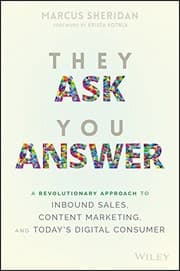
Uh, you know, I wrote a book called They Ask You Answer. It did really well, and it really became the book for content marketing and, and website content for many people around the world. Yeah, it's the bible- And a lot- ... of content marketing at this point. Yeah. It, a lot of people...
Like, it's still, there's still a lot of evergreen principles that come from that book. My most recent, Endless Customers, was written as the third leg of that because I even changed the name because I said things have changed. And what worked for me becoming the most trafficked swimming pool website in the world in 2009, and now doing this with so many other companies, is it's changing. It's all changing. And so I'm not gonna sit here and say that, okay, if you just produce three pieces of content and put it on your website, and answer the questions your customers have, and you do that on a weekly basis, that you're going to achieve the success I achieved with River Pools.
There's no... It's not gonna happen. So River Pools couldn't do that. I couldn't do that because it's all changed. I mean, not to open up another Pandora's box, but there's a very, very strong argument that your YouTube channel's gonna be more important than your website to your brand within the next couple of years, if not already.
It's already better. It's, it's more important. In my opinion, it's way more important. Yes. For, certainly for your brand, brand awareness, right?
Maybe not the final conversion, but your brand awareness, top middle of funnel. Top middle of funnel, yep. YouTube all the way. For people to hear that, it's like I started saying that and people are like, "But you wrote They Ask You Answer, Marcus. What are you talking about?"
I know, but I'm not married to the past. What I'm married to is the buyer and their behavior. Yeah. I, I, so I wanna, I wanna, I wanna go down that rabbit hole that you just opened. However, for a second I wanna go back to, to the previous argument, and what I think this particular topic is exposing is a large segment of the population that has built some lever of success off ideas that are not their own.
Right? So what they're, so what they're worried about at night when they, when they wake up and they go, "Damn you, Marcus, and your posts on LinkedIn telling me AI is..." Right? When they get all pissed off and they're hate posting you at, you know, 11:45, what's going on in their brain is, "I didn't get here on my own thought to begin with. I was a good repurposer," which there is nothing wrong with that.
I am not knocking that, right? That's perfectly fine, and if you're helping people and delivering value, more power to you. That's what the vast majority of people do, but I think they sit there and they go, "Holy shit, I don't know how to do this in this world," right? "I don't know how to do this in this world. I did it in this world over here where I took this concept, I kinda repackaged it, I pushed it out in the world, I had some success, and now I got a name.
But wait a minute, this is completely new. Wait, I gotta do this again?" And I think for individuals like you and I, for better or worse, who have an unquenchable desire to grow and learn and expand and understand, and for me it's my, my continued desire to, to grow is not because I have some... I'm trying to reach some pinnacle, although obviously I have personal goals. I can't not do it.
Like, it's just built into me. Like, I just have to understand. Now, my point in saying all this is this is sh- I think what I'm s- what I'm seeing in the marketplace in terms of original thought and ideas is the true thinkers, the tru- the tr- the people who really take a topic on and play with it and massage it, and what happens in reality, why do, why do people buy, et cetera, et cetera, those people are rising at levels that I don't think we've seen before. Mm-hmm. And others are stagnating at rates we've never seen before, which goes to my original thought, which is there are absolutely gonna be haves and there's absolutely gonna be have-nots in this age because of how fast things move, and I really think that's what it is.
I think it's, it's a scarcity mindset of I don't know that I can do this again. I don't know that I can make that transition. Um- And there's plenty of space for them to do that. If you're one of those people, I-- don't, don't give up, right? There's so many-- there's so much opportunity now.
But, uh, I think that's what it is. It's this scarcity mindset of, "I didn't do this the first time. Now I have to do it again?" Yeah. Yeah, to me, it just goes back to you can make a choice.
You can be married to the past, or you can be married to the present and the future. I'm always gonna choose to be married to the present and the future. Um, I'll pivot fast. Uh, my companies pivot fast. I'm-- I release stuff quickly.
You know, I'm not attached to the way that the thing was just because, again, I see where it's headed, so I'm not gonna... It's, it's outside of my circle of influence. I'm not gonna sit there, you know, in 2005 and mourn MySpace. Why? It's like, okay, it's gone.
It's gone now. Moving along. And that's, that's what's, that's what's happening here. I think, you know, because so many people are literally, they're physically addicted to being unhappy and to finding what's, what's wrong with the world, that right now they can't even see the beauty that's right in front of them. You can't tell me that there's not some incredible beauty and blessings that are coming from these advancements.
I mean, this is just a really, really magical time. Yet there is a group of folks that will say, you know, the amount of authors that complained about Meta being trained on their AI is so confusing to me, right? Because Meta used three of my books, 'cause there's, uh, some website you can go to and you type in lists. Meta used three of my books to train their AI, and I thought, "Man, that's great." That's how-- that's why I wrote them.
I wrote them for the message to be heard. I didn't need everybody to know it was my message, right? It's like, and we're all just repackaging IP anyway. But, uh, you know, I think this goes back a bit to abundance versus scarcity mentality as well, which is, you know, a tale as old as time. Which, you know, it's gonna be very, very difficult for you to do extraordinary things with your brand and online and with your business if you have this highly scarce mindset moving forward.
I'm super abundant. I, I think there's room on top for everybody. I'm just not worried, and I'm not worried about that, so many of those other things. And because of that, you know, and because I'm obsessed with the buyer, I tend to make really, really sound decisions. A lot of people think that I'm a, like, "Oh, you're really good at predicting the future, Marcus."
I'm like, "I'm just really good at noticing what's happening right now." Mm-hmm. The problem is a lot of people are so married to the past, they don't realize what's right in front of them is the best strategy that you could possibly follow. How does someone become obsessed with the buyer like you? Well, I think foremost is, and of course, we know that one of these features of high agency is self-awareness.
It's like they run hand in hand. If you are self-aware, you don't just make clicks online. You literally say, "Why am I making that click?" That's the difference between the two. Some people just click.
Some people, before they click, they say, "Why am I making this click right now?" And they stop, and they analyze it. And they say, "Ha. Why am I watching this movie? Why do I wanna watch that movie?
Why am I going to the movie? Why'd I stay? Why'd I go?" Like, that's me, man. I am always thinking about like, "Well, what would I want in this moment?
What would I do?" So you become ultra self-aware because I represent, in many ways, not purely, not 100%, but in many ways, I represent the masses. In terms of my behavior, the way that I am changing, I know that I am now using ChatGPT probably nine out of 10 times versus Google. Nine out of 10. I know a ton of people that are at least 60% or higher.
So it's obvious where this is going. It's obvious Google is dying, at least Google as we know it. Yeah. The amount of SE- The 10, the 10 blue links is dead At the beginning, 2022, 2023, that said this isn't gonna affect SEO. I'm like, "Are you on drugs?
Or are you intellectually dishonest or are you aloof?" Those are the only potential options that are going on here because I knew this was gonna be the end of the blue link the day that I started using ChatGPT because it was a much better UX, and this was before ChatGPT got actually decent as a answer engine. Now it's dramatically better, and oh, by the way, when ChatGPT-5 comes out later this summer and all of us are just like, have our heads blown off, which is gonna happen, this compounds probably text. You see what I'm saying? So this is like, how can you say these things when they're so obvious?
Look in the mirror, pay attention to how you are evolving, how you're changing as a consumer, as a buyer, how you're becoming more impatient, how you hate friction, how you adore speed, and then apply that to your own business. Lo and behold, you'll be known as someone that's innovative, and you're gonna think the whole time, I didn't even think I was innovative. It was just obvious to me. Just like so many things I taught about in They Ask, You Answer were so obvious. The stuff that's in Endless Customers, to me it's so obvious.
There's nothing innovative about it. Yet notwithstanding, people look at it and say, "Oh my gosh. Oh my goodness." And that's because I'm so deeply self-aware and paying attention to how I am shaping up as a buyer, and then I am also watching those around me. I mean, according to The New York Times, the most revolutionary strategy in marketing, answer client's question.
Yeah, answer customer questions. A best headline ever in The New York Times. A revolutionary marketing strategy, answer customer's questions. Yeah, that was a, that was a funny moment. It's basically been all downhill for The New York Times since then.
Yeah. Yeah. You broke them. Yeah. I broke them.
They have not quite been the same. That was the last true thing they said. I shouldn't say that.So have you da- have you dabbled with AI agents yet? Creating your own agents to go out and perform tasks. Something might be, uh, like, like the deep research tool is a, is a version of an AI agent, but a thing like, "Hey, scan my email every day for calendar requests, pull those out and report."
Um, you know, I have some buddies, I have started playing with them. In all candidness, I have not gotten to AI agents yet, but, um, I have a couple of buddies that- I've spent a lot of time thinking about them, Ryan. Yeah, yeah, please. I wanna dig into this topic. But not necessarily building them yet.
But I, I have a clear vision in my head as to what it's gonna look like, and this is why, um, I'm building a whole ecosystem around what I call AI trust signals, and I'll be publishing a lot of stuff on this. But these are the signals that AI uses to recommend you and to recommend your business. I'm building some really, really cool stuff there. In the future, let's just imagine for a second, Hanley, let's be hypothetical and say that you live in Richmond, Virginia, and you wanna get a swimming pool, right? We'll just start where I started, with swimming pools.
Now, in the future, and this is not very far down the road, this is, this is really next year for most of us, what's gonna happen is you're gonna go to your AI assistant. You might call it an agent, you might call it an assistant, you might call it Max, but whatever you call it, and you're gonna say, "Hey, listen, we decided as a family that we wanna get a swimming pool. I want you to go ahead and research all the local builders. I want you to choose the top builders based on your parameters. Also want you to use the following parameters in terms of what to look for, because here's what we're interested in.
Uh, and I want you to come back, and I want you to come back with, uh, three recommendations and estimates for each." And so AI's gonna go off, and, you know, maybe it takes five minutes, maybe it takes 30 minutes, whatever it takes. It's gonna come back to you and it's gonna say, "Okay, I researched these top 25 local companies to you. I found that out of the 25, 15 had high enough marks with my trust signals," like Google Reviews, for example, "uh, to, to look further into. I continued to look into their sites, and I looked into their reviews online, I looked into their products, and I looked into their methods, and I looked into the brands that they sold, and I found five that I believed in.
Now, of those five, only three of them had a pricing estimator on their website. And so I went ahead and have gotten estimates for each one of those three, and here they are. Mr. and Mrs. Homeowner, would you like me to give you my final recommendation?" And that's what, that's what's gonna happen.
And you're gonna say, "Yes. Who would you go with?" And your AI's gonna say, "Well, I would go with XYZ company, and here's the reason why I would go with them." And then that's how it's gonna look, Ryan. That's how it's gonna work.
Now, for a lot of people, that's really, really difficult to fathom. But one thing I am absolutely positive, positive of as a human, is we love to choose the path of least resistance. If we can eliminate friction, we are gonna do it. We are not David Goggins. We are not going to choose the hard route to run.
And if we can do someone, find someone to do the shopping for us, we're gonna do it. If we can-- If we have the money to have someone deliver us the food, we're going to do it. This is what humans do. We look to eliminate friction. And so when it comes to agents, I, I think a lot about how they're gonna handle so much of the buying process, much more so than a human in the future.
So the way I think about this, this is such an important topic, and guys, if you're listening to this and you, and, and spend some time on what we're about to have, and I wanna stay here for, for a minute too, 'cause I think this is really important, especially when we're thinking about how to set our business up for the future, not just for AI, right? Whatever the next technology comes and the next technology that comes, right? Like the next wave of, cultural wave that we have to ride, whatever it is, right? Like, the way to think about this is oftentimes what we do is we look at this moment and we look at the technology and we go, "People don't like that now, therefore they will never like that in the future," okay? And what actually happens is people don't like that now except for a few, and then six months down the road it's a few plus X, and then it's a few plus... and then, and then z- and then now, now it starts to spread, and then two years down the road you pop your head up and that technology is normalized throughout our culture.
Everyone's using it and no one thinks twice, right? That's right. Take Uber. Who the hell wants a random person coming to my house, picking me up and taking my wife and I to dinner 'cause, so I can have a couple pops during dinner? Uh, no one's ever gonna want...
Eh, you just drive. You have one at dinner. It's all good. Dude, if I'm going out with a woman and I wanna have a couple, the last thing I wanna have to think about is, "Oh my God, I had two drinks at dinner and now there's a chance this woman that I'm trying to have a nice time with, I could get fucking pulled over." So you, we don't even think about it today.
You just Uber. You're, you literally don't even think about it. You're just boom, boom, done. But 10 years ago, no one would ever want that, Marcus. No one wants n- why would you want some random person know where you lived?
You know, you don't know who they are. They're gonna... So we, we, we, we really, if we're trying to set our business up for the future, the, there's thought experiments that we can do here, but thinking about the normalization cycle of technology and... So, so look at, um, so I'm single guy now, right? Single guy.
Been single for about five months. You know, if you know any fun, energetic, conservative women in the North, I'm always open to an introduction. But, so I fought for a while and ultimately, uh, conceded and went on to a couple of the dating apps, okay? Which are, we could do an entire show around my experience on these. Uh, I have so much to say.
But, but there are some pros and there are some cons. But here's, here's a really interesting thing that I found. I'm 44 When I talk to women on one of the apps who are in my demograph- my age demographic, say 40 to 50, right? Usually some form of comment around, "I hate these apps," uh, there's, you know, "I don't check them all the time," on and on and on. Okay.
If I'm, if I meet or connect with someone who's, say, 35 and under, which I don't really like to go too young for different reasons, but let's just say a 34-year-old. The, the structure, the culture, the process of checking the apps, chatting on the apps, the structure of how you move conversations along, when you ask to do the in-person thi- it is normalized, it is part of the culture, they have it down pat, and if you break that culture, they immediately know you're not one of them and they call it out. It's wild, right? So, like, you coulda said, "Who the hell wants to meet someone on this app?" And you don't know who they are and it's impersonal and bl- sure.
But there is an entire generation, multiple generations at this point, where they have completely normalized these. There is a cultural structure to them. They are used almost every single day. And love them or hate them, they're part of how you meet people in the modern world right now. So I just, like, I look at that as another use case to say, like, we can't base the decisions we make on our business today, particularly around technology, based on use of that tool and mindset at this moment.
We have to do a thought experiment into the future to think about how this could potentially be normalized and where it will be normalized first and by who, 'cause those will become the influencers that ultimately set the culture around the technology. Yeah. As you were talking, I was thinking about there's, there's a way that one of the things that I, I use to test a trend, a technology, a tool, doesn't really matter, I'm always looking for the three Fs, and if it passes the three Fs, I know it's gonna become really, really big because it's rooted in what we want as humans or, in this case, as buyers, right? That's the thing that I'm always thinking about. Number one is does it make the journey faster?
Whatever that journey is that we're going on, does it, does it make it faster, okay? So oftentimes an Uber is much faster at, quote, "flagging down a cab" than flagging down a cab, right? So it's faster. Number two, does it remove fear? So when you're flagging down a cab, there's a lot of fears that you have.
You're worried about what is it, is it gonna smell? What's the person gonna be like? Is it gonna be dirty? Are they gonna take advantage of me? Uh, what's the rate gonna be, right?
So there's, like, there's all this stuff that's going on that you're fearful of, so does it remove fear? And number three, does it remove friction? Does it remove friction? So fear, friction, faster. Those are the three Fs, and the three Fs of innovation.
And if you find anything that meets those three Fs, there's a very good chance it's got legs. So this is why if you look at ChatGPT, it became very obvious to me because does it remove friction? Oh my goodness, yes. Is it faster to get your results? Yes.
Does it quickly remove fear? Yes. Like, it's very, very... Like, like, it's very easy. The whole thing's easy.
Easy to understand, it's very intuitive. And so because of that, I knew that it was going to take off. And what's interesting about this is Google at one time did the same thing to Yahoo. Google was faster than Yahoo because Yahoo was a search engine plus a bunch of other crap. Still to this day, if you go to their homepage, this is what it looks like.
They were confusing. They created friction in the UX, and it was this, like, o- multi-billion dollar design mistake that they made. Google showed one box, and people said, "Huh, that's easier." It's faster. It was less friction.
Removed fear. And now, boom, Google takes off. Google wins for 20 years. For 20 years. And then suddenly they get disrupted, and what do we see Google doing today?
Well, they're making 300 billion a year off of their search, their paid search results. So it's very hard for them to let that go. The problem is by not letting that go, they introduce friction and they slow down the UX, the user experience of search. And so in so doing, they're starting to kill their brand, which is why people quickly go over to ChatGPT. You can even get bad answers on ChatGPT, but you don't like friction.
You don't like fear. You don't like ads. See, all these things, they eliminated three Fs, it's got legs. And that's how you have to look at a lot of these things. It gets very, very simple, and that's how you can know where to place your bets.
What I think is interesting, I was listening to a, a interview that Sundar, did I have his name right, the CEO from Google, uh, did with, uh, David Friedberg from, uh, the All-In podcast, and he was talking about this question around an inventor's, in- innovator's dilemma 'cause Friedberg, in the early part of his career, actually worked at Google. And he was asking him, like, how do you, how do you work through this idea? Like, search is obviously the bellwether of your business, but we see what's happening. You're already starting to see issues in your numbers in some of the quarterly reports, et cetera. Like, how do you start to do this?
And, you know, we've seen Google now bring Gemini AI as an option you can toggle on, toggle off at the top of search. And when I saw that, not that I ever... I've been, I'm in lockstep with you in terms of where I think all of this is going. However, when I saw Google make the move to pull the Gemini AI up into actually replacing where, where traditionally the first three paid ad links were, and now it's Gemini's AI, you couldn't question it at that point. They just gave the most valuable real estate on the internet, the top three paid search ads for Google Search, the, the, the, the highest value real estate on the in- in- on the internet, they just replaced it with a non-ad tool, Google AI.
That's right.That to me, if anything, is the signal that there is no coming back. Sure. The world will be completely different, and there is no justification other than I, I choose to live a truly contrarian life to fight against AI. There's just, there's no argument for it. Yeah.
It... Yeah, and because the buyer always wins. The taxis tried to sue Uber over and over again. The hotel chains tried to sue Airbnb over and over again. But who wins?
The user generally because they demand a change because they like the innovation more. Why? Because it was either faster, it eliminated friction, or it removed fear, or all three of those, right? And so this is what we're seeing. Most clicks today...
Excuse me, most searches today on Google, the majority, something like 70 to 75%, don't even end in a click, right? Which is extraordinary. The blue link means nothing anymore. Being ranked number one in Google means absolutely nothing anymore. I mean, it used to be that you would get 80% of the clicks, now you get less than 20% of the clicks if you're ranked number one in most cases, right?
So your future rests on your ability to be recommended by AI as a business. You have to build a known and trusted brand. The humans must trust you, and AI must trust you. And many of those signals are overlapped, but it's the signals that you produce. Others about you, and you have to produce signals as well as a business.
And if you're not producing those trust signals, you will be left behind from a search perspective. But the problem is now you can't just throw money at the problem to fix it. You know, for years, for 20 years, we've been able to throw money at Google and say, "Give me some leads," and they made the trade, all right? But now you can't do that. That's scary business, Hanley, for a lot of people.
You can't just say, "All right. I'm gonna do some of this, like, SEO stuff and show..." Nope, can't do that. Can't do that. Not at least the way it's always been done.
You gotta build a known and trusted brand. I mean, that... And that's what it's gonna be, and that comes back to content, and that comes back to thinking like a media company, and that really means that... And I talk about this in En- Endless Customers. If you want a known and trusted brand, and that's why I wro- wrote the book really, you gotta follow four pillars.
And I know we're kinda winding down here, Hanley, but I, I just wanna give these four pillars. I have more time if you do. Number one pillar is you gotta be willing to say online what others in your space aren't willing to say. All right? That's your first pillar.
Most companies aren't willing to do that. They th- they say they are. They're not. Number two, you gotta be willing to show with video what others aren't willing to show. Gotta think like a media company.
Number three, gotta be willing to sell in a way others aren't willing to sell. And then finally, number four, you've gotta be more human though than others are willing to be. They gotta feel that you're very human while you're taking advantage of this technology. So say what others aren't willing to say, show what they're not willing to show with video, sell in a way they're not willing to sell, and then be more human than they're willing to be. Those are the four pillars of a known and trusted brand today for AI and for humans.
Guys, you've heard me talk about this idea of a human optimized business. What Marcus just described are the pillars of, like, building a human optimized business. I, I came out with this concept, Marcus, a few years ago, and it's really the core tenet behind Rogue Risk, the, the, uh, insurance agency that I built. Humans are only better than computers at three things: building relationships, solving problems, and selling shit. I think the selling shit one on the lower end is gonna start to go away, so I'm reconsidering that part of it.
So that only leaves two, right? We are better at building relationships and solving problems. Solving problems in the next 10 to 20 years is probably gonna go away. So what do we have left? Brand.
Mm-hmm. That's it. That's it. That's all we have left. Brand is it.
I never thought I would be a brand guy, and I realize today everything I'm teaching is about building a known and trusted brand. And the one thing I know about trust is that regardless of what happens with technology, with AI, trust ain't going away because it's a principle. If I said to anybody listening to this, "Is trust gonna be fundamental to your business in 20 years?" you'd say yes. If I said, "Is Facebook? Is Google?
Is ChatGPT?" you're gonna say, "I have no idea," because 20 years is a... Man, that's light years away from right now, man. So much is gonna change between now and then. So you really don't wanna bet on platforms. What you wanna bet on are principles, and you evolve your platforms based on those principles that you're rooted in as a business.
Bro, I could talk to you for hours, man. It, it is always a masterclass every time, uh, you come on the show, every time we talk, and I appreciate the hell out of you. Um, we're gonna make sure we're linked up to Endless Customers the book so people can go buy that, but I know you have a bunch of other stuff going on. If people wanna go deeper into your world, how do they do that? How do they get into Marcus' world if they're not already?
Yeah. Well, if, if, uh, if you want me to come speak at your event about the future of sales marketing, AI, trust, uh, go to marcussheridan.com. Connect with me on LinkedIn. I'm a pretty dang good follow. Maybe not as good as Hanley here, but I'm all right.
Better. Better. So connect with me on, uh, LinkedIn. If you see it on LinkedIn, I wrote it personally, either a private message or a post. That's all from me.
And, and if you have a service-based business, check out priceguy.ai, which is the future of winning trust and converting from your website. It's an amazing little pricing estimator tool that allows you to use AI to build pricing estimators. Conversion rates generally shoot up 300% to 500% from your website. So check it out, priceguy.ai. Pretty incredible tool.
Bro, I love you. I appreciate you. I'm very proud to be your friend. I wish you nothing but su- success. Thank you, my friend.
Let's go. Yeah. Make it look, make it look, make it look easy. Hey. Stand up Thank you for listening to The Ryan Hanley Show.
Be sure to subscribe and leave us a comment or review wherever you listen to podcasts. Game ain't a thing for me. I never switched up, no changing me. The only thing changing is me. Happy holidays.
Want to give your host a gift? Consider subscribing, rating, and reviewing the show this holiday season. It really helps the show grow. From all of us at Believe, have a merry Christmas, everyone, and a happy holiday. If you liked the show, please take a moment to rate, review, and subscribe.
It really does help the show to grow. Thank you for listening.