Key Takeaways
- →The biggest digital threat to your kids is silence, not strangers.
- →95% of violent encounters are avoidable through situational awareness alone.
- →Meditation isn't spiritual decoration. It's an operational advantage.
The most dangerous threat to your children is not lurking behind a dumpster in a dark alley.
It's sitting in their backpack. Charged. Connected. Unlocked.
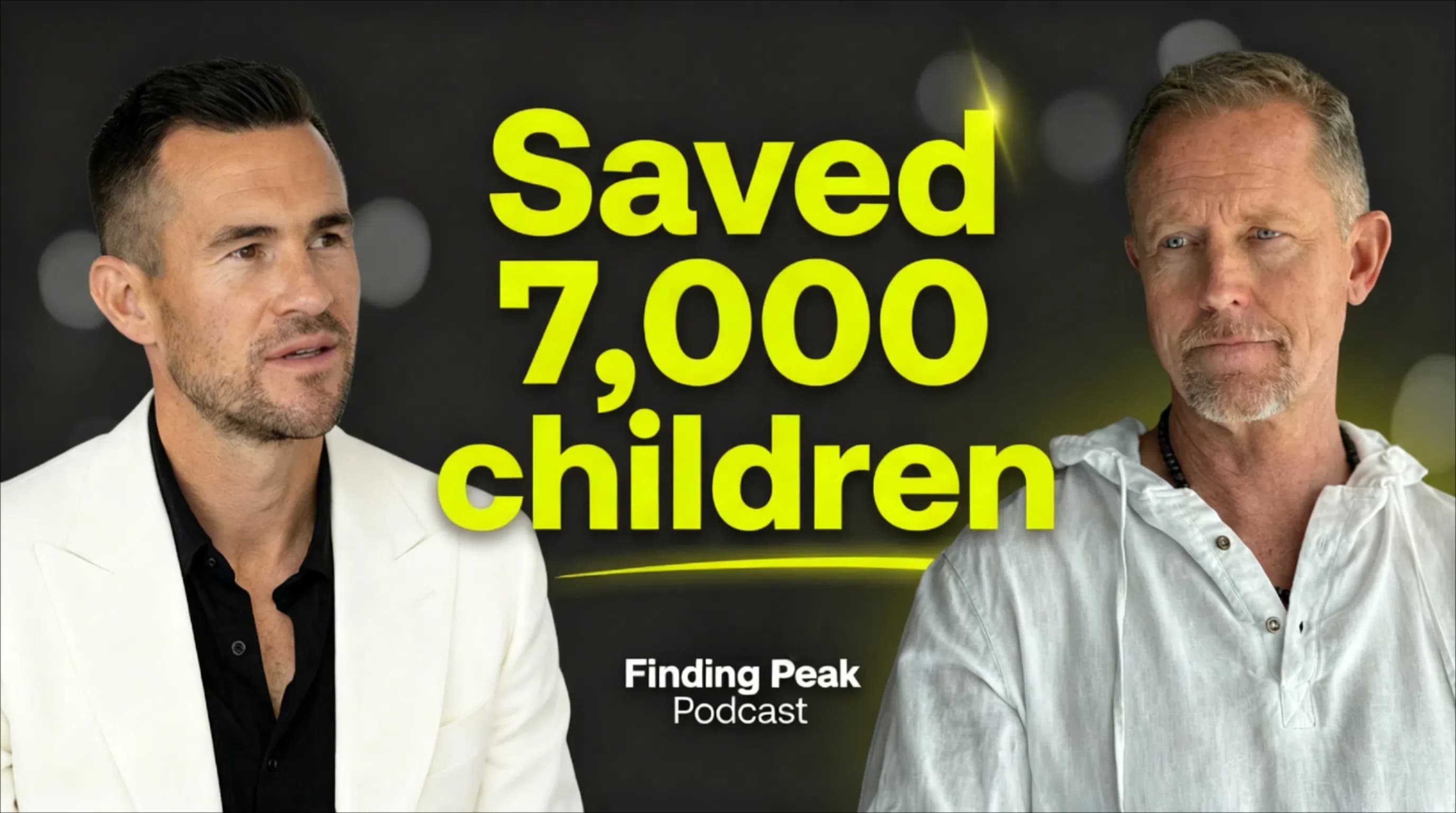
Paul Hutchinson built Bridge Investment Group from the ground up, grew it to over $40 billion in assets under management, retired in 2017, and then did something that would make most Wall Street guys choke on their espresso.
He went undercover. Over 70 missions. 15 countries...
...rescuing trafficked children from the worst humans on the planet.
Paul Hutchinson is the primary investor and executive producer behind Sound of Freedom.
Founder of the Child Liberation Foundation and the guy whose character in the film was played by Eduardo Verástegui because Paul didn't want his real name out there.
He wanted the mission to speak, not the messenger.
I sat down with Paul for this episode, and we went somewhere I didn't expect.
Yes, we talked about trafficking.
Yes, we talked about the operations, Haiti, Ecuador, the cartels, and the corrupt judges. But what Paul kept coming back to wasn't tactical.
It was spiritual, and I mean that in the most grounded, practical way possible.

Connect with Paul Hutchinson
Paul Hutchinson on LinkedIn: https://www.linkedin.com/in/paulhutch/
Website: liberatinghumanity.com
Donate: childliberation.org
The Sound of Freedom book is on Amazon: https://amzn.to/4mbJED9
Your Kid's Phone Is More Dangerous Than You Think
Paul told a story about an FBI Citizens Academy training he attended almost 20 years ago. A CIA agent opened the session by saying that by the time the class was over, everyone would want to take their kids' phones away.
But here's the tension. Kids born today will spend a third of their lives sleeping and a third in front of a screen. You can't rip them out of that environment and expect them to grow up normal.
So what do you do?
Paul's answer is uncomfortable for helicopter parents: teach them correct principles and let them govern themselves.
I have a 12-year-old and a 10-year-old. Both have phones. I lost the debate on timing.
But I won the one that matters more. I talk to my boys. A lot. I exposed my older son to Wu-Tang at seven because I couldn't stomach another second of whatever auto-tuned garbage was on the radio.
That led to honest conversations about language, context, and boundaries that most families never have.
By the time my kids were 10 and 12, curse words had no power over them. They weren't sneaking around giggling about them. They understood context.
...and that same framework of exposure plus conversation is exactly what Paul is advocating for when it comes to digital safety.
He broke down sextortion, which the FBI has identified as one of the most serious threats targeting kids right now.
The average victim is a 12-to-14-year-old boy. A predator connects on a gaming platform. Moves the conversation to WhatsApp or Signal. Poses as a teenage girl. Gets compromising photos. Then threatens to send them to the entire school unless the kid pays up or meets somewhere.
There have been suicides.
The fix is not locking your kid in a tower. It's building the kind of relationship where your 12-year-old can walk up to you and say, "Dad, I screwed up." Without fear. Without shame. Without thinking the world is over.
Paul said it plain: make their social accounts private, monitor their friend lists, and for the love of God, turn off geotagging. But none of that matters if they can't come to you when things go sideways.
Here's the stat that should rearrange your priorities:
92% of children who are sexually abused know their abuser. It's familial.
It's the babysitter. It's the uncle at the family reunion. It's the friend's older brother. The stranger-danger boogeyman is real, but it's the exception rather than the rule. The majority of threats are already inside the circle of trust.
Which means your job isn't to build a higher wall. It's about building a relationship where no secrets survive.
95% of Violence Is Avoidable
One of Paul's trainers was a guy named Steve Turani. Top edged-weapons instructor. Trains CIA, FBI, Secret Service. And his number one lesson had nothing to do with fighting.
Situational awareness.
95% of the situations where someone has to resort to hard skills, combat, self-defense, fighting their way out, could have been avoided entirely if they were just paying attention.
Paul referenced a study where convicted felons were shown video of random people walking through a mall. They were asked who they'd target next. Almost every felon identified the same people. Headphones in. Eyes on their phone. Walking slow. Alone. Low confidence.
Paul referenced a book he had all his operators read called The Gift of Fear. The premise is that your subconscious mind is gathering data constantly. It knows how many steps you took today. It noticed the guy wearing a coat too heavy for the weather as you walked into the store. Your conscious mind missed it entirely. But your gut didn't.
That gut feeling isn't mystical. It's your subconscious doing math faster than your prefrontal cortex can process. And most of us have trained ourselves to ignore it.
Teach your kids to walk with their heads up. To scan without being paranoid. To trust the feeling when something is off. That's not fear. That's preparation.
I tell my boys the same thing every time we walk through an airport. Most of these people couldn't care less about you. But pure math says a few of them are bad. Walk like you know it. Not scared. Aware.
The Skill Nobody Talks About
Here's where the conversation took a turn that I didn't see coming but needed.
Paul spent a significant portion of this interview talking about meditation. Not the crystals-and-incense kind. The kind that helped him locate trafficked children in Port-au-Prince at two in the morning when his team had hit a dead end.
He told a story about being in Haiti with a brand new team of operators.
Five days on the ground. Zero leads. He asked to take the lead, closed his eyes, focused on his heart, took one deep breath in through the nose, held it, out through the mouth.
Then Paul Hutchinson walked up to a guy in a motorcycle gang in a black alley. That guy connected him to someone.
That someone led to the takedown of the largest child trafficking ring in the Caribbean. Four corrupt federal judges went down with it.
Paul credits a man named Jerry Prine, a guy who never graduated elementary school but tested as one of the highest IQs ever recorded at the University of Utah.
Jerry told Paul at lunch 35 years ago:
"The difference between me and you is I listen better than you."
Then touched his heart.
Jerry said the medical devices he patented weren't his inventions. They'd existed for billions of years. He was just a better receiver.
Now. I know some of you just rolled your eyes so hard you saw your own brain. Stay with me.
Paul isn't selling woo. He's describing a practice that produced measurable, documented, life-or-death results across 70 missions in 15 countries.
In Ecuador, his team drove up to a suspected trafficking front and the federal agent said it was shut down. Intel was a month old. Place was closed.
Paul told him to stop the van. He could feel it. Got out, closed his eyes, did the breath work, walked into a nearby restaurant and asked the manager about the "special massage place." The manager said, "Do you have an appointment?" Still there.
He went back outside, did it again, and felt drawn to one woman walking her dog in a crowd of people. She made a phone call. A madam opened two steel doors. They took down the entire operation.
The CIA has run remote viewing programs for decades. The accuracy rates, when you look at the data, don't support the "it's all nonsense" narrative. And if the government keeps funding something across multiple agencies and multiple administrations, it's not because it doesn't work.
The practical application is simpler than you think. Close your eyes. Hand on your heart. Deep breath in through the nose. Hold. Out through the mouth. Listen.
Not to your head. To something quieter.
Paul said something that stuck with me: prayer, for most of his life, was praise, apology, request, hang up. That's not a conversation. That's a voicemail. Meditation is learning to shut up long enough to hear the response.
WATCH NEXT: The Science of Scaling: Why Retention Starts in Sales, Not Customer Success
The Man in the Mirror
Paul closed with a story I won't forget.
A dad is sitting on the couch. His kid keeps asking to play baseball. Dad tears a map of the world out of a newspaper, rips it into pieces, throws it on the floor. Says, "Tape this back together and we'll play." Expects it to take an hour.
Kid comes back in five minutes. Perfect.
Dad says, "How did you do that?"
Kid says, "There was a picture of a man on the other side. I just put the man together and the whole world came together."
That's the answer to every problem Paul has spent the last decade fighting. We don't fix trafficking by pulling children out of hell. We fix it by pulling the hell out of the adults.
Heal the man. The world follows.
Subscribe to Finding Peak at ryanhanley.com/subscribe.
This is the way.
Hanley.