Listen to the audio version of the podcast on Apple or Spotify.
Most people have never been punched in the face.
I don't mean that metaphorically.
I mean a closed fist connecting with your jaw while another human being tries to put you on the floor.
That specific, visceral, there-is-no-undo-button moment where your brain goes white and your body decides in a fraction of a second whether you're a fighter or you're not.
I wanted to know what that moment feels like from someone who lived it at the highest level.
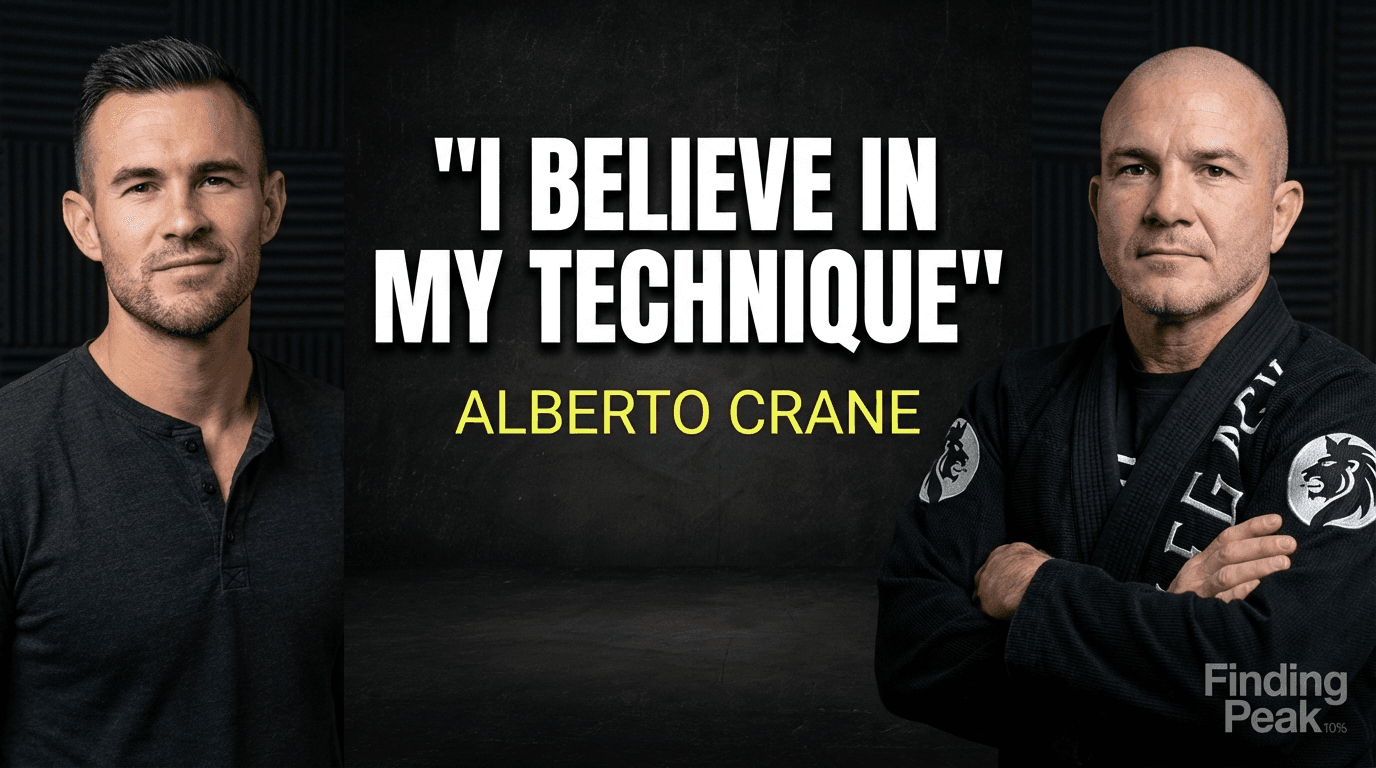
So I sat down with Alberto Crane.
If you don't know Alberto, here's the short version. He left everything behind at 19 years old, moved to Brazil on a maxed-out credit card, and trained Brazilian Jiu-Jitsu full-time at Gracie Barra.
He became the first American to earn a black belt from that academy. He went undefeated for five years in MMA. He fought in the UFC.
He won championships in King of the Cage and Ring of Fire. He compiled a 15-5 professional record.
He built Legacy Jiu-Jitsu in Burbank, California, which has been running for 25 years.
Then he got diagnosed with multiple sclerosis.
And instead of shutting it down, he went on a world tour.
This conversation hit me in places I wasn't expecting. We started talking about punches and ended up talking about presence, fatherhood, and why the rough edges in your life might be the best things about you.
Here's what stuck.
Connect with Alberto Crane
Alberto Crane is a UFC veteran, BJJ World Champion, first American black belt from Gracie Barra, founder of Legacy Jiu-Jitsu, and TACFIT Chairman.
His book All In: Lessons On and Off the Mat is available now.
Gameness Is Real. And You Either Have It or You Don't.
Alberto used a word I'd never heard before in this context: gameness.
It's a term from the animal world. Are you game? Will you keep going when it hurts? When the crowd is quiet? When nobody's watching and you're three rounds deep and your legs don't work anymore?
He tied it to something primal. DNA. Heart. The thing that makes some people get off the canvas and others stay down. And I'll tell you, I saw the same thing in football. You didn't need to see a guy's stats. You needed to see how he got up after getting hit. That told you everything about who your teammate was going to be.
Alberto said it straight: "It's not one thing. We're complex beings. It's the environment, your team, your DNA, your upbringing. But some of it is in you before you ever step on a mat."
I believe that. I've seen it. And I think most operators and founders know exactly what I'm talking about. You can smell it on someone in the first five minutes of a conversation.
Are they game? Or are they going to fold the first time a client says no?
WATCH NEXT: The Science of Scaling: Why Retention Starts in Sales, Not Customer Success
Michael Jordan's Teammates Had Rings and Complaints
We got into The Last Dance. If you haven't watched it, that's on you at this point.
The thing that still blows my mind about that documentary is this: guys who had championship rings on their fingers because of Michael Jordan still complained about how hard he pushed them.
They won six titles. Six.
...and some of them couldn't get past the fact that Jordan was a demanding teammate.
Alberto nailed it:
"Are you going to be a little bitch or are you going to move forward and try to win this damn game?"
That's the question every leader faces. Not whether to push people. Whether the people around you can take the push. And when do you know someone's not one of you? When do you cut them from the herd?
There's no clean answer. But I'll tell you this: if you're the hardest worker in the room and you're dragging people behind you, you owe it to yourself and them to find out fast whether they want to be dragged or whether they want to run.
Three Years of Losing Built More Confidence Than Any Championship
This was the part of the conversation that hit different.
Alberto told me he lost his first 13 tournaments over three years. Thirteen. He was investing money he didn't have, flying to competitions, training like a maniac, and losing. Every time.
And every time, the next morning, he got up and tried again.
When he finally won, he didn't just win a tournament. He was one of the best blue belts in the world. But he wouldn't have known that if he'd quit after loss number five. Or eight. Or twelve.
"Those three years of losing have given me so much confidence, so much resilience that no matter what happens to me, I know it's going to be okay."
Read that again.
The losing was the thing. Not the winning. The losing. Thirteen consecutive failures became the foundation for everything that followed. His championships. His UFC career. His ability to get an MS diagnosis and say, "Okay. What's next?"
This is the part that worries me about the ChatGPT generation. You can't read about Jiu-Jitsu on ChatGPT and expect to survive on the mat. You can't prompt your way to competence.
You can know every move name, watch every tutorial, understand the theory. But until you've been found out a thousand times, until your technique has been tested and broken and rebuilt, you don't own it. You're borrowing it.
The losses are the tuition. The wins are the diploma. And most people quit before they finish paying.
"I Believe in My Technique"
Alberto told me a story that I'm going to think about for a long time.
After his MS diagnosis, he decided to do a world tour of Jiu-Jitsu competitions. Not because he was guaranteed to win. Because he didn't know if he'd be able to walk in six months. If he was going out, he was going out on his shield.
He made it to Spain. One of his last stops. And he got food poisoning.
Could barely stand. Couldn't eat. Couldn't drink. Lost his first match but survived the round without throwing up on the mat, so he qualified for the open weight division.
He sat there, feeling like death, and a single phrase came into his head:
"I believe in my technique."
He repeated it. Over and over. For about 90 minutes. Not out loud. In his head. Like a mantra he didn't know he had.
Then he went out and won. Match after match. Multiple victories in a day. On an empty stomach. With food poisoning. While battling MS.
The power of the mind is one of those topics that splits a room. Half the people nod. The other half roll their eyes. I used to be an eye-roller. Four hundred episodes of this podcast later, I'm a nodder.
I had my own version of this. After I sold my business, I was in a free fall. Identity gone. Financial hits stacking up. The whole thing felt like it was on fire. And one day I sat there and said to myself: "Don't fall apart. That's the win. Don't fall apart."
It wasn't aspirational. It was survival. But saying it to myself did something I can't fully explain. It created a floor. A place I could stand. And slowly, everything rebuilt from there.
Alberto's phrase was different. Mine was different. The mechanism is the same. When you've got nothing left, the story you tell yourself becomes the only fuel you have. And it either moves you forward or it doesn't.
WATCH NEXT: Why Your Passion is Destroying Your Life (And How to Fix It)
The Blessing of Being Forced to Slow Down
Here's the part that convicted me.
Alberto said his MS diagnosis was a blessing.
Not spin. Not toxic positivity. He meant it. Because it forced him to stop running. To stop chasing the next tournament, the next belt, the next title. To sit still long enough to notice his wife. His kids. His students. The actual life happening around him while he was grinding.
He told me about a trip to India with his wife where a meditation teacher explained that meditation isn't sitting still and being nowhere. It's being fully present in what you're doing. When you're rolling on the mat and someone's trying to choke you, you're present. When you're on stage making people laugh, you're present. When you're face to face with your kid asking about their day, you're present.
The problem is we treat those moments as the exception. We scatter our attention across 15 things, never give full focus to any of them, and then wonder why we can't find flow state.
I asked Alberto how you cultivate presence outside the moments that demand it. His answer was simple: activities that force you into the now. Goals that require your full attention. Slowing down in the morning. Looking at the damn flowers.
He asked me a question I wasn't ready for: "What are the most important things in your life?"
I said my kids. Being a man they can use as a jump-off point.
And he just let it sit. Then said, "Isn't it crazy that we spend our whole lives working and chasing things that don't matter when all that matters is our kids and our family and the people who love us?"
Yeah. It is crazy. And I'm as guilty as anyone.
Five Things Your Brain Needs (And You're Probably Missing Three)
Alberto dropped a framework from a brain researcher he'd studied that stopped me mid-sentence.
The brain needs five things to function well: nutrition, movement, challenge, novelty, and connection.
Not productivity hacks. Not morning routines. Not another app. Five inputs.
Think about your last week. How many of those five did you actually feed?
Most operators I talk to are running on nutrition (maybe, if coffee counts), some movement (inconsistent), and challenge (endless, but the wrong kind). Novelty? When was the last time you drove a different route to work? Took a class? Had a conversation with someone outside your industry? And connection? Real human connection. Not a Zoom call with cameras off. Not a Slack thread. Actual face-to-face, present-tense connection with another human being.
Alberto ties this back to Jiu-Jitsu. Every time you step on the mat, you're getting movement, challenge, novelty (every roll is different), and connection (try being disconnected from someone who's trying to submit you). That's four out of five in a single activity.
Find your version of that.
The activity that checks multiple boxes at once.
I call this "Easy Mode."
For me, it's speaking. When I'm on stage, I'm challenged, present, connected, and doing something novel every time because no two audiences are the same. When I'm not on that cadence, I feel it. My brain gets foggy. My patience shortens. I get scattered.
The framework is simple. The execution is where everyone falls apart. Because Netflix is easier than novelty. And scrolling is easier than connection.
Your Rough Edges Are Features
Near the end of the conversation, I said something I've been thinking about for a while.
We spend so much time trying to sand down the rough edges. In business, we want to automate everything, make it frictionless, optimize every angle. And some of that is good. But some of those rough edges are what make you who you are.
Is Alberto the same teacher without the MS? Without the 13 losses? Without getting knocked out in 12 seconds at King of the Cage? Without the maxed credit card in Brazil?
No. He's not. Those aren't bugs. They're features.
The hardest things that happened to him became the foundation for everything he teaches. Every kid who walks into Legacy Jiu-Jitsu in Burbank gets the benefit of a coach who has been beaten, broken, diagnosed, and rebuilt. That's not a liability. That's the whole damn product.
I think about this a lot when I talk to founders who are in the middle of their hardest season. Losing clients. Cash flow problems. Partner disputes. Health issues. It feels like the end. But if you keep showing up, if you don't fall apart, those rough edges become the story that separates you from everyone else.
Alberto brought up Teddy Roosevelt. The Man in the Arena. I've got it on my wall. First thing you see when you walk in my house.
It's not the critic who counts. It's the man in the arena, face marred by dust and sweat and blood. Who at best knows the triumph of high achievement, and who at worst, if he fails, at least fails while daring greatly.
Alberto didn't just quote it. He wrote the book on it. Literally. All In: Lessons On and Off the Mat is out now. It covers his journey from Santa Fe to Brazil to the UFC to an MS diagnosis to building one of the most respected academies in the country.
Go get it.
...and more importantly, go do something that scares you today.
Sign up for the thing. Take the meeting. Make the call. Go to the gym even though you don't feel like it.
The rough edges are where the story lives.
This is the way.
Hanley