Key Takeaways
- →AI multiplies whatever you point it at—wrong KPIs lead to fast failure.
- →15% of customers drive 90% of profits; optimize for lifetime value.
- →Brand building with AI is now low-risk and worth billions in market cap.
Listen to the audio version of the podcast on Apple or Spotify.
If you are using AI to optimize for conversion rate, return on ad spend, or time-to-hire, you are pointing a self-driving car at the wrong address.
And it’s going to take you there really, really fast.
I am so far down the AI agent rabbit hole that it's insane.
I'm not a native tech guy. I can't code at all. I took one week of C++ in college and was like, "Screw this."
But I love getting into AI because it is undeniable what is coming.
Being unprepared as a leader feels like denying yourself a skill set that's going to be mandatory.
I get a ton of questions from the audience about how much of this they should be putting into their business. Should they wait? Should they let the technology mature?
To me, AI feels different. It feels like it's moving so fast and so far in each leap that if you're trying to wait until the finished version is available, you're not going to be able to catch up.
I wanted to know what this looks like from someone who has seen the inside of the biggest companies in the world.
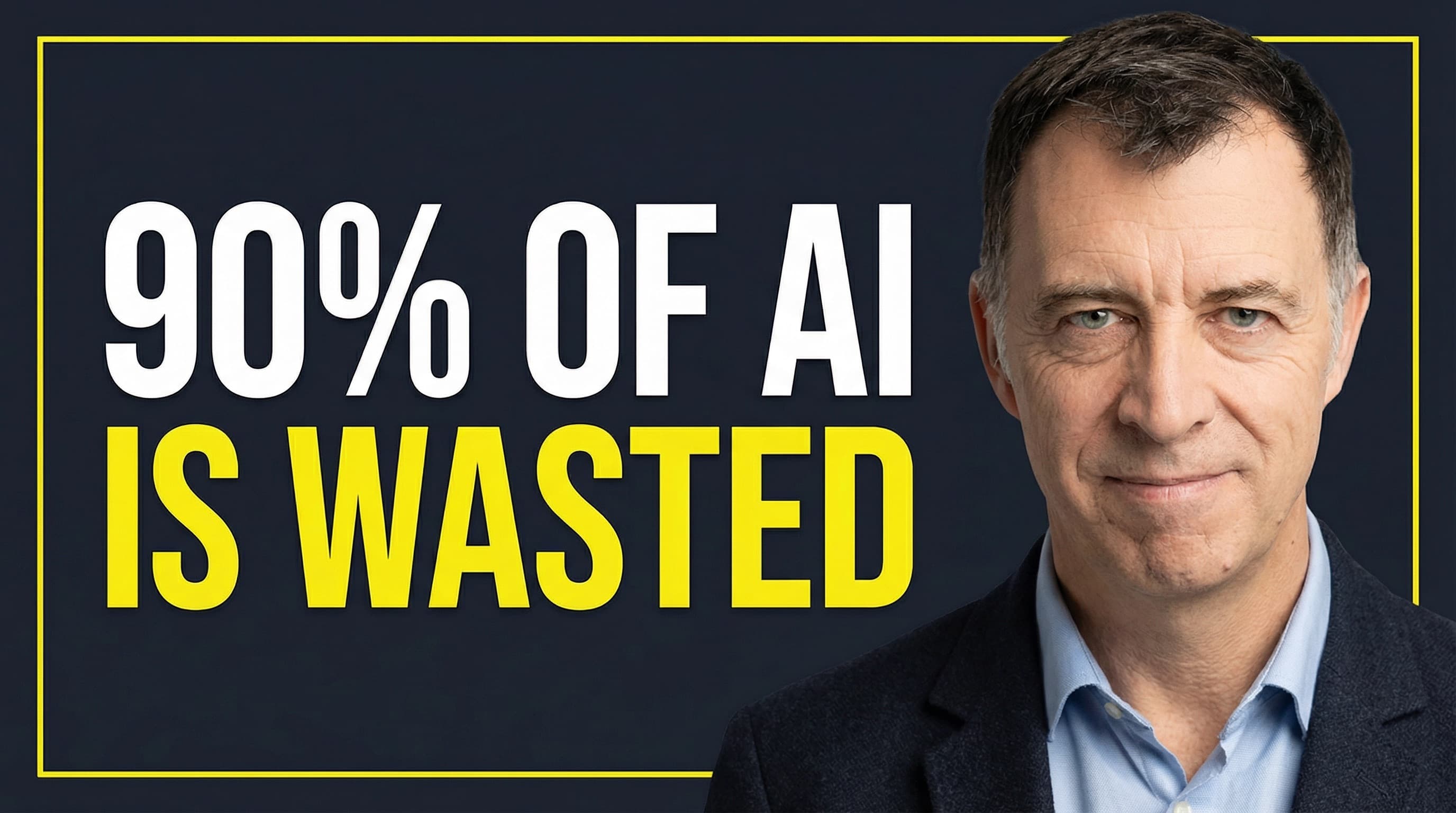
Nicolas Darveau-Garneau
So I sat down with Nicolas Darveau-Garneau.
If you don't know Nicolas, here's the short version. He is the former Chief Evangelist at Google. He has advised over 1,000 CEOs on digital transformation, marketing, and AI strategy. He has started four companies himself. He is the author of Be a Sequoia, Not a Bonsai.
His conclusion after looking under the hood of the world's biggest companies?
90% of them are optimizing AI for the wrong KPIs.
This conversation hit me in places I wasn't expecting. We started talking about AI models and ended up talking about customer lifetime value, the danger of "efficiency," and why the most profitable companies are leaving everyone else behind.
Here's what stuck.

Connect with Nicolas Darveau-Garneau
Nicolas Darveau-Garneau is the former Chief Evangelist at Google, a serial entrepreneur, and an advisor to CEOs worldwide.
His book Be a Sequoia, Not a Bonsai is available now.
The Self-Driving Car with the Wrong Address
Nicolas used an analogy that I haven't been able to stop thinking about.
He pointed out that AI models are doubling in power every six months and getting 90% cheaper every year. If you compound that out over five years, that's a 100-million-fold improvement in price and power.
That is an unimaginable amount of leverage.
But leverage is just a multiplier. It multiplies whatever you point it at.
If you're telling the AI to go in the wrong direction, the AI's going to take you there really, really fast," Nicolas told me. "It's like a self-driving car with the wrong address.
I see this constantly. We have these incredible tools at our fingertips, and we use them to do the wrong things faster. We use them to optimize for metrics that don't actually move the needle for the business.
Why? Because those are the metrics we've always tracked. Those are the metrics our old, clunky software systems allowed us to track.
We track time-to-hire instead of quality of hire. We track average handle time in customer service instead of customer satisfaction. We track return on ad spend instead of actual cash generated.
We are optimizing for the limitations of our past, not the possibilities of our future.
WATCH NEXT: Every New AI Tool Is Making Your Business Dumber
The One Metric That Actually Matters
Most companies look in the rearview mirror. They look at what happened yesterday to make decisions for tomorrow.
Nicolas argues that we need to look through the windshield. We need to get comfortable making decisions based on predictions. And the only prediction that truly matters is Customer Lifetime Value (CLV).
In almost every industry, 15% of customers drive 90% to 100% of the profits.
Read that again.
15% of your customers are driving almost all of your profit.
Yet, most companies optimize their marketing to acquire any customer as cheaply as possible. They optimize for Cost Per Lead or Return on Ad Spend.
Nicolas shared a story of a local gym owner who flipped this script. Instead of trying to get as many members as possible, he used data to figure out who his most valuable customers were.
It turned out to be 55-year-olds with specific health goals.
He optimized his entire business around that specific avatar. He hired different trainers.
He built nutrition programs.
He stopped caring about how many members he acquired and started caring about how long they stayed and how much value he could provide them.
The result? He turned a $200K business into a $1.2M business without adding more members. His churn dropped to 3%, and his average customer became worth 28x more than a typical gym member.
That is the power of optimizing for the right thing.
When you put Customer Lifetime Value in the middle of your business, everything changes.
You stop asking, "How can I get more leads?" and start asking, "How can I find more people like my best customers, and how can I make them even more valuable?"
The $15 Billion Brand War
This was the part of the conversation that blew my mind.
Nicolas told a story about Invisalign and SmileDirectClub during the pandemic. You had to go see a dentist to get Invisalign. SmileDirectClub shipped direct to consumers. You'd think SmileDirectClub would have eaten Invisalign alive during lockdowns.
But in Q4 2020, when dentist offices started to reopen, Invisalign's revenues went up by 26% and SmileDirectClub was down by 6%.
The difference in market cap that happened that day was about $15 billion.
Why? Because Invisalign used AI to test brand advertising.
Historically, building a brand was expensive and risky. You had to spend hundreds of thousands of dollars on a TV spot before you knew if it worked.
Now, you can use AI to create 15 different variations of an ad. You can run them on YouTube for pennies. You can see in real-time which ad is driving people to search for your brand. You double down on the winner in a small market, see if sales go up, and then scale it nationally.
Invisalign did this. The searches for their brand doubled. When the dentist offices reopened, people were primed to buy from them.
They built a brand with almost zero risk, and it was worth $15 billion.
I have been shouting this from the mountaintops for years: Your brand might be your most valuable asset today. Having a good product is just the barrier to entry. If you have the best product and the worst marketing, you lose.
AI has democratized brand building. The speed at which an AI-driven business can iterate and test brand messaging is going to win over time, every time.
My AI Chief of Staff
I shared my own small-ball example with Nicolas.
I built an AI agent using OpenClaw. His name is Maximum Effort (Max for short, an homage to Deadpool).
He is essentially my Chief of Staff for this podcast and my consulting business.
Max goes through my inbox every day.
He looks for podcast outreach emails.
He does a full research report on the potential guest based on guidelines I gave him.
He scores them.
If they are an 8 or above, he automatically crafts a response, sends my Calendly link, and books them.
When they book, Max goes into Riverside, creates the recording link, and updates the calendar invite.
I don't touch any of it until an hour before the interview when I start my research.
It saves me about two and a half hours a week.
That might not sound like a lot. But those two and a half hours were filled with transactional nonsense that drained my energy.
Now, I have that time back to actually think. To make strategic decisions. To be a leader again.
We are all looking for these massive home runs with AI. But in these early days, a lot of the wins are just finding a half-hour here, an hour there. Stacking those small wins gives you the headspace to focus on what actually matters.
WATCH NEXT: The Addiction to Waiting
Building a Limitless Testing Organization
The companies that win in the AI era won't necessarily be the ones with the best proprietary models. They will be the ones who run the most tests.
Nicolas broke down how to build a culture of relentless testing. It's not about being right; it's about getting it right.
He talked about a massive internet company that was moving too slow. They created a cross-functional growth team.
They tracked every impediment to running a test—legal, creative, whatever and broke them down one by one.
Then they opened it up to the whole company. They offered $15,000 prizes for the best test ideas, regardless of whether the test actually worked. The only criteria were: will it thrill the customer, and will it increase profitability?
Suddenly, the whole company was listening to customers. They were running 25 times more tests than before.
Now imagine plugging AI agents into that system. Agents that can come up with new tests, write the code, and deploy them automatically.
As long as you use Customer Lifetime Value as the optimization metric, you can build an unlimited testing organization.
But again, if you have the wrong KPI, you're just going to build a business going in the wrong direction really, really fast.
It's an ego-less business. You have to be willing to say, "It's not about being right. It's about getting it right ."
If you have to be right, this doesn't work.
But if you're willing to let the systems, the machines, and the tests guide you as you layer on your experience, there has never been a more exciting time to build.
This is the way.
Ryan Hanley