Key Takeaways
- →The destruction happens on the exit, not the entry.
- →Long-term investing is a behavior game, not an IQ game.
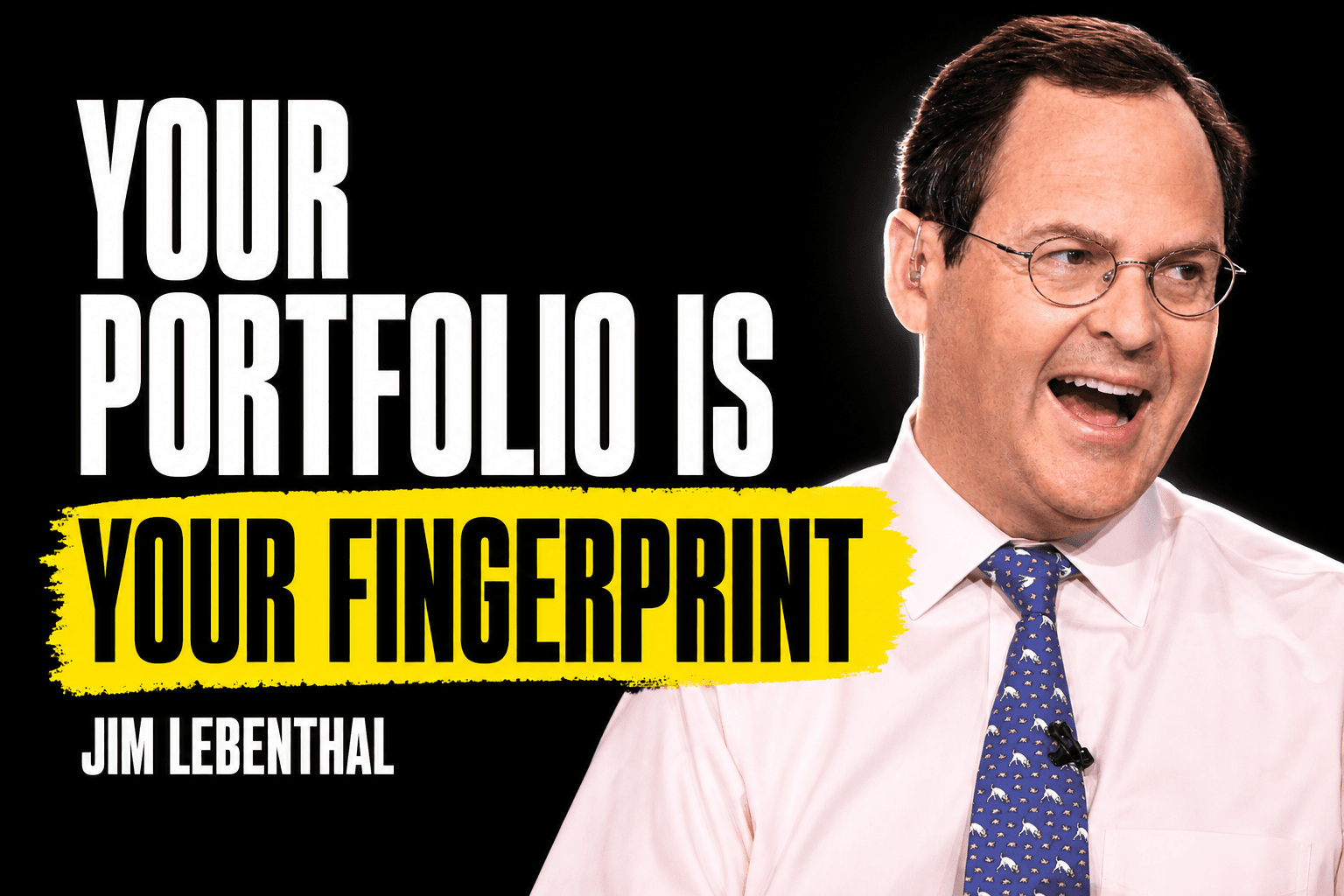
- →Your portfolio is a fingerprint of your personality.
A friend of mine watched American Express fall from around $100 a share to $3 during the financial crisis.
He worked there. Half his personal wealth was in that stock. He sold at $5. Six months later it was $120.
He still gets emotional telling that story on the golf course. It's the most expensive long-term investing lesson I've ever seen: hundreds of thousands of dollars gone because the headlines convinced him the credit system was finished, and he believed them.
That story is why this conversation matters more than anything else I'll publish this year. Not because markets are scary right now, though they are to a lot of people.
Because the entire culture around money has drifted toward the opposite of everything that works. Prediction markets. Zero-day options. Crypto bets funded by credit card debt.
Everyone is selling the idea that wealth is one correct guess away, and almost nobody is selling the boring truth: wealth is time plus behavior.
Jim Lebenthal sells the boring truth. He's a Partner and Chief Equity Strategist at Cerity Partners.
You know him from CNBC's Halftime Report, where he sits at the desk two to three times a week. Before markets, he was a nuclear engineer who drove submarines for the Navy, a world where pulling a control rod half an inch produces the same result every single time.
Then he came to finance and found a world where, in his words, "two plus two can equal five, and there doesn't have to be any reason to it." He built his whole practice on helping people survive that.
Here's what I took from our conversation.
Connect with Jim Lebenthal
CNBC: Halftime Report, noon to 1pm Eastern
Book: How to Ride the Subway: Getting Around on Wall Street and in Life (Regalo Press, 2026): https://www.amazon.com/dp/B0FVMJFJXL?tag=findingpeak-20
Market Timing Turns Temporary Losses Into Permanent Ones
Jim's opening punchline: you can study what works and what doesn't. And what doesn't work is market timing.
I am telling you just from empirical observations, it doesn't work," he said. "I've seen it work once in a while, which is the worst thing that can possibly happen to somebody. When they get market timing right once, then they think they can do it again and again.
Then he showed me the math he shows every client. Take the last five crises the market has faced: the financial crisis, COVID, 9/11, and more.
If you invested at the exact wrong moment, the day before each downturn, and you stayed in, "your annualized return from investing at the exact wrong point in time is about 10% for each of the last five crises."
Read that again. Wrong day. Wrong year. Worst possible luck. About 10% annualized, because you stayed.
The destruction happens on the exit, not the entry.
Jim has watched it in real time: a client who took on more risk than they could stomach wakes up at 3 a.m. during a downturn, calls at the worst possible moment, and says sell everything. "And what that does, Ryan, is it turns a temporary loss into a permanent loss."
Want the stat that should retire the whole idea of jumping in and out? Over the last 30 years, the S&P 500 returned about 9% annualized. Miss the 20 best days in those 30 years and your return drops by more than half, to about 4%. Twenty days out of roughly 10,950. And here's the trap Jim pointed out: those best days cluster right next to the worst days, the exact moments when every instinct in your body is screaming at you to stay out.
"You cannot get return without risk," he told me. "They go hand in hand." That's the price of admission most people keep trying to dodge.
WATCH NEXT: How Self-Talk Controls Your Results | Michael Bernoff
Long-Term Investing Is a Behavior Game, Not an IQ Game
Here's where the episode surprised me. I expected Jim to tell people to suppress their emotions. He went the other way.
"The emotions are real," he said. "Don't deny them, but work with them."
His framework treats each emotion as a problem with a specific tool attached. Feel FOMO on a stock that's already run up? Scratch the itch. Buy a little, small enough that it stops bugging you, and keep enough dry powder to dollar cost average into a bigger position if it drops.
Feel fear because the headlines say private credit is full of cockroaches and fraud? Find the data. Jim walked me through it: private credit is roughly a $2.5 trillion asset class, sitting on top of about $10 trillion of deployed private equity that would have to go to zero before there's systemic risk.
Then look up non-accrual rates and loan-to-value ratios. "When you get those data points, you start to get a lot more calmer."
The same behavior-first thinking runs through everything else he preaches.
Diversification is about your nerves, not your spreadsheet. Jim is comfortable at 100% equities. Most people aren't, and the worst thing an advisor can do is hand a client more risk than they can hold through a downturn. Out of the 30 or so names in the portfolio he runs, fewer than five are flyers.
The other 80% is tried and true Fortune 100 companies built to make it through thick and thin.
...and if you own something wild like Tesla, own something boring that zigs when it zags. A consumer goods stock. A utility. Balance is what lets you sleep.
Individual stocks require a thesis. A real one, written down, built from financial statements and customer health, not from something a guy like him said on CNBC (his joke, not mine).
If the sector is too esoteric to underwrite, quantum computing was my example, that's when an ETF earns its place.
But read the holdings first. Jim has found ExxonMobil and Microsoft inside ESG funds, because managers quietly rebuild the core of the S&P 500 and call it a theme.
Retirement accounts come early, but not at gunpoint. Fund the IRA, fund the 529, because decades of tax deferral are how ordinary contributions turn into seven figures.
But his exact instruction to younger listeners was to do what you can.
Please don't sacrifice your well-being right now. Don't make yourself miserable by funding what's going to come decades down the line.
And speculation? It gets a seat at the table. A small one. Jim's rule: well below 10% of your net worth, and never with borrowed money.
Credit cards charge 10 to 25%. Borrowing at those rates to fund a bet isn't investing, it's renting risk you can't afford.
Patience Is the Whole Game
"I think the biggest investment virtue that somebody can have is patience," Jim told me. "Once you've made your investment thesis, stick with it."
Then he told a story he said he's never told before, not even in a private client meeting. A client and friend named Fred passed away, and Jim, the accountants, and the estate lawyers had to perform what he called a financial autopsy.
They found investments in private companies nobody knew about. Restaurants. As they tracked down the proprietors to value everything, a picture came into focus: Fred wasn't chasing returns. He saw people starting businesses and he wanted to help them.
The autopsy made everyone who loved Fred love him more. And he'd still made sure he had enough to live his life. He wasn't betting his savings on the local Italian place.
Then Jim landed the line I haven't stopped thinking about:
Your portfolio is a fingerprint of your personality. It really is.
Sit with that. If you passed today, would the people going through your finances understand why you did what you did? Would they see a thesis, a purpose, a person? Or a pile of impulses?
This is where the investment journal comes in, and I'm stealing this habit outright. Jim keeps a journal of his investments and the reasoning behind each one. Nothing fancy. Shorthand. When quarterly earnings land, he writes up the call while it's fresh.
When a position goes against him, and it will, he goes back and reads what he believed at the moment he believed it. That's how he held Citigroup and Cisco through years of going nowhere, until they went somewhere and more than made up for the wait.
The journal is also what taught him he was trading too much early in his career. Written feedback doesn't lie.
I have my own version of the patience story. Best investment I ever made was Waste Management. I bought it at $31 in 2010 and dollar cost averaged in for about four years.
My entire thesis was that we're never going to have less garbage, they had more available landfill space than any other publicly traded garbage company, and they were turning landfill methane into energy. Getting paid twice on the same trash. It took almost a decade. Then one day I looked brilliant. It's around $175 to $200 now. The garbage thesis was never brilliant. The patience was.
The World Has Ended Exactly Zero Times
We closed on optimism, and Jim earned the right to it.
He told a story from the 1950s New York Stock Exchange, slightly apocryphal, his words. Stocks crater one day on a rumor that Khrushchev launched an ICBM attack. An older trader tells his young clerk to go buy everything he can. The clerk is horrified. The old man's logic: either it's a rumor and we're getting everything on the cheap, or the world is ending and it doesn't matter.
"How many times have each of us heard in our lives that the world is ending?" Jim asked. "For the number of times that we have all heard the world is going to end, you know how many times it's ended? Exactly zero."
This isn't blind cheerleading. It's pattern recognition, and it's the same pattern he applies to AI. Thirty years ago there were 5,500 people on the floor of the New York Stock Exchange.
Today there are about 300. Digital technology ate those jobs. And over those same 30 years, financial services employment went up 20%, because the destruction created new categories: planners, performance reporters, entire roles that didn't exist. "That is creative destruction," he said.
Jobs are destroyed, more jobs are created. He expects AI to follow the same curve, and the data so far backs him: four years into the ChatGPT era, unemployment sits around 4.3% and weekly jobless claims show no firing wave.
His advice for working with an advisor lands in the same place. "Trust is, in my opinion, the currency of my industry," and it can't be demanded, only built, before the downturn comes.
Because the downturn will come, the media will tell you it's the end, and the right move will be the one my American Express friend couldn't make: hold.
"Don't give into fear," Jim said. "It's a real emotion. Don't give into it. History shows that that's the wrong thing to do."
Stay in. Size it right. Write it down. Let time do the heavy lifting.
Listen to the full episode on your favorite podcast app, watch it on YouTube at https://youtube.com/ryanmhanley, and if you want more of this thinking every week, subscribe at https://ryanhanley.com/subscribe.
This is the way.
Hanley.