Key Takeaways
- →A promise without a path becomes propaganda.
- →Ownership is responsibility for the system, not control of every motion.
- →The American Dream is built, not promised — and building is still available.
The framed copy of the Declaration of Independence sits beside my front door.
My boys have to pass it when they leave the house. They pass it again when they come home. A piece of Teddy Roosevelt's "Man in the Arena" speech sits nearby.
Neither document is decoration.
That is where the idea that the American Dream is built gets personal.
They are there because a country, a company, and a family can forget what made the whole thing work. Memory leaks. Comfort speeds it up. Pretty soon we are arguing over the results while nobody remembers the operating system.
That is why my conversation with David Rubenstein landed harder than I expected.
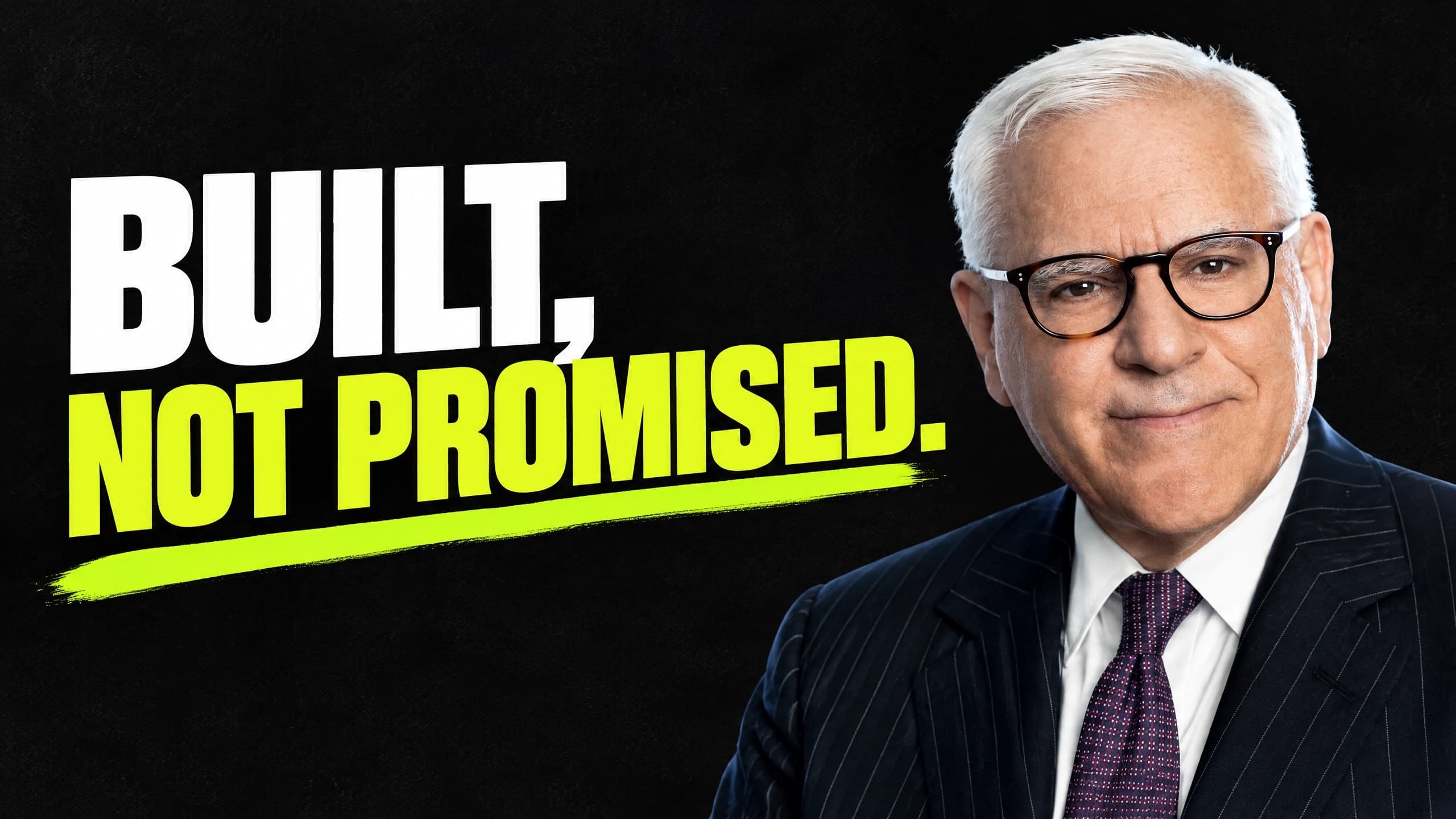
David is the Co-Founder and Co-Chairman of The Carlyle Group. He is also the Chairman, CEO, and principal owner of the Baltimore Orioles. He has spent decades around capital, government, history, and institutions large enough to outlive the people running them.
He also said something that should make every owner sit up straight.
The American Dream is dissipating.
That was David's diagnosis. It does not have to be our destination.
The phrase did not disappear. We still drag it onto a stage every election year. The problem is that too many people cannot see a believable route from where they stand to somewhere better.
A promise without a path becomes propaganda.
A path built through opportunity, responsibility, and useful institutions gives belief somewhere to put its feet.
The Margin Is Where Belief Breaks
I put the pressure in household terms.
A grocery run that used to cost $200 now costs $250. Six months later, you worry it will cost $300. You are doing the same work, paying the same mortgage, raising the same kids, and trying to operate the same life on thinner margins.
Then you hear somebody with eight or nine figures explain that the economy is doing fine.
Good for the spreadsheet.
The family still has to eat.
David did not pretend the tension was imaginary. He said the people at the top are doing fine while average Americans feel squeezed. He tied that pressure to a loss of confidence in social mobility, the belief that a person can work from the bottom toward the top.
That belief matters because capitalism runs on more than capital. It runs on consent.
People will tolerate unequal outcomes when they believe the game is open, the rules are stable, and effort can improve their position. When the route upward disappears, the defense of the system starts sounding like the winners grading their own homework.
This is where founders and executives make the same mistake as politicians. They point to the total result and ignore how the result is distributed through the organization.
Revenue is up. Great. Does the person carrying the customer relationship have room to grow?
The company is worth more. Fine. Can the people creating that value see a future inside it?
The quarter was strong. Wonderful. Did the team win because the system improved, or because a few dependable people took another beating?
You cannot spreadsheet your way around a credibility problem.
Get C.R.E.A.M., my weekly growth-marketing experiment, playbook, teardown, or take for people doing the work in the age of AI. With receipts: https://ryanhanley.com/subscribe
The American Dream Is Built With Memory
David's first diagnosis was not economic. It was historical.
He argued that fewer students study history because parents and students fear a degree outside science, technology, engineering, or mathematics will not produce a job. The exact numbers need care, but the direction is real. The American Historical Association reported that history represented slightly less than 1.2 percent of bachelor's degrees awarded in 2019, down from 5.7 percent in 1967.
The consequence is larger than a struggling academic department.
History is the receipt folder for civilization.
It shows what people promised, what incentives they created, where the pressure moved, and who paid when the theory met a human being. You do not study it to memorize trivia for a dinner party. You study it because humans keep repainting old mistakes and selling them as new construction.
David connected that memory loss to our political division. He said bipartisanship used to be evidence that a legislator could build something with people on the other side. Now the word can function like an accusation.
That point deserves one qualification. Historical ignorance is not the lone cause of polarization, and David did not claim it was. He said there are many reasons. Money and political incentives were among the ones he named.
Still, a country with no shared memory has no shared replay booth.
Every argument begins at zero. Every failure can be marketed as unprecedented. Every useful limit looks like cowardice to the person who never learned what happened the last time somebody removed it.
James Truslow Adams coined the phrase "American Dream" in his 1931 book, The Epic of America. His definition was not a promise that every person would become rich. It was a social order where people could reach the fullest stature of which they were capable, regardless of birth or position.
That is a more demanding responsibility than comfort.
It requires access, agency, standards, and a route.
It also gives leaders somewhere useful to work. We do not control whether an entire country believes. We do control whether the institutions in our hands produce stronger judgment, visible opportunity, and room for capable people to rise.
Ownership Is Not Permission to Play Every Position
The second half of our conversation moved to David's book, Inside the Owner's Box: Conversations on Power and Leadership in Sports.
The business has changed. David said sports franchises are now an investment class. Buyers still love the team or the city, but they also understand the financial value of scarce franchises, media rights, sponsorships, tickets, merchandise, and everything that grows around a winning organization.
Major League Baseball confirmed that the control stake of the Orioles was sold to David's group for $1.725 billion in 2024.
That number gets attention. His reason for buying the team matters more.
David grew up in Baltimore. He described the purchase as a philanthropic gesture meant to help revive the city. He was also blunt that the work is slow, the team has not won as much as he wanted, and a ballpark cannot fix a downtown by itself.
That is ownership without the superhero costume.
Capital gives you the ability to act. It does not give you the ability to skip reality.
David's description of the Orioles' operating structure was clean. Ownership stays informed. Ownership approves major capital commitments. Ownership asks questions. The president of baseball operations makes the baseball decisions because he lives and breathes the work.
That boundary is where a lot of founders get exposed.
They hire expertise, then punish it for not behaving like obedience. They say they want an operator, but what they hired was a well-paid witness. Every meaningful decision travels back to the founder's desk, where it waits behind twenty other decisions the founder also refused to release.
Ownership is not control of every motion. Ownership is responsibility for the system in which the motions happen.
There is a three-part test worth stealing from the owner's box:
Set the standard. Define what winning means and which tradeoffs are unacceptable.
Fund the consequential decisions. Capital allocation belongs with the people accountable for the whole.
Protect expert judgment. If somebody knows the work better than you, make them explain the decision. Do not make them surrender it to protect your ego.
The owner carries the capital risk and the public criticism. The expert carries the craft.
Confuse those roles and both get weaker.
Asset Value Is Not the Same as Stewardship
Here is the contrarian turn.
A rising valuation can hide a dying institution.
The asset becomes more scarce. The price climbs. The people closest to it feel less ownership in the outcome. The spreadsheet celebrates while belief leaves through the side door.
That can happen to a baseball team, a business, or a country.
I am not arguing that appreciation is bad. If you take risk, allocate capital well, and build something valuable, you should participate in the upside. I am arguing that price is incomplete evidence.
The real ownership question is not only, "What is this worth?"
It is, "What does this make possible for the people who have to live with it?"
For David, the Orioles are an investment and a Baltimore institution. That creates a harder scorecard. Wins matter. Revenue matters. Downtown matters. The little kid asking for an autograph matters, even when David keeps telling the kid he is not a player.
That last part made me laugh because it captures the strange public burden of ownership. David said a chemical company can produce billions in revenue and nobody asks him about it. Own the Orioles and everybody has a question.
Visibility does not track economic size. It tracks emotional ownership.
Fans believe the team belongs to them in a way no customer believes a chemical company belongs to them. The legal documents say one thing. The relationship says another.
That is why David's thick-skin line works beyond sports.
If you want the authority, you inherit the criticism.
Do not ask for the owner's box and then complain that people can see you sitting in it.
Get Easy Mode book resources and updates: https://ryanhanley.com/easy-mode
The American Dream will not be rebuilt by better slogans. It will be built where people can see a path, do work that matters, and trust that the person with authority accepts the burden that comes with it.
That starts smaller than Washington.
It starts at the front door. In the weekly meeting. On the payroll. In the decision you fund, the expert you trust, and the standard you refuse to fake.
The American Dream is built, not promised. That is harder work. It is also better news, because building is still available to us.
Listen to Finding Peak: https://linktr.ee/ryan_hanley
Watch Finding Peak: https://youtube.com/ryanmhanley
Visit David Rubenstein: https://www.davidrubenstein.com/
Read Inside the Owner's Box: https://www.simonandschuster.com/books/Inside-the-Owners-Box/David-M-Rubenstein/9781668022498
This is the way.
Hanley.