Key Takeaways
- →Your past success is the exact mechanism keeping you stuck right now.
- →A performance plateau is a perception gap, not a skills gap.
- →You can't out-repeat a repetition problem — the playbook needs to change.
You didn't stop growing because you got lazy.
You stopped growing because you got good.
Everyone sells you the opposite diagnosis. More effort. More hires. A better morning routine. As if stuck means soft.
But look at your last twelve months. New tools. New people. Maybe an offsite with butcher paper on the walls. Effort went up.
Results moved sideways.
That's not a work ethic problem. That's an operating system problem.
The strategies that built your success are now the exact mechanisms keeping you stuck.
The most dangerous place a high performer can be is comfortable enough to keep going but frustrated enough to know something is off.
Revenue is fine. The team is fine. Everything is fine.
And fine is starting to feel like a slow leak.
Here's what's happening inside your head. And how to get out.
What the Psychology of Growth Reveals About Plateaus
A plateau is not a failure state.
It's a cognitive trap dressed up as stability.
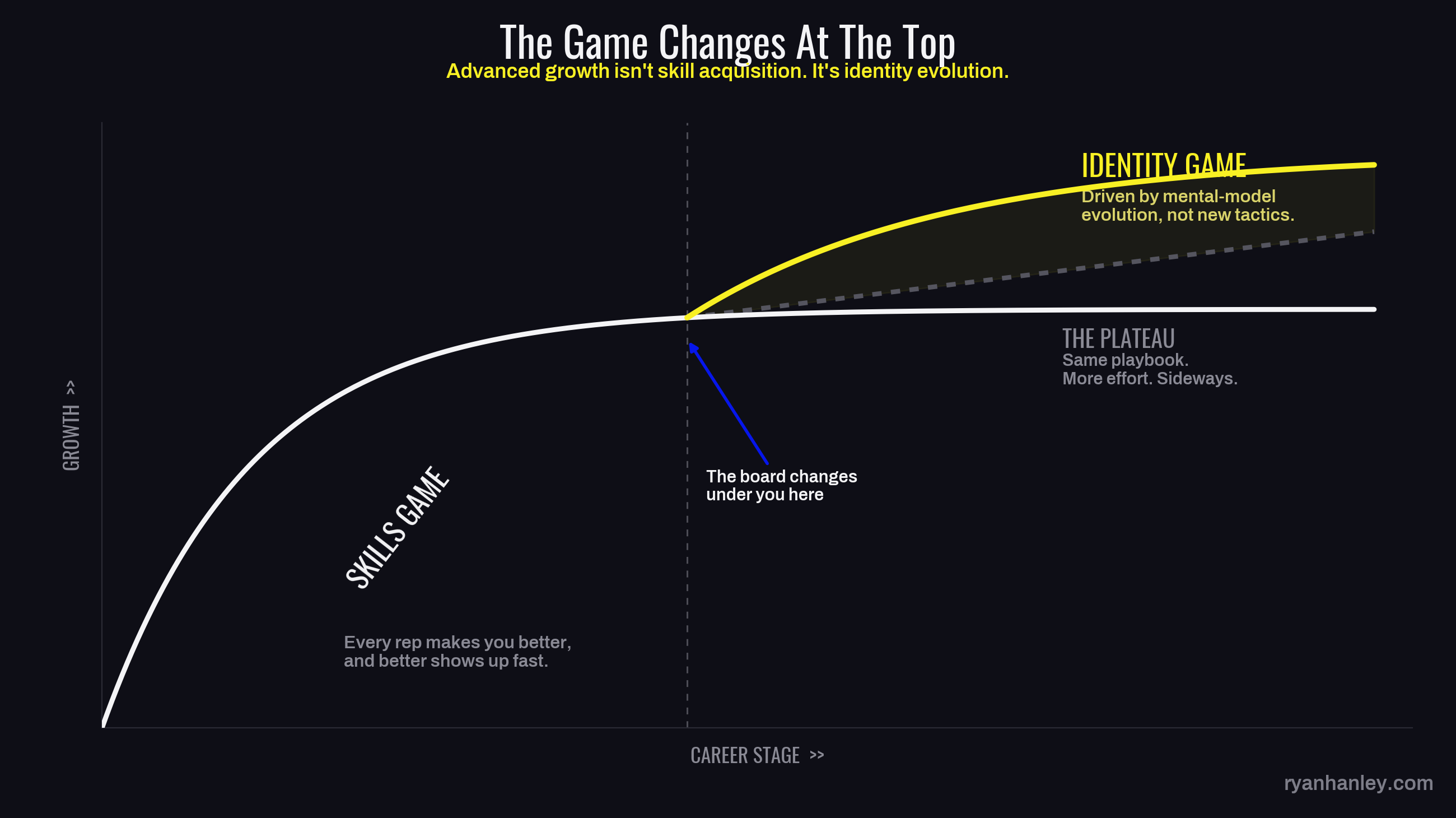
Early in your career, growth is a skills game. Learn to sell. Learn to hire. Learn to read a P&L without sweating. Every rep makes you better, and better shows up in the numbers fast.
At the top, the game changes. Advanced growth isn't driven by skill acquisition. It's driven by identity and mental model evolution. Nobody hands you that memo. You keep playing the skills game while the board changes underneath you.
A performance plateau in high achievers is not a skills gap. It is a perception gap. The brain keeps running the patterns that worked in the past, which makes it structurally resistant to the strategies needed for the next level.
Psychologists have studied this trap for over 80 years. In 1942, Abraham Luchins gave people a series of water-jar puzzles.
Once they learned a complicated formula that solved them, most kept using it even when a dead-simple solution was sitting in plain sight. He named it the Einstellung effect.
In 2008, researchers Bilalić, McLeod, and Gobet ran the same trap on expert chess players. They showed them positions with two winning solutions. One familiar. One better.
Most experts found the familiar solution and stopped looking.
The eye-tracking data is the brutal part. Even when players said they were searching for a better move, their eyes kept drifting back to the solution they already knew. They believed they were exploring.
They were circling.
Water jars in 1942. Chess masters in 2008. Your business right now. Same trap, different board.
Erik Dane at Rice University calls the broader pattern cognitive entrenchment. His research shows the more expert you become, the more your thinking runs on stable, well-worn schemas, and the less flexible it gets. Expertise makes you faster inside the pattern and blinder outside it.
Which brings us to the four specific biases doing the damage.
The 4 Cognitive Biases Trapping High Performers in Incremental Thinking
1. Competence Confirmation Bias
You won with a specific playbook. Your brain now filters reality for evidence that playbook is still the right one.
The more you've won, the stronger the filter.
Watch it play out. The founder who scaled with scrappy generalists keeps hiring scrappy generalists into a company that now needs specialists. The CEO who won on hustle keeps throwing hours at problems that need architecture. Same hiring profile. Same build. Same reflex.
Long past the point it fits.
The trap is that it doesn't feel like bias. It feels like experience. Your gut is quoting old data and calling it wisdom.
2. Identity-Locked Decision Making
When your identity fuses with your method, changing the method feels like self-destruction.
"How I work" quietly becomes "who I am."
This is where growth stalls hardest. I watch leaders stop experimenting, and it's not fear of failure. It's fear of discontinuity. Change the method and you stop recognizing yourself in the mirror.
I lived a version of this building Rogue Risk. The scrappy, do-it-myself instincts that got the agency off the ground were the same instincts I had to put down as it grew. Putting them down felt like quitting on the guy who built the thing.
It wasn't. But your brain doesn't know that in the moment.
The next level requires a new self-concept, not new tactics. Most people go shopping for tactics because tactics don't threaten the ego.
3. The Complexity Premium
High achievers distrust simplicity. If it feels easy, it doesn't feel earned.
There's real wiring under this one. In a classic 1959 study, psychologists Aronson and Mills found that people who endured a harsh initiation to join a group valued that group far more than people who walked right in. It's called effort justification. We price things by what they cost us.
Now run that wiring forward.
I worked this hard to get here, so the next level must require even more.
That single belief repels every elegant move that crosses your desk. The simple hire. The offer you should kill. The one-page strategy that would replace the forty-page one. Luchins' subjects kept reaching for the complicated formula while the simple answer sat in front of them.
So do you.
Busyness becomes a status signal. Complexity becomes proof of worthiness. The calendar becomes the scoreboard.
This is the entire reason I'm writing a book called Easy Mode. The path forward often looks embarrassingly simple.
Which is exactly why high performers keep walking past it.
4. Horizon Compression
Under pressure, executive thinking contracts.
The ten-year vision shrinks to a 90-day execution window. The architect becomes the operator.
There's neuroscience here too. Amy Arnsten's research at Yale shows chronic stress impairs prefrontal cortex function and shifts control toward the brain's habit circuits. The prefrontal cortex is the exact region you need for planning, flexibility, and non-linear thinking.
Translation: the brain in perform mode cannot access architect mode at the same time.
So the harder you grind, the more you become an operator of your own old vision instead of the designer of a new one. You're not thinking smaller because you lack ambition.
You're thinking smaller because your hardware is rationed.
Why Previous Success Makes This Worse, Not Better
Your objection is already loaded. I can hear it from here.
"My track record proves my approach works."
It does. That's the problem.
Success doesn't teach you how to grow. It teaches you how to repeat.
Every win carves the groove deeper. Your brain has been rewarded, over and over, for one pattern of behavior.
Dopamine is wired to that pattern now. Then there's sunk cost identity: the more years you've invested in a way of operating, the more releasing it feels like writing off the investment.
Call it the winner's curse, cognitive edition.
I've seen the archetype dozens of times. The founder who scaled to $10M the exact same way he got to $1M, then sat across from me wondering why everything got harder instead of cleaner.
Nothing was broken. He was running a $1M operating system on a $10M machine, and the machine was grinding its gears.
Growth requires a different curriculum than success.
And the tuition is your certainty.
READ NEXT: Executive Time Management: Kill the 72% WorkSlop
The Breakthrough Isn't More. It's Different.
You don't grind through a cognitive trap. You dismantle it.
Three moves.
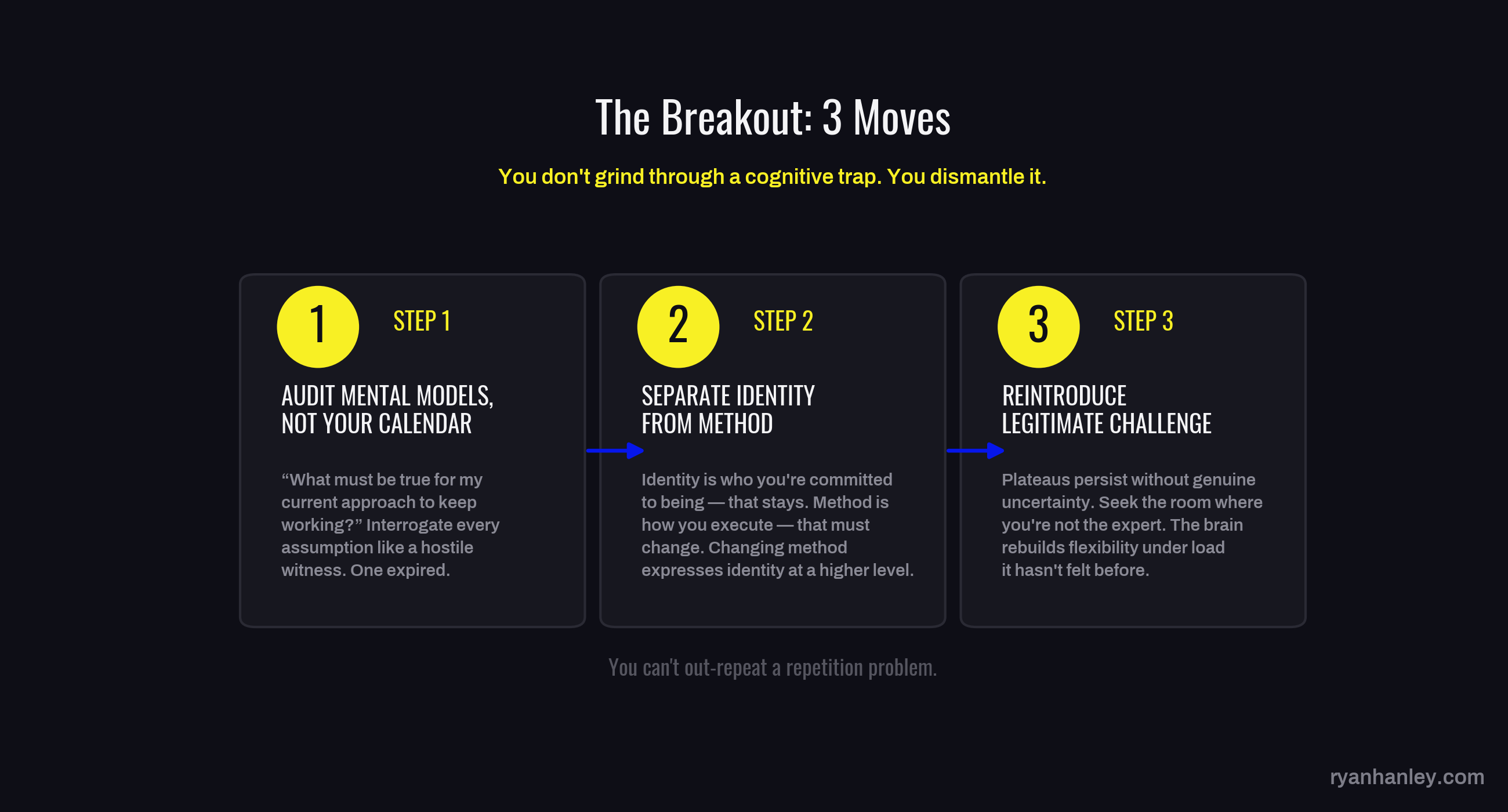
Step 1: Audit Your Mental Models, Not Your Calendar
Most founders attack their calendar when the real bottleneck is their thinking. You can color-code your week into oblivion and still make every decision from the same altitude.
Run this prompt instead: "What do I believe must be true for my current approach to keep working?"
Write down every assumption. Then interrogate each one like a hostile witness. Market assumptions. Team assumptions. Assumptions about what you personally must touch.
At least one of them expired a while ago. You've been paying rent on it anyway.
Step 2: Separate Identity From Method
Your identity is who you're committed to being. That doesn't change.
Your method is how you currently execute. That must change.
The problem is you've stapled them together. So here's the exercise: name three things you do "because it's just how I work." Those are your identity-locked behaviors. The staples.
Then reframe. Changing your method is not betraying your identity. It's expressing it at a higher level. The builder who refuses to evolve isn't protecting the builder.
He's embalming him.
Step 3: Reintroduce Legitimate Challenge
Plateaus persist in the absence of genuine uncertainty.
Read that again, because it indicts most of us. High performers curate environments where they're likely to win. Rooms where they're the smartest voice. Deals inside their comfort zone. Comfortable, yes.
Cognitively deadening.
The prescription: seek the room where you're not the expert. Take the meeting with the person operating three levels above your current ceiling. Let it sting a little.
This is not humility as a virtue. This is a neurological stimulus as a growth tool. Your brain rebuilds flexibility the same way your body rebuilds muscle.
Under load, it hasn't felt before.
The Rub
The plateau was never about effort. You've got effort to burn.
It's the groove in your head. The playbook is quoting its own highlight reel. The identity that confused the method with the man.
Do this today:
Write down the three assumptions your current playbook depends on. Circle the one that expired.
Pick one "it's just how I work" behavior. Suspend it for 30 days and watch what happens.
Book one conversation this week with someone operating three levels above your ceiling.
You can't out-repeat a repetition problem.
And the ceiling was never above you.
This is the way.
Hanley
P.S. More than 16,000 founders and executives get an essay like this every week. If you're not one of them, fix that at ryanhanley.com/subscribe.
...and if this one hit a nerve, send it to the founder in your life who's grinding harder and moving slower.