AI agents are everywhere, automating tasks and making decisions at machine speed. But agents make mistakes. Just one rogue agent can do big damage before you even notice. Rubrik Agent Cloud is the only platform that helps you monitor agents, set guardrails, and rewind mistakes so you can unleash agents, not risk. Accelerate your AI transformation at rubrik.com.
That's R-U-B-R-I-K.com. What is up, guys? This is a special audio-only episode. I'm actually on a long drive, and I've been thinking a lot about 2025. I've been talking to a lot of people about their goals.
I've been talking to a lot of people who either are or work with high performers about what makes those high performers special. How do they separate themselves? How do they reach their goals? How do they reach the highest levels of whatever field they're in, whatever their expertise is in, whatever their practice is in? How do they get there and so many, so many others don't?
What is that separating feature? I've also been thinking about what-- how am I going to set up 2025 in a way that when I get done, I'm proud. 2024 was a very tough year for me personally. Uh, I flailed. I tried a lot of different things.
I spent money on different projects. I invested time, resources, energy into projects that went nowhere. I came out of 2024 with a much deeper perspective on what success looks like for me personally. And as much as, I'll be honest with you, I'm ready for 2024 to be over, nothing's gonna be different in 2025 if I don't make changes. If I don't take the lessons, the failures, the obstacles, the challenges, the setbacks, the sunk cost into things that just did not materialize, if I don't reflect on them and make changes in 2025, 2025 will be exactly the same.
There's nothing special about 2024. It's a number. It's an arbitrary period of time that we set, we set expectations on. And while it's easy to say, "Hey, I'm, I'm ready to turn the page on 2024. I'm looking forward to 2025," nothing changes if I don't change.
Nothing changes if we don't change. And that's scary because what it means is nobody's coming to save us. No external force will be a differentiating factor in our success. It's all on us. And while that should scare the absolute shit out of you, it does out of me, it also creates infinite opportunity because you control your destiny, just as I do.
We all control our destinies in a way that is so profound, so amazing that with even small tweaks, with even small changes in habits, in routine, in focus, in energy, and, and what we give our time to, we can make massive, massive, massive improvements in our life. I think, you know, not to get too philosophical, uh, most of you know that I'm a Christian. I believe-- I've shared this story in the past with you guys. Uh, about six months ago, this was over the summer of 2024, uh, my son, who, uh, my kids go to a Catholic school, uh, my older son has gotten very much into the religion aspect, right? He-- I won't say he's, like, ready to go be an altar boy or anything, uh, probably, uh, won't be.
However, he, he has a lot of questions, and he's very into it. And I, and I think that's wonderful. He asked me, "Dad, do you think that hell is really a fiery place below the ground?" And I said, "No, I do not." Regardless of what hell is, here's how I visualize it.
I believe that at birth, God gives us the ability to be our max potential. He gives us a max potential, a max upside, what we're capable of and the impact that we're able to have on the world, the, the love, the positivity, the energy, the creativity that, that we're able to bring to the world. He gives us this max ability. And when we die, we are presented with that version of ourselves. And heaven is when we're proud of how close we are, and hell is when we're shameful of how close we are.
And that is a driving force in my life because what I think it says to us is it's all there for the taking. Maybe you grew up like me in a, in a small, tiny town that was going nowhere with parents who loved me and did the best they could, but they didn't have a lot of resources. I wasn't-- I didn't grow up with resources. I had to put myself through college. I had to go get scholarships.
There was no expectation for me going to college. Zero. Zero expectation from my parents that I would go to college. The day that I came home from school and said- "Mom, I wanna go to college. I'm gonna start applying."
Her response was great, and that's not a knock on my mother. I have a tremendous mother, wonderful. But there was zero expectation because we didn't have any money. She wasn't sending me to college. She loved that I wanted to go, but she was doing the best she could.
She's a receptionist. My parents were divorced. You know, my dad had his own problems, and we did the best we could. My point in sharing that with you is it doesn't matter where you start. You could have horrible parents.
You could have all the money in the world. You could have somewhere in between. You could have every- everything given to you. You could have nothing given to you. None of that matters.
AI agents are everywhere, automating tasks and making decisions at machine speed. But agents make mistakes. Just one rogue agent can do big damage before you even notice. Rubrik Agent Cloud is the only platform that helps you monitor agents, set guardrails, and rewind mistakes so you can unleash agents, not risk. Accelerate your AI transformation at rubrik.com.
That's R-U-B-R-I-K.com. Because you're given a max potential by God, and our goal in life, the reason that we're here, is to do the best we can to meet that goal. That's, that's essentially, I'm maybe expanding upon my answer to my kid, but that's essentially what I believe why we're here. People ask, "Why are we here? Why are..."
M- M- My belief is just because it creates a construct for me that I can work towards, right? Even if that's not exactly the way it is. Obviously, I have no idea. It gives me a construct and permission to do everything in my power to be the best version of myself that I can be, and I miss on that constantly, guys. I'm-- That's-- I'm not trying to sit here on some ivory throne and tell you that I'm living some maxed out life and, and, and you need to do everything I do.
That's not the case. I struggle with the same doubts and fears and shame and regret and all the things constantly. But what I hold in my heart and how I get through those moments is this idea that it is me, and only me, that has the ability to make the decisions, to make the choices, to make the changes necessary to become the person that God intended me to be, to become that max version of myself. In all these conversations that I've had with individuals that either work with or are high performers, there's been a few things, a few key items, a few factors that have been consistent. This has just been burning a hole in my head, and it's probably not the best audio quality.
I don't care. I had to get this message out to you. These factors are simple, straightforward, and they're 100% in your control. If you want 2025 to be a, to be a more productive, more impactful, a year filled with more energy, more excitement, more intrigue than 2024, than you ever, than you thought was possible, right? We always wanna make the next year the best year we've ever had, and we should.
We should always want that. There's a few things. The first is the cultivation of our own energy, and what I mean by that is how I frame that idea is like this. For the last six months, I've been wearing a Whoop strap. Whoop, a Whoop strap is a bio-tracking device.
Uh, I wear it as a, like, it's like a wristband, and it tracks your sleep, your recovery. Uh, you can track your activity, your strain, et cetera, on that. What I really wanted to track was sleep and recovery. I wanted to figure out what were the things that I was doing in my life that kept me from waking up every day with maximum energy. And the things that I found were not things that were outlandish, but were very pro fact.
First and foremost, I can have no more than one drink in an evening or my sleep goes to shit. On this app, you wanna be 80% recovery or above to be in that kind of max energy zone. Now, if you wake up in the 90s, man, you can feel it, right? Now, obviously, the app is just reporting back to you the way you know you feel. But when that app shows 93, 95, 98% recovery, you feel like you could take on the world.
You feel like you run through a brick wall. Even at 43 years old, you feel like you're in your 20s. You're, like, ready to freaking go. 80 or above, you feel good. It's all good.
You're crushing your day. But if you wake up and that app says 50, 60% recovery or less, man, you're dragging. You're dragging. You're pushing for that extra cup of coffee. You're, you're, you're wishing for a moment to take a little power nap.
You can't wait to check out for the day. And I'm a pretty, like, generally day-to-day motivated dude. Like, most days, I'm, like, willing to get after it. I rarely wake up and just wanna be a freaking bum. But man, I just found that certain, like, things like not getting enough sleep.
Those of you who are sitting out there going, "I can, I can, I can perform on six hours of sleep," no you can't. No you can't. There are a very small portion of the population, very small por- very small portion of the population who can operate effectively off a minimum amount of sleep. I know we all hear Jocko Willink and other guys that t- tend to be in the military who've trained themselves to work on that amount of sleep. I promise you, they're not going off three hours of sleep every day.
Now, on days when they only get three hours of sleep, what they're willing to do because of their training and the willpower they've developed and the routines and habits that they do not negotiate with, they're able to push through three hours of sleep But those, those, they're human beings. They're not living off three hours of sleep, and you're not living off six hours of sleep and being the best version of yourself. You're absolutely not. Seven-plus hours of sleep minimum for max recovery. Seven-plus hours minimum.
Inside of that recovery time, we need to make sure we're doing the right things. So, as I said, if I have more than one alcohol, drink of alcohol, one, one drink a night, I'm not recovering well. And even with one drink, I'm not getting into the 90s. Not gonna happen. Alcohol just destroys your sleep.
Now, for those of you that are pot smokers, right? You smoke pot, maybe wind down at the end of the night. Some people are okay talking about it, some aren't, right? I have tested, uh, using pot as a way to kinda land the ship at the end of the day. In 2023, I was diagnosed with hyperactive bipolar, so I'm essentially switching between hyper manic and manic all day long, uh, which is one of the reasons why I naturally have a lot of energy and motivation, right?
Another reason why I talk so fast. So, inside of that, I get to the end of some days, and I'm, like, jacked out of my mind, and it's 8:30, 9 o'clock at night, and I can't, I can't calm down. And I've tested using pot as a way to kinda pull myself in, and it does that. It works incredibly well as a tool to calm my mind, narrow my focus, settle my body down. Problem is, I sleep like shit.
I never drop into deep sleep, and even if I get seven hours of sleep, I'm not getting... I'm getting 60% recovery max, max. So, all of you out there who are smoking pot and saying, "Oh, I work better," or, "It gives me focus," or whatever, that's all great, and maybe in small doses, in the right situations, managed properly, it can help you as a tool. I don't think most of you are using it for that way. Most of us are using it that way.
I think it's very easy to abuse. Just know that you're essentially burning the candle on the other end, so while it may help you in some regards while you're awake, it is not helping you when you sleep, and then you're waking up e- and you're not recovered. And now you get into your day again, and you're groggy again, and your willpower is low, and you start negotiating with yourself, right? You start s- "Ah, I'm gonna skip the gym today," or, "You know, I really need to have that tough conversation with my employee, but I'm gonna skip that." Another one is exercise.
If I work out strenuously for 45 minutes, I sleep better at night. You've used your body. You've pressed your body. Now, there was a recent study that came out that showed, uh, when you contract your muscles, when you contract your muscles, they release a protein that calms your body, removes depression, and we've known that for a while. We've known why that it happens, that depression, anxiety, stress, fear, all of these negatively oriented emotions and ideas that float around in our head, that when we exercise strenuously, either cardio or weightlifting, uh, that we, uh, that it calms our body.
It removes those negative emotions from our body. We didn't know why. It's because when we contract our muscles, our bodies release a protein which, which attaches to the chemicals in our body that, that, that create those negative emotions, and it flushes them out of the system. Those negative emotions are oftentimes what keeps us t- into dropping into high-recovery sleep. My-- I'm gonna, I'm gonna end there, 'cause I could go on for another hour talking about recovery.
But managing your energy, if you want 2025 to be the best year of your life, I'm sorry, you have to take your energy level seriously. I'm not talking about exercise. You know, I'm not specifically talking about diet. I think you have to figure out what that means for you. But if you're waking up every day on five to six hours sleep, a little hungover, or you, you smoked some pot, or you didn't work out, you just sat in front of your computer and then watched TV and went to bed, and you're not recovered at the end of the day, that next day when you wake up, you're gonna be right back in the same situation.
You're not gonna be able to get after it. And when, you know, you're making maybe, if you're a salesperson, maybe you're only making 10 phone calls and then negotiating yourselves out of the 50 that you told yourself you would make. Or if you're, you know, you have a creative project you have to put together, you do 10 minutes worth of work, and then you say, "Ah, my brain's not working today. I'll put this off to tomorrow." Or those, just the jobs, tasks you need to get around your house.
You know, folding the laundry. Uh, you know, whatever you gotta do with your kids. Like, maybe you're s- instead of being present with your kids and playing a board game or doing something with them, you decide to scroll on your phone and let them sit on their tablets because you don't have the energy to, to be there with them. And it's not 'cause you're fucking old. It's 'cause you're not managing your energy.
You're not managing your energy. So, for 2025, a big focus of mine is gonna be energy management. The second is focus. What you focus on is who you are. What you focus on is who you are.
The highest performers, they are constantly managing their eng- energy levels, and they are ruthlessly focused. So, what does focus mean? It doesn't just mean popping an Adderall pill so that you can bang out a bunch of tasks at work. That is very shallow way of breaking down focus. Focus means what are you willing to sacrifice to achieve the things to become highly proficient, to create impact in the areas of your life that are the most meaningful to you?
And this has been a big problem for me, because I consider myself a bit of a, I'm gonna use this term, it sounds really douchey, I don't mean it to, a renaissance man. I have, I'm interested in so many different things. I love sales. I love leadership. I love marketing.
I'm super interested in product design. I love politics. I find it infinitely engaging and interesting the way these maniacs operate and how politics works. I love economics. I'm super interested in, like, what's going on in the universe and, you know, just astrophysics stuff.
I, I just love reading about that stuff. I love reading about mindset and personal development. I just-- I'm so interested in all these different areas, which is, which is wonderful for me, except for the fact that when I allow myself to be, to be distracted by things that I'm interested in versus the things that I can-- that drive true value and impact in my life, I'm less than I could possibly be. It's fun to, to get into things like conspiracy theories, another area that I waste way too much freaking time on. I just find conspiracy theories to be so engaging and fun and, you know, I get a lot of shit from people because I'm so interested in conspiracy theories.
But, you know, a lot of conspiracy theories over the last three years have been true. And, and, but what does that do for my life, right? How does that, how does that keep me from creating for Finding Peak or, you know, creating new, uh, you know, developing new product designs and helping, uh, you know, build new, uh, business development relationships and, and driving growth in Linkora? Linkora is the company that I'm the chief marketing officer of, and I love the company. I love Linkora because I feel like the industry that I'm born in, that I work in, the insurance industry, I feel like I get to be part of delivering this technology, artificial intelligence, to an industry that has given me everything that I have in a way that I believe is going to be useful and secure for that industry, that's gonna do it in a way that's not gonna be a bait and switch.
It's not-- I'm not just selling them a product to make some money and bounce out of the industry. I love the insurance industry. I love the people in the insurance industry. I understand the value of the insurance industry. And while I may coach people and I may do keynotes, uh, presentations, and performances outside of the, the insurance industry around leadership and personal development and things and topics like that, my home is the insurance industry.
And if I can be one of the individuals as part of one of the companies, Linkora, who is helping provide and usher in artificial intelligence into that industry in a way that is useful and pragmatic, there for the long term, that to me is a major, major value creation, not just for the people who end up using our product, but for me personally. I get to wake up in the morning and say, "This technology, which is coming on like a tidal wave, I can help. I can help insurance agents, insurance carriers, individuals and companies inside that space understand this technology and put it to use and catch that wave and drive their businesses forward." That creates tremendous value for me. But if I'm spending two hours listening to a podcast about conspiracy theories, is that really helping move that needle forward?
Or is it just pri- providing me some fun, you know, small talk banter at a, uh, trade zone cocktail hour? These are the kind of decisions that we have to think about. I know a lot of people like to golf. They like to-- They have all these hobbies, and I think those are great. I think we need to have a real discussion with ourselves around are we...
Is this hobby that I have, is this thing that I do, is it really adding value to my life, or is it an escape from the things I'm not doing in the places that I should be doing them? And look, golf's amazing. I love golf. Truth be told, last three years, I haven't really golfed that much. I was growing Rogue Risk.
Last year, I was, you know, kinda refinding my place in the world post Rogue Risk, building Finding Peak. I joined Linkora. And I don't really have plans to golf too much in 2025, 'cause I'm gonna be growing the shit out of Linkora and continuing to build my leadership and sales consulting and, and coursework and stuff, like Master the Close program, which is coming out in January of 2025. I wanna continue building that thought leadership, that IP, and continue helping people move forward with the content that I create. And those, professionally, are the two most important goals that I have, and anything that takes me away from them, I have to say no to.
That's incredibly difficult for me. I love saying yes to shit. I'm always interested in a new startup and a new... You know, I, I have 14 angel investments that I, that I track and try to help, and those are the kind of things, though, that take you away from your primary goals. I think too often when things become difficult or mundane, we look for that new thing, and every new thing that we take on, if it's not at least tangentially related to the primary goal, to our primary impact, to the primary value that we're trying to create, not only for ourself, but for whoever it is we serve, it's a distraction, and we have to say no.
So in 2025, energy management and focus. And the third idea that I wanna share with you that high performers... And again, I've talked to, you know, I've had these people, a lot of these people on the podcast. I had Steve D'Agostino a few episodes ago on the podcast. He coaches some of the highest performing, uh, basketball players that have ever come out of, uh, the greater Albany area.
There's multiple pros. Uh, we have, uh, multiple dozens of Division I athletes, and all of them have come through his, his basketball coaching program. He, he coaches for the, uh, the national junior, uh, US basketball team, right? I mean, this is a-- He coaches incredibly high-performing basketball players. I've had, uh, just recently Adrian Kahler.
He works with some of the most successful leaders in the entire country, Fortune 100, Fortune 500, entrepreneurial endeavors, high, high performers, alphas, up and to the right Ds, right? These are people who drive, who drive results. If you just go back in the podcast, you'll hear over and over and over again, high performers think big. If you've set a goal for yourself, is it a big goal or a small goal? Are you setting a goal that's reachable so you can feel good about yourself at the end of the year?
Are you setting a goal so fucking big and audacious that there's no freaking chance you're gonna hit it? There's no chance. I think we honestly have to ask ourselves that. We set all these goals for, "Oh, I'd love to have this happen this year, and I'd love to have..." What do you mean you'd love to have?
What's the biggest, baddest thing that you could possibly do this year? Go frigging get it. Go get it. Go get that thing. And in talking through the podcast to all these amazing thought leaders, all these amazing high performers, all these amazing high performance coaches, they don't think small.
High performers don't think small. One of my core issues in life is I tend to think small. It's the way I was raised. I was raised by two parents. One was a union guy.
One was a receptionist for a large company. What they taught me was go get the big, safe job. Go work for the company. No risk. Don't have big downside.
Don't take chances. Because that's what they knew. That's how they survived, and I love my parents for living that life and, and, and getting us, getting us through that. But I don't believe that's what God intended me for, yet I'm constantly battling that voice in the back of my head that says, "There's no one there for you. If you fail, you're gonna fall on your face.
Everyone's gonna laugh at you. You're, you're not gonna have any money. You're gonna lose your hou-" That's, that voice is constantly in my head. So if you have that voice, don't think, don't think you're alone. You're not.
Everyone has that voice. You know what the difference is between the high performers and those of us who continue to wallow in a place that we don't love? They don't let that voice keep them from setting enormous goals and then doing the things necessary to reach them. It doesn't mean you're ever gonna get there, but you got no shot if you don't shoot up. Jordan Peterson said this, "Aim high."
Aim high. I watched an entire keynote that he did on aiming high. It's the only chance we have. It's the only chance we have, and in every moment of my career where I have achieved incredible performances, it has been in the moments where I gave myself permission to aim high. I didn't give into the fear.
I didn't give into the naysayers. I didn't give into the people that told me it wouldn't happen. I didn't give into the people who said, "You shouldn't do that. Who are you? Why would you think that you're ever capable of that?"
I didn't give into them, and I pushed through it. Why, what are we doing here if we're just getting by? What are we doing here? What are we doing here if we're just getting by? What fun is that?
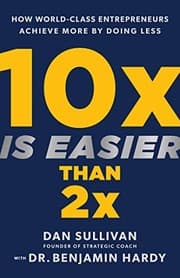
If you don't believe me, read the book by Dr. Benjamin Hardy, 10X Is Easier Than 2X. In that book, he outlines the case for what I have just made, in which he says 10X goals are easier than 2X goals, and the reason is because if you set a 2X goal, say your goal was to write, uh, $100,000 in business in 2025. That's your goal. Well, there's 1,000 ways to do that.
Now make your goal a million dollars in business. You're a salesperson. You're gonna write a million dollars in business. How do you get to a million? There's only one, maybe two ways to get there.
What does that do? It immediately narrows your focus. Someone asks you to do something, "No, that doesn't get me to my 10X goal." "I need you to help me with this project." "I'm sorry, that doesn't get me to my 10X goal."
You wanna wake up every day and have the energy to do the things necessary to hit your 10X goal? You have to manage your energy. You have to be... You can't be hungover. You can't be sleepy.
You can't be tired. You wanna hit that 10X goal? You have to be supremely focused. If you want 2025 to be the best year you've ever had, if you want 2025 to be a year that you get to the end of and you're proud of, that you're sitting around the Thanksgiving table or your, your, your, whatever holiday you celebrate, Hanukkah, Christmas, whatever it is. You're at that New Year's Eve party, and you wanna sit there with a smile on your face, proud of 2025, manage your energy, dial your focus, and set big, hairy, audacious goals, and then go fucking get them.
Why not be a complete badass? Why not be a complete badass? Why have a dad bod? Why, why be someone who spends hours scrolling social media? Why be someone who is always told what they have to do instead of the one who gets to choose what they wanna do?
I can't think of a better definition of hell than standing next to St. Peter, looking at the version of myself that I was supposed to be, and realizing that I didn't go 100% for it. Guys, I'm gonna get it in 2025, and I hope you're along for the ride, because 2025 is gonna be a wild year. And I know there's gonna be setbacks, and I know there's gonna be challenges, I know there's gonna be obstacles, and I know there's gonna be stuff that happens that I wish didn't happen, but I'm gonna fucking plow through those things, because I don't want another 2024. I let a lot of doubt and fear, frustration leak into my life, and those are things that I gotta deal with, but what it did was wake me up to who I could be, to what I wanna be, and the things I need to do to get there.
I love you for listening to this show. Guys, if there's anything I can do, reach out, ryan@findingpeak.com. Send me an email, DM me, LinkedIn, Instagram. I'm always here for you. I'm gonna be sharing my journey.
I'm gonna be sharing the things that I do, the things that I learn, as well as growing Linkora, as well as gr- growing Finding Peak on those channels. And if you wanna be part of those journeys, please follow along, reach out. I am always here to help. I love you. I'm outta here.
Peace. Happy holidays. Wanna give your host a gift? Consider subscribing, rating, and reviewing the show this holiday season. It really helps the show grow.
From all of us at Believe, have a merry Christmas, everyone, and a happy holiday. If you liked the show, please take a moment to rate, review, and subscribe. It really does help the show to grow. Thank you for listening.