The McDonald's Snack Wrap is back. You brought it back. Ranch Snack Wrap. Spicy Snack Wrap. You broke the internet for a snack.
Snack Wrap is back. Ba-da-ba-ba-ba. With Venmo Stash, a taco on one hand and ordering a ride in the other means you're stacking cash back. With Venmo Stash, get up to 5% cash back when you pick a bundle of your favorite brands. Earn more cash when you do more with Stash.
Venmo Stash terms and exclusions apply. Max $100 cash back per month. See terms at venmo.me slash stashterms. Got a jam-packed gift list this year? Let Half Price Books help take the pressure off.
Our shelves are full of great gifts that'll have you checking that list off in no time. Games, toys, comics? Check. Gifts for record collectors? Check.
We even have gifts for regular collectors. Head to your local Half Price Books or search millions of items online. And while you're there, you might as well pick up a gift for yourself. You know, for all the hard work. Find a store near you or shop online at hpb.com.
In a crude laboratory in the basement of his home. Hello and welcome back to the show. Today we have what I hope will be an incredible episode because it's going to be a solo episode so I never know what is going to come spewing out of my face when I do these episodes. Obviously I have a plan but, you know, we're kind of letting it fly when we do solo episodes and I hope you enjoy it. That being said, this is going to kind of be a little more of a fluffier conceptual episode.
So if you're into something super hyper tactical, you're looking for like meat and potatoes, nuts and bolts kind of stuff, then I'd actually encourage you to jump over to findingpeak.com. That is the new community that I created where I am sharing, you know, basically my process, my thoughts, the things that I'm researching, what I've done, what I've learned over the years and creating peak performance in business, in my life, which, you know, works and doesn't work sometimes. And ultimately what I'm doing at rogue risk in the insurance industry. So if you're looking for that hyper tactical stuff, go to Finding Peak, subscribe, there's a free version, there's also some really deep dives into some content marketing and inbound lead generation stuff that you can pay for if you like. Incredible community, we have over 1,200 people that are now subscribed to Finding Peak in less than a month.
We launched it first week of November and we're not even to December yet, so that's pretty fun. So if you want all that, go to Finding Peak. Also want to give a huge shout out to my friends, my colleagues over at SIAA. Guys, you know, a lot of people actually have asked me since I joined SIA, like, what, you know, what has it been like? What's it like?
Well, first and foremost, I can tell you that Matt Masiello, the CEO of SIA, who purchased SIA in conjunction with a few other entities, purchased out his father in a previous ownership group, and the way that Matt handles himself, the way that he leads this organization, the way that he is driving growth, it's a new SIA. And, you know, you never know what to expect. I like the people. Obviously, I had a tremendous amount of respect for Matt. Many of the people that I respect have respect for Matt, and that was why I initially engaged and then getting to know the people and then ultimately making the decision to move forward with the acquisition of Rogue.
You never know what you're going to get, right? And I've talked about this before, but they have been nothing but absolutely tremendous. And I know there's 5,000 plus agencies in the network, and everyone's experience is slightly different. And if you do Google searches on SIA, you're going to find great comments, and you're going to find negative comments and all that kind of stuff. And that's just the nature of a large, you know, kind of enterprise-level, best-in-class organization like SIA.
But I will tell you, if you're looking to optimize the revenue of your agency, if you're looking for growth, if you're looking to get into a community with people who are driving forward, where massive change is happening, then I would highly consider SIA. I mean, I know you're going to say, well, Ryan, these guys own you, so obviously you're biased. And, you know, some of that is true. I mean, I work for SIA essentially now, so there is some of, like, these are the people that pay my bills. But at the same time, like, they don't ask me to do this.
I've told you guys this many times, like, SIA does not own this podcast. Like, this is mine still. And I can do whatever the heck I want with it. And I'm choosing to use this time to share that if you are considering a network, and there are many great networks out there. SIA is not the only great network, and SIA is not for everyone.
So I don't want it to be like that. I mean, there are some really tremendous networks, both small and large, that might be a better fit. But what I would like to just put in your ear is if you're looking to maximize the revenue of your agency, if you're looking to be part of a larger ecosystem with an incredible supportive network that has made major changes in both the way they handle their contracts, the way they handle their members, their master agencies, the way they deal with carrier partners and vendor partners, and get in at a time where growth, where technological innovation, where education are becoming major priorities, then I think you at least should give SIA a chance. And the best way to do that is to go to SIA.com. So with that, guys, I love you for listening to this podcast.
I love you for being part of this community. I do this podcast because I just like sharing with you. Like, I think if you're taking the time to give me your ear space, then that's a wonderful gift that I do not take lightly. And I've said this to you a thousand times and hopefully I'll send it to you a thousand times more. I love you for listening to this podcast.
So with that, we're going to put a transitional moment in here and get over to what I wanted to talk about, which is inspiration in a conversation that I had yesterday. So you're listening to this. Know that very recently from whenever you're listening to this, I had another episode queued up for this week, the week that this episode is being published. I had another episode of the podcast scheduled to be published, and I bumped it for this particular topic, which came out of a conversation that I had with Chris Paradiso. So Chris and I, just because we're both very busy with everything he's got going on, everything I have going on, and life, and the holidays, and all that kind of stuff, we haven't caught up in a while.
And we had a chance to. We talked for a while, and it was awesome because Chris is a tremendous guy, and he's always got very interesting and probing questions that force you to think, and it's wonderful to have him as a friend and a mentor and as someone that I can reach out to and have these conversations with. And he brought up an idea that I wholly agreed with, which was he said, and to be honest with you, I can't even remember the context in which this vein of the conversation came up, but once it did, I had a hard time getting off of it. And it was this idea that the concept or the quote or whatever, which you can find all over the internet, if you search for this term, you're going to see thousands and thousands of articles that have been written on the idea of get comfortable with being uncomfortable. And what Chris's comment was, I hate the idea of getting comfortable being uncomfortable because there is nothing comfortable about being uncomfortable.
And if you, you know, the idea of the concept obviously has merit, right? Like put yourself in uncomfortable situations and accept them and all that kind of stuff. But the term being comfortable with being uncomfortable is, it's a fallacy. It's a misguided goal. It's going to lead you down a path ultimately to the type of failure that isn't productive.
It's going to lead you, in my impression, it's going to, you know, I believe, it's going to lead you to failure and to quitting. Not the kind of failure that you learn from, but the failure for when something that you really wanted doesn't actually happen and isn't going to happen. Because if you're hoping that if you go for a run every day for a week or you make a couple cold calls or you do a couple videos or whatever it is that makes you uncomfortable that's holding you back from your goals, right, you take a couple cold showers or you start being honest with your spouse or with your friends or, you know, you take a leadership position or put yourself out in front of an organization for a not-for-profit or whatever that thing is. If you think that you're ever going to become comfortable being uncomfortable, then you are wholly mistaken. One of the things that I am proud of in my life is that I have resisted pure, you know, being purely comfortable for most of my life.
I tend to need and seek out uncomfortable moments, situations, activities, things that hurt or are hard or make me question what I'm doing, make me, you know, create negative feedback or criticism or just criticism in general, not necessarily negative. You know, these types of moments, they're incredibly uncomfortable and they're always uncomfortable. If you're chasing the concept that somehow you're going to, like, wake up one day and be like, oh, cold showers are, like, super easy or, hey, cold calling. I'm like, this is easy. I love being rejected.
That's amazing. That's bullshit. That's complete and utter bullshit. When people say that stuff, they're selling you something, right? Cold showers suck every single time you get in them forever.
I did cold showers for two and a half years. I haven't been doing them for the last year or two. And, you know, that's me failing at that particular activity. But when I start doing them again, which I want to, they're never going to be comfortable. They're purposefully uncomfortable, right?
Joe Rogan, I don't know if you guys like or dislike Joe Rogan. I love Joe Rogan. I think that he's a national treasure and believe him to be one of the great people and thinkers of our time, for sure. As much as to some of you, that might sound weird. He posts images of himself and or the thermometer in the sauna that he has in his podcast studio.
And he'll have it cranked up to 190, 200, 220 degrees at times. And what he'll say, and I'm looking at one of his Instagram posts that he put up, is basically he does this not for the first 20 minutes, but for the last 10 minutes, saying he sits in there for a half hour when he does it. The last 10 minutes, every time, are incredibly uncomfortable. No matter how often he's, you know, no matter how well he has his breathing and rhythm or, you know, how hydrated he is or how mentally prepared he is or whatever, the last 10 minutes suck. They're just terrible.
And the breathing is difficult. And it's painful. And he's sweating. And he wants to end it. And he, you know, he even says he stares at the door and all he wants to do is open it and end the sucking, right?
End the awfulness. But the point is that it's awful. That's the point. The point is that it is uncomfortable sitting in a sauna at 200 degrees for 30 minutes. It's incredibly difficult to do that.
And most people won't do it because it feels like you're cooking yourself because that's essentially what you're doing. You're cooking your body like a turkey or, you know, whatever, a roast in the oven. You're cooking yourself. And it's tough. And it's the uncomfortableness that makes it a worthy activity because our lives today are so set up for comfort, right?
We want things to be easy and automated. Just Google automation in our industry. Everyone wants everything to be automated. Automated this. Automate, automate, automate.
Easy, easy, easy. Well, it's like if we just keep automating, then what separates us? Your ability to automate, I guess? I mean, it's not really that hard to automate a business. It's really not.
It just removes all the personality, authenticity, creativity. It removes all the depth. It removes all the soul of your business. I mean, I wrote a book, Content Warfare, back in 2015. And one of the chapters in that book and one of the concepts that I'm the most proud of is this idea of digitizing the soul of your business, right?
When we go online, we're not trying to replace our business. We're not trying to reinvent our business. We're trying to digitize the soul of our business. And when we seek out comfort, right? When we seek out comfort, then all we're doing is we're diminishing.
We're diminishing that soul. We're making it less than. We're making it softer and we're giving the edges a fuzziness because it's easy. It's easy and it's comfortable and it feels good and it doesn't force us to think hard. It doesn't force us to make tough decisions.
No one's going to question us for making easy, comfortable decisions. And we can go about our day in this, you know, kind of drugged up haze of comfortability that somehow we've got it all figured out. And then something shitty happens and being comfortable doesn't work anymore. What's up, guys? Sorry to take you away from the episode.
But as you know, we do not run ads on this show. And in exchange for that, I need your help. If you're loving this episode, if you enjoy this podcast, whether you're watching on YouTube or you're listening on your favorite podcast platform, I would love for you to subscribe, share, comment if you're on YouTube, leave a rating review if you're on Spotify or Apple iTunes, et cetera. This helps the show grow. It helps me bring more guests in.
We have a tremendous lineup of people coming in, men and women who've done incredible things, sharing their stories around peak performance, leadership, growth, sales. The things that are going to help you grow as a person and grow your business, but they all check out comments, ratings, reviews. They check out all this information before they come on. So as I reach out to more and more people and want to bring them in and share their stories with you, I need your help. Share the show.
Subscribe if you're not subscribed. And I'd love for you to leave a comment about the show because I read all the comments or if you're on Apple or Spotify, leave a rating review of this show. I love you for listening to this show and I hope you enjoy it listening as much as I do creating the show for you. All right. I'm out of here.
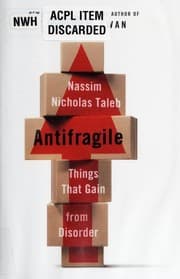
Peace. Let's get back to the episode. And, you know, I'm reading this book and it was funny that a lot of this came, Chris has just finished the book as well. It's called Anti-Fragile by Nassim Nicholas Taleb. It is by far one of the best books I've read in my entire life and I've read quite a few books.
It is a very heady, deep, long read. It has literally taken me months to read this book. I've put it down and come back to it. The concepts are intense. He uses words and turns of phrase that are sometimes difficult to follow. at face value.
You have to think about them. The thing is dog-eared and I have notes in it and underlines and circles and red ink and blue ink and all kinds of different stuff and it's essentially become like a textbook in the way that I've kind of marked it up and at its core is this idea of being anti-fragile. So what Taleb basically describes is what he calls the triad, right? It's the three kind of phases or three outcomes, three stages that we could potentially be in. We can be fragile, we can be robust, or we can be anti-fragile.
And the defining characteristic of fragile versus anti-fragile is that fragile has limited upside and infinite downside. Anti-fragile has limited downside and infinite upside, particularly when bad things happen, right? So the idea here is how do you create a life that allows you to be anti-fragile? And the idea is not to become comfortable with uncomfortable things, but be able to sustain through uncomfortable things. To know that it's going to be uncomfortable, that it's going to suck, that it's going to be painful, that you're going to hate it the entire time that you're doing something, but that you're going to persist and survive.
That is the goal of being anti-fragile. That is the goal that I think we should strive for in our life. It's what I'm working towards, you know, be honest with you, with everything that happened in my life this year, with my divorce, with dealing with that, I fell apart at certain times and at very dark moments. And I'd like to believe that the work that I've done in peak performance in previous iterations of my life, the work that I did in dealing with all the inflammation that I had in my body for so long, and you can go back and read some of those articles. I'm happy to share them with you if you're interested.
You can find some of them at ryanhanley.com, or if you just search my name and anti-inflammatory diet or whatever, you can find that stuff on the internet. You know, this work, this taking cold showers, the deadlifting, the working out, you know, for no reason, you know, it was funny, Chris even said, he goes, look at how much you work out, and I work out, and like, what are we trying, like, we're not going to be like beach body guys, it's not like we're going to spring break and showing off our muscles, like, why would we do this? It doesn't make any sense. And the idea is, I want to know that when shitty things happen, that when bad stuff happens, and I'm, you know, it could be complete and utter catastrophe and apocalypse, which would be horrible, or it could just be something acute and awful that happens in business, a big deal falls apart, a key employee leaves, your boss or your partner gets up in your ass because you're not performing, or you're, whatever, your spouse kicks you out of the house, or your kids are having a really tough time, or, you know, someone starts messing with you for no reason, or hating you on the internet, or, or, or deceiving you, or, or a partner creates a bad deal, or something really bad happened does, something really bad in the world does happen, right?
Like, to be able to persist and survive, and not be comfortable with the uncomfortable, but be able to drive through it, because if you're, because, because this is the concept, the concept is, when you've made 50 cold calls, and every single one of those have told you no, and you feel like shit, and it's awful, and you're grinding, and every part of your body is telling you to stop because you suck at it, and people hate you, and your offer isn't good enough, and your pitch isn't good enough, and your intro isn't good enough, and you keep making those calls, that's how you win. That's not, you're not going to get comfortable with that, every time you do it, it's going to suck, it's going to be terrible, it's going to be awful, and your skin's going to crawl, and you're going to hurt, and your head's going to hurt, and you're going to get headaches, and you're going to get anxiety, and, you know, you're going to get heart palpitations, and your blood pressure's going to spike, and you're all this, and you're going to be, just feel terrible, but you're going to get through it. Not because you're comfortable being uncomfortable, but because you're willing to persist being uncomfortable.
You're anti-fragile. You're willing to push through and create upside when everyone else is experiencing downside. You're willing to think out into the future and create situations of what Taleb calls optionality. I'm not going to go into that concept today. I would encourage you to get the book or just Google it.
I'm sure there's, like, excerpts. But optionality gives you the ability to have limited or known downside with infinite or max upside. And the more optionality we can create in our life, the more ability we have to persist through the uncomfortable and be the most, the biggest, baddest versions of ourselves. We have the ability to continue to outlast our competition. Because when they're hunkering down, when they're letting people go, when they're consolidating their resources, when they're licking their wounds, you don't give a shit.
You're bleeding, and you're beat up, and you're bruised, and you're miserable, and you hate your situation, and you hate what's happening. But you're going to keep freaking going. Not because you're comfortable, but because that's what it takes to be successful. And not everyone is going to be able to walk this path. And most people will not.
Most of you listening to this have probably already shut it off. You're like, ah, this fluffy bullshit, whatever. I don't care. Right? Or Hanley doesn't know what he's talking about.
What the hell does he know? And that might be true. All of that might be true. But I believe what I believe. And I've experienced life in a lot of different ways.
You know, a lot of shitty things. Just like everybody. Just like everybody. A lot of shitty things have happened to me. And I'm as proud of who I am today as I have ever been.
I'm not the fullest, most badass version of myself I could ever be. But I'm working towards that. And I'm trying to put myself in more uncomfortable situations. I'm trying to be more honest with people every day. I tend to hide my feelings.
I tend to repress my feelings because I don't like to hurt people. I don't like to create conflict. My natural mechanism is to avoid conflict as much as some of my previous bosses may not necessarily agree with that. I don't like conflict. I tend to avoid it.
I tend to be a people pleaser. I tend to, you know, get overwhelmed and stressed. And as much as I'm kind of like an omnivert, I can be very extroverted. But I also tend to need to back in and kind of recoup my energy. And that ying and yang is often sometimes hard to manage.
And I wake up some days and all I want to do is screw off and not do the work that I know I need to do. And then other days I can't stop working. And, you know, I've kind of recently accepted that I probably have like some ADHD stuff, which is fine. You know, whatever. I mean, it is what it is.
Frankly, I consider it more of a superpower. But accepting it has helped me deal with some of the times when I get frustrated people that they can't follow the way my brain works. And I've had to kind of realize that some of that is just my brain works differently than some other people. And it's not fair to think that someone can follow the way I'm thinking, you know, because I struggle to follow the way they're thinking. And that has created a lot of conflict in my life.
And I'm trying to deal with that. And, you know, all of this is uncomfortable and hard and to keep up with the podcast and to get everything I need to do with Rogue and to be with and to do the things I need to do for my children. And, you know, I'm seeing this woman and, you know, I'm trying to be the best version of myself that I can be for her and not make the same mistakes that I made with my spouse, which obviously were mistakes that cost me that relationship. And, you know, it just is it's it's it's an uncomfortable world. And I hope my hope for you looking looking out into 2023 is we think through all these things, right?
There's all these things that we're that we have to think that we start planning and we start, you know, creating goals and all that. And I guess I guess my hope for you is that you will not seek comfort in 2023 or even try to be comfortable being uncomfortable. That you will just embrace the shitty suck that is doing the uncomfortable things that make us fucking awesome. That's my hope for you. I love you for listening to this podcast.
If you enjoyed it, I hope you'll share it. I hope you tell a friend about it. I really hope that you'll subscribe to Finding Pete because I feel like I'm starting to do good work there. Still shaking out some of the cobwebs from not creating as much. But it feels really good to have fingers back on keyboard.
And as always, my friends, I hope you absolutely dominate. I love you for listening to this podcast. I'm out of here. Peace. Peace.
Close twice as many deals by this time next week. Sound impossible? It's not. With the one call close system, you'll stop chasing leads and start closing deals. In one call.
This is the exact method we use to close 1,200 clients in under three years during the pandemic. No fluff. No endless follow-ups. Just results fast. Based in behavioral psychology and battle tested, the one call close system eliminates excuses and gets the prospect saying yes.
More than you ever thought possible. If you're ready to stop losing opportunities and start winning, visit masteroftheclosed.com. That's masteroftheclosed.com. Do it today. I'm out of here.
Hear that? That's me in Tokyo learning to make sushi from a master. How did I get here? I invested wisely. Now the only thing I worry about is using too much wasabi.
Get where you're going with SPY, the world's most traded ETF. Getting there starts here with State Street Investment Management. Before investing, consider the fund's investment objectives, risks, charges, and expenses. Visit statestreet.com slash IM for prospectus containing this and other information. Read it carefully.
SPY is subject to risks similar to those of stocks. All ETFs are subject to risk including possible loss of principal. Alps Distributors, Inc. Distributor. The McDonald's Snack Wrap is back.
You brought it back. Ranch Snack Wrap. Spicy Snack Wrap. You broke the internet for a snack. Snack Wrap is back.
Ba-da-ba-ba-ba. At Capella University, learning the right skills could make a difference. That's why our business programs teach you relevant skills you can take from the course room to the workplace. A different future is closer than you think with Capella University. Learn more at capella.edu.
When you walk into a Burlington, you're walking into amazing prices and great gifts. That's main character energy. Because at Burlington, the holiday savings aren't the only things turning heads. Discover quality finds and perfect presents for everyone on your list, even those who are hard to shop for. Toys and jewelry to new beauty brands and styles, these gifts go seamlessly from our stores to under your tree.
Seriously, with these savings, why shop anywhere else? Burlington deals, brands, wow. Did you know that parents rank financial literacy as the number one most difficult life skill to teach? Meet Greenlight, the debit card and money app for families. With Greenlight, you can set up chores, automate allowance, and keep an eye on your kids' spending with real-time notifications.
Kids learn to earn, save, and spend wisely. And parents can rest easy knowing their kids are learning about money with guardrails in place. Sign up for Greenlight today at greenlight.com slash podcast.