You've finally broken loose from work. Three friends, one tee time, and then the text. "Honey, there's water in the basement." Not exactly how you pictured your Saturday. That's when you call us, Cincinnati Insurance.
We always answer the call, because real protection means showing up, even when things are in the rough. Cincinnati Insurance. Let us make your bad day better. Find an agent at cinfin.com. If you're an HVAC technician and a call comes in, Grainger knows that you need a partner that helps you find the right product fast and hassle-free.
And you know that when the first problem of the day is a clanking blower motor, there's no need to break a sweat. With Grainger's easy-to-use website and product details, you're confident you'll soon have everything humming right along. Call 1-800-GRAINGER, click grainger.com, or just stop by. Grainger. For the ones who get it done.
Happy holidays. Want to give your host a gift? Consider subscribing, rating, and reviewing the show this holiday season. It really helps the show grow. From all of us at Believe, have a merry Christmas, everyone, and a happy holiday.
Hello, everyone, and welcome back to the show. Today, we have an extra special episode for you. This is the recording of a keynote I did about two months ago titled How to Become a Finisher: The Secret to Making Better Decisions and Creating Inevitable Outcomes. You've heard me talk on this show quite a bit about frameworks, mental models, mindsets that have allowed me to hit high levels of su- success over and over again, uh, whether it's as an executive or in my own endeavors as an entrepreneur. And it's these frameworks that create guardrails for decisions that lead to consistent positive outcomes.
We're never gonna be 100% with our decisions. However, by using frameworks, by using mental models, we can be more consistent in our positive outcomes, and that's what we're trying to do. That's how we compound success. That's how we hit our goals, and that's how we become finishers. I hope you enjoy this keynote.
And guys, I created a resource. It's a free guide. It's like 40 pages, very detailed, called How to Make Better Decisions Using AI. And if you go to AI, the letters AI.ryanhanley.com. There'll also be a link in the description or the show notes, wherever you're either listening or watching this show.
You can get that resource for free. Just enter your name and email, and you will get that guide. Using AI to make decisions is the future of leadership. It doesn't mean there isn't intuition. It, there doesn't mean our experience and our expertise doesn't play a role.
It means AI has features, has use cases that allow us to create more consistent outcomes and be a true value add and enhancer to our business. This guide breaks it down for you. I hope you enjoy it. I hope you enjoy this episode of the show. I was proud of this keynote.
It is the first time that I've gone fully outside of insurance with a keynote topic, and I was very happy with the outcome. I hope that you enjoy it as well. Love your feedback. Uh, you can go over to YouTube, leave a comment, or just DM me. I'd love to hear what you think about this topic, what you think about the keynote in general.
With that, let's get on to my keynote, How to Become a Finisher. Hello, everyone. In 2017, in 2017, I had the distinct honor with my team and colleagues at Agency Nation and Trusted Choice, and one of which is in the room right now, one of my favorite humans in the entire world, Sydney Rowe. We put on Elevate 2017 in Milwaukee, Wisconsin. Was anyone there?
Who was there? Jeff was there, right? Well, what many people don't know about that conference is that on the second day, there was a closing fireside chat. I was gonna interview a man by the name of Michael Prehm. I had been the emcee for the entire conference.
This was the first time I was gonna come out on stage and actually interact with the crowd in any kind of capacity. And when I stood behind the curtain, I almost passed out. I had to be caught by one of the, our other team members that was behind stage with me. I had to sit down. I was seeing stars, and I was in a really rough place.
I pounded a bottle of water real quick, stood up, looked at Michael Prehm, and said, "I might not make it." We walked out. I sat down, looked at him, and mouthed the words, "You have to take this." And thankfully, he had the capacity and ability. He understood what was going on.
He stood up, and he finished. The audience didn't know the difference. I just sat there, tried to have a smile on my face, and listened to him like that's the way it was supposed to go. But the truth was, I had allowed my mental and physical health to de- deteriorate to the point that I couldn't finish a two-day conference where all I was doing was emceeing. I said-- And, and not that emceeing is easy, but you're out for two, three minutes, and you're back behind the curtain.
There was no reason for me to feel the way that I had felt. And at that time, I weighed two hundred and seventeen pounds. I drank. I ate terrible food. I didn't sleep well.
I didn't nourish myself mentally. I wasn't-- I didn't read. I wasn't going and seeing a counselor. I wasn't doing anything. I was barely getting by physically, but I had convinced myself I'm an athlete 'cause I played sports in college.
I'm fine. I'm in good shape. I'm okay. I'm getting by. But my body shut down.
And it was in that moment ... It wasn't in that moment. I was flying home. I was flying home from that event, and as much as it was an amazing experience that to this day I think back on very fondly, it was a, a profound and, and life-changing experience, I was disappointed in myself. I didn't go home with a big, huge smile like some victor who had just conquered a mountain.
I felt like I had let myself down. In 2017, I was 37 years old. At 37, I should be able to get through two days. And I vowed that that would never happen again. I would never allow myself to be so unprepared for a situation that I couldn't operate at my absolute best regardless of the circumstances.
And I began a journey that I continue on today. I started reading Jordan Peterson. I started listening to different, uh, podcasts, Ed Mylett and others. And I came across a quote by Marcus Aurelius. Now, I know all men are into the Roman Empire, so some of you will have heard this before, right?
Yeah. Can't be a dude and not be into the Roman Empire. That's what the internet tells me. Yeah. But in 2017, I came across this quote.
And there was something about it that just grabbed me. It's wedged in my brain. I come back to this quote all the time. 'Cause we are responsible. We're responsible for, for what we put in our brains, for what we put in our bo- ... We're responsible for these things.
And what ... If, if we want our best out of us, we have to put the best in, and I was not doing that. How could I say I was being the best version of myself for my, for my wife? How could I say I was being the best version of myself for my kids? How was I saying I was being the best version of self for the team me- ...
I had 19 team members on my team at the time. For my audience, for our customers. If I wasn't reading and feeding myself good stuff, if I wasn't putting good fuel in my body, if I wasn't exercising and taking care of myself, if I wasn't surrounding myself with people who are positive. Your soul becomes dyed with the color of its thoughts. It becomes who you are, and I didn't like who I was, and I went on a journey.
And 12 months later, we put on what I believe, no offense to Sue, the single greatest insurance conference in the history of the world of all time, Elevate 2018. We had 817 people. We had 315 people in 2017. We did 817 people a year later. Again, I had an amazing team, but in large part, this was due to a massive energy shift.
Not only was just in general was I able to produce more, work more, and work longer hours, but I also was more positive with my team, more accepting of the challenges that they were facing, able to answer and take questions in a positive way where I would react it. Because I, I had changed what I put in my body and was slowly redying my soul to what I wanted it to be. During that time, I developed a mental framework that I use to this day to make big decisions and to get projects done. The title of this talk is How to Become a Finisher, and what I'm gonna ultimately share with you is what I call the Finish Formula. It is a very simple formula.
We don't use it for every decision we make during our day, but for the big decisions, the big things, those projects that are, that are paramount, that are crucial to our success, that mean something to us, and they don't have to be business-related, this formula is something I come back to over and over and over again. But first we have to address why we make bad decisions in the first place. Now, what is the color that enrages bulls? Like, when bulls get all pissed off, what's the color that they see? Red.
Red, right? Red. Do you know that bulls are colorblind? Right? They're, they're ...
They don't see red. We all said red. Red's in all the shows. They don't see this color. It's a belief that most people have that's intrinsically false.
How much of our brain do we use? It's not a trick question. How much of our brain do we use? 10%. Right?
10%. We are told and have been told for 90 years that we use 10% of our brain. If only we can figure out how to tap into the rest, we'll all be geniuses, and it's just not true. We actually use, in every 24 hours, essentially 100% of our brain. The reason we think we only use 10% of our brain is 'cause of a random misquotation of the original study in a news article in which the author of the news article changed it from, uh, uh, utilization to, uh, capability or from capability to utilization.
So the author was saying, though we use a hundred percent of our brain, we tend to only operate at about 10% of our capability. The author of the news article changed it from that to we only u- we only actually use 10% of our brain, and that single misquotation has created 90 years of misinformation, that we believe ... We, we base entire beliefs on the fact that somehow if we eat this mushroom or we do this s- breathing exercise, that somehow we're gonna tap into more of our brain. There's more of these. We're gonna fly through a couple of them just 'cause they're fun.
Oh, th- wait, I didn't get the ... This clicker sucks. There we go. Boom, there's the 10% one. I'm gonna do this.
I don't know why it's not flipping. Maybe I'm not pointing at the right thing. The laptop. Yeah. There we go.
You cannot see the Gr- cannot see the Great Wall of China from space. Can't do it. We've been told that for how long? Ever. Ever.
Can't see it. Chinese actually sent an astronaut up 'cause they didn't believe us. And he goes, "Yeah, yeah, I can't see it." All the pictures we have of it are from cameras or video cameras that have amplification characteristics. One more.
I am sorry to tell you, and as a major baseball fan who's been to Cooperstown probably three dozen times, Abner Doubleday did not invent baseball. Abner Doubleday did not invent baseball. There's an entire town in Upstate New York that I live about an hour and a half from based on the fact that Abner Doubleday invented baseball. He did not. Abner Doubleday was at West Point during the time, and in 1939 when, or 1839, I'm sorry, when, when baseball was invented by Abner in Cooperstown, he was actually running drills in West Point.
There's not a single article, uh, the, um, travel schedule for West Point, all his journals, all his writings, he was never there. The whole Abner Doubleday story was invented by a guy by the name of Abner Graves, who was a lunatic. Two convicted murders, ended his life in an insane asylum. He wrote one letter, which was complete fiction, that Abner Doubleday invented baseball, and no one gave two craps about it until 1910 when Robert Spalding, who had ultimately founded the Spalding Athletic Company, wanted to a national pastime and needed someone to build around, and he took this one singular letter, invented the Abner Doubleday myth, and now we all go to Doubleday Field in Cooperstown. My, my point in sharing this with you guys is that we operate on a day-to-day basis through beliefs, through information that we don't, we don't ever confirm, right?
We let our emotions guide us. We wanna believe that Abner Doubleday invented baseball. I wanna believe it. I've, I've played on Doubleday Field three times. I'm actually, like, I have, like, about .600 average, a home run, and a couple doubles, so I'm doing all right there.
But, but it's not true. My pitch to you today is we have to remove belief, we have to remove emotions and feelings from our decision-making process, and instead replace that with a series of frameworks that we work our major decisions through, not, not moment to moment, but our major decisions through, in order to more often be successful and consistently successful in our decision-making over a longer period of time. There's some reasons why we hold these biases. Anchoring. How many of you have ever negotiated on something?
Right? If you're buying, offer low. If you're selling, anchor high. Because whoever gets the first offer in, we then negotiate from that number. Anchoring.
So whatever your first thought is, it is very, very difficult for you to move too far from that original thought, right? Status quo bias. Essentially, this is what our entire industry is based on, right? We don't like to change. Survivorship bias.
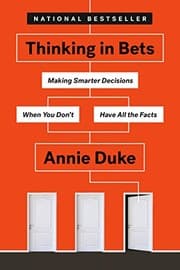
We will take one individual case in which something was successful, and despite all the exceptions in that particular case, we will play that out as an absolute and something that should be duplicated. Base rate neglect is a terrible series of words in order, but essentially it means there is a entire, uh, uh, database of information that we choose to neglect in exchange for one data point that we actually agree with. Cognitive dissonance, we can't hold two competing ideas at the same time. Just look at our entire political system. And ultimately, the most insidious of all these is hindsight bias, which Annie Duke, who's a professional poker player, more than $5 million in winnings in her career, she wrote an awesome book called Thinking in Bets.
Assuming that decision-making is good or bad based on a small set of outcomes, seemingly one, is a pretty reasonable strategy for learning chess. And what she means by that is a linear game. As soon as you put uncertainty into the equation, business, life, relationships, in this case poker, as soon as uncertainty is added to the equation, we cannot take one singular outcome and decide whether it was a good decision or not. Think about your first marriage. Right?
Good decision? However, it doesn't mean you shouldn't get married again. It just means maybe we should reevaluate the way we pick the other human we decide to spend our life with. Because if you use the same structure for making the decision on the second w- person as you did the first one, you will probably have a third. Now understand hindsight bias.
Okay, what is a better way? Frameworks, filters, and ultimately we're gonna get to finishing. Uh, Charlie Munger, great decision-maker, one of the best, uh, investors of all time, used frameworks and mental models to make all of his decisions. Why so many people were able to criticize him while he sat around and did nothing, yet consistently made some of the best bets on stocks and on companies in the, of any investor in the history of the world, is 'cause he did not make emotional or belief-based bets. Charlie Munger had a series of models that were his, and he applied them to situations, and if the situation came out no, the answer was no, no matter how he felt about the CEO, no matter how he felt about the industry.
A good example of this is crypto. Berkshire Hathaway has not invested in any form of crypto, certainly not up unti- until Charlie died in November. Wasn't 'cause they weren't interested in it, wasn't because they didn't think there c- wasn't potential. But the models that they use that had made them consistently successful for over sixty years in investing, it didn't fit. So they were able to emotionally remove themself from the idea of chasing easy profits and continue on.
And I think they have, like, a hundred and eighty-seven billion in cash as of their last report, so they're doing all right, right? If it's good enough for Charlie Munger, should be good enough for us schmucks. Okay. Uh, other frameworks, these are some commonly ones that you know. We're gonna fly through these.
Eighty-twenty rule, right? We all know this one. None of us practice it, although we all love to talk about it at, when we're having drinks after conferences. Your twen- your top twenty percent of your customers, uh, make eighty percent of your revenue, and this applies almost to every aspect of your life. Occam's razor.
If we're given two solutions, the simplest solution will more often than not produce better results. More often than not. We're never gonna get every decision right, no matter how many f- no matter what frameworks we use. But the idea here is, what I want you to take away from this is that if we remove emotion, belief, and ideas that we haven't verified from our decision-making process, we can set ourselves up to make more better decisions that will consistently produce positive outcomes over the long term. At any given moment, in any situation that has uncertainty, we can potentially win.
Think of all those people who are pulling the h- slot machine handle, right? They have one data point. One time, I won once, and therefore, pulling a handle is gonna make me money and I'm gonna keep doing it, right? Removing the entertainment value from the thing. Opportunity costs.
Do you weigh both the positive and negative ramifications of saying yes and the positive and negative ramifications of saying no to this decision and weighing them out in, in a math equation? Or do you just go, "You know, my favorite insurance nerd likes this new CRM, so I think I'm gonna drop everything we're doing and buy that one," 'cause it feels good, right? It feels like we're doing something. Did you do an opportunity cost analysis? Is it more or less complex to switch CRMs?
No. You're like, "He's cool. She's awesome. They're both on that CRM. That means I'm a dork.
I need to get on that one." That's what we do, and then we chase the shiny object, and then our staff hates us, and we spend more money, and we never actually use it because we're using emotions, beliefs, and unverified ideas to make a decision instead of just applying a framework to it. And if the framework says yes and you wanna do it, great, because now you worked through something that removed all the emotion and belief from it. So before twenty seventeen, before Elevate, before that moment, I operated most of my life with a, just a general sense of dissatisfaction. I probably couldn't have put my finger on it at the time.
I thought I was doing good stuff. I had good friends. I enjoyed being a dad. But I never felt like I was, like, a hundred percent me. I never felt like I was everything that I could possibly be, that I was...
I wasn't, like, not that I wasn't proud of myself, but I knew I could be more, and I couldn't figure out what it was going on inside of me that didn't allow me to get there. Maybe I didn't want it enough. You know, maybe it's 'cause my dad's an alcoholic, right? Like, we all have stuff. You have your stuff.
I have my stuff. For thirty-seven years of my life, I used my stuff to be eighty percent of what I could be. And this is what it was. This was the easiest list to make out of my, all these slides. A general sense of discontentment.
You just never feel a hundred percent happy. I'm just dissatisfied. Like, even on my wins, I'd be like, "Yeah, but..." Right? You ever get, like, a good win and then throw a "yeah, but" in there?
And you're like, "Why did I do that? I just had a win. Where'd that 'yeah, but' come from?" Just fast to get frustrated. "Why didn't that go my way?
What's wrong with me? When's it my turn?" And I had to take a really hard look at myself. Right? I don't like these things.
I don't want this. This is terrible. And then I had a friend throw out the idea of silent suffocation. And, and, and, and actually, this friend is, is also a mentor and, and he said to me something that has changed my life, and use this, don't use it, but it's, it's what's worked for me. He said, "Go find a counselor, man, woman, doesn't matter."
Mine's a woman. "Meet, meet with that person every other week for the rest of your life and just consider it a life expense. Whether you're doing great, whether the world's on fire, whether you're happy, sad, or anywhere in the middle, just show up at the thing and talk." And what I found myself after a few months, right, I was really struggling with this. What I found myself explaining was this idea where I was like, "I, I feel like I get, I get my head above water for a minute, and then all of a sudden I'm back under.
I don't know how to stay above water. I don't know how to stay to, to, to, to swim on top of the water. I keep coming down in it. And, and then I, then I work my way back up, and then all of a sudden I'm back underwater again. And I hate it 'cause I'm constantly working, and I don't want that.
I wanna get ahead, right? I wanna be on a yacht." Right? I wanna be doing one of those dives off the yacht that you see all the rich people do from the second story. That looks amazing, and I wanna do that someday.
But I can't do that when I'm trying to get air, you know, 'cause I can barely keep my head above water. And she said to me, "You're making decisions with your emotions, feelings, and beliefs, and they're lying to you." 'Cause we are not our emotions. We're not. Our emotions are data points trying to keep us alive in this exact minute. That's it.
That's all they are. They're chemical reactions happening in your brain that are trying to keep you alive right this second. They don't care about five minutes from now. They don't care about a year from now. Yet we operate like this...
Like they're a guiding path. They are not your friends. They're data points. It's important to understand what they're saying to you, but we can't make decisions on our emotions. And when I learned this lesson through a lot of fricking work, although you're getting all of that for free today, so you're very lucky.
She charges me sixty-five dollars for this. Um- When I started to let that sink into me and really grab onto it and started to listen, started to listen to those emotions and what they were actually telling me and how misaligned they were from what I actually wanted, right? You worked out yesterday. You don't need to work out today. No one's gonna know if you show up to work a little late.
Send that email tomorrow. You can just, on the plane ride you can fix that thing before your talk or your presentation. Because there's a Netflix series that your buddy told you was awesome, and man, it would be really cool to talk to him about that series. Yet none of those things are getting me where I wanna be. When I'm alone, I know exactly who I wanna be, and then I let myself get talked out of it.
How we get there is by applying frameworks, filters, and mental models that will consistently help us make better decisions over the long term. And when done, as we see on the quote here from Naval Ravikant, those good decisions start to compound over time. Each good decision compounds on the next one and the next one and the next one, and all of a sudden we wake up and a year later we've lost twenty-seven pounds. I'm as mentally clear as I've ever been in my life. I can operate for days.
And, and we pulled off the greatest insurance conference in the history of the world. Ever. It's the best one ever. Never one like it and there never will be. I'm very biased 'cause I put it on with a bunch of my friends.
But I have the microphone, so I can say whatever the fuck I want. Um- The truth is the difference was night and day. Not just in my energy, not just in my physical appearance, but in my attitude. I was happy. I was doing something that I, that I was finally able to love.
I lo- I loved, I loved it supposedly in twenty seventeen, although I felt dissatisfied, discontent, like I was underachieving. Doing the same exact thing a year later and just everything about it was amazing. I was getting-- I was allowing myself to experience all the feelings because for that year, I didn't live my life on my emotions or my feelings or my beliefs or unverified information. I set a series of frameworks with the help of my counselor, and I just went off the frameworks. And you know what the framework said?
"Go to the fucking gym. I know you don't want to. I know you don't like the gym. But you know what? You wanna be-- You want your brain to work better?
You wanna be happier? You wanna stop being depressed? Use your body." Can't get around it. Doesn't mean you be an athlete.
Doesn't need to be, need to be Adonis. You don't have to be in swimsuit models or swimsuit magazines. Just move your body even when you don't want to. Right? We all talk about cold calling.
No one likes to cold call. Cold calling is the worst. What do you do? Just make the calls. Same thing goes for everything in our life.
Apply the filters, frameworks, and models that get you to the result that you want, and be relentless in your commitment to those models. And what'll happen is, over time, the results compound and compound and compound, and we find ourselves in a place we never thought we could get to. A hundred percent of who we are. Imagine, I get chills just saying that. I don't know that I'm there right now.
But man, I've felt it for moments. I have. It feels very fucking good. 100%. You are operating at your current max capacity.
You are satisfied in who you are. You are achieving results. You are able to, to work through obstacles. People enjoy being around you. You got a big ass smile on your face, and you are awesome at sex.
100% of who you are. Right, who doesn't wanna be awesome at sex? Um, all right, sorry, I like sex jokes. So what, um... The mistake that I was making was actually quite small, and I worked with, again, worked with my counselor on this particular, putting this all together.
But the mistake I had been making unbeknownst to me was I valued these three pieces of information the most. I wanted to be prepared. I wanted to know, know the stuff, have the right connections, be in the right place. I wanted to be able to work at a pace, meaning have an ability, have the energy, and I knew I was willing to put in the hours. And when you think about how prepared you are, the pace you can work at, and the number of hours you're willing to put in, you get your max growth capacity.
And every single one of you can do that equation, and most likely does that equation with most things. And somehow we still don't get exactly where we wanna be. Even if we do, we don't go as far as we're capable of. And the reason is we forget the denominator, and that is what I have been doing for the first thir- 37 years of my life. If we do not consider the distractions, then the growth doesn't mean anything 'cause every distraction cuts into that max growth.
Every single distraction. Wake up hungover with foggy brain because you can't not have that drink the night before. Growth potential comes down a little bit. Have to watch Netflix every night for some reason. That comes down.
Refuse to time block, take every meeting, don't outsource, refuse to use virtual assistants, still feel like even though you're the owner or the top level producer that you need to do the, the $5 an hour work because that's who you are. You are limiting your upside. You are not 100% of yourself. We all remo- forget to remove the distractions. So distractions for me were I felt I needed to have a beer or two every night, just for whatever reason.
You know, wind down. I got ADD. My brain's going on high level, you know? I gotta wind down. I need to have a beer or two every night, right?
That's 360 calories that my body does not need. Alcohol also slows your metabolism. So not only are you putting extra calories in your body that it doesn't need, your metabolism, what actually burns all the stuff that was already in there, slows down. Also, regardless of what you think, and alcohol's impact on your ability to fall asleep, you sleep like shit when you've had alcohol in your system, and I have tracked it multiple times using multiple different devices. You are not special or unique.
If you have a drink, you sleep worse, and you have less energy when you wake up in the morning. It's just the way it... I'm not saying you shouldn't drink. I love drinking, guys, just, just so you know. Just...
We just need to make decisions on actual information. But that was a distraction for me, right? Instead of, instead of doing an extra hours worth of work or reading or spending time with my children, God forbid, or just going to bed earlier, I felt the need to sit up on the couch by myse- by myself. That was a distraction. I had to cut that out of my life.
If being the best version of myself was a priority for, for Elevate 2018, I had to cut that out of my life. And I didn't stop drinking altogether. I made a rule. I get one night a week. That was my rule.
I get one night a week. That's fine, right? That's reasonable. I stopped watching bullshit TV. I watched a few sporting events and otherwise during the time when I normally would distract myself with the television, I read.
I read books. I read a lot of books. That's what I chose to do. And so on and so on, I started a- attacking every aspect of my life and saying, "What are the necessary distractions that I need to move?" Now, we're never gonna get rid of all of them.
I wanted to hang out with my children. Compared to my goal of being the best version of myself for Elevate 2018, spending three hours on the floor with my kids is probably could be considered a distraction. But I wanted to do that. That was a-- I was willing to take slightly less growth in that area for that distraction. My point is not that you live some sort of caveman or like, what do they call it now?
Like monk mode. Isn't that what all the kids are saying? Who's under 35 here? You understand that language. Monk mode.
Am I saying that right? Broheim over there knows. Yeah, he knows. He's, he, he confirms. He...
Um, so I, I'm not advocating for a particular lifestyle 'cause frankly, you know what you want more than I do. What I wanna give you is a tool that you can use to pass the decisions that you make in your life through if a certain goal is important to you. But if you're not using some sort of framework to get to your goal, then it's all just bullshit. That's what your goal is, is bullshit. It's pandering and it's posturing.
It's your ego going, "I'm gonna write two hundred and fifty thousand in new business next month." And then you don't do any of the shit that you need to do to actually get there. You still futz around in the morning for an hour. You stand at the coffee thing and ask Tina about her day and Tommy about his kids and whatever, instead of getting to freaking work. Or whatever your goal is.
Your goal could be, "Work's amazing. I wanna be a better spouse." Okay, let's work through this. Are you prepared? Do you understand who...
You know, I'm a guy, so I'll talk-- Do you understand who your wife is? Like, what's important to her? What she really values? The life she wants to live. Do you understand h- how she wants to evolve as a human?
When's the last time you fucking talked to her, right? Do you have the ability, the attention span, willingness to be present in the moment with her so that she feels like you're actually fucking listening to her? And then are you willing to put in the time, take her out to dinner? Or, God forbid, you go grocery shopping or something together, like, that's just, like, regular. Spend a little time, if that's your goal, and then remove the distractions.
Guess what you don't get to do? Desk scroll when she's talking to you. You don't get to go golfing four times that week. You don't get to check out when you get home and go into the garage and don't talk to anybody. If that's your goal, right?
Are you prepared? Do you have the ability? Are you willing to put in the time? And can you remove the distractions? That is how you get shit done.
But it's a framework. There's no emotion in there. Your decisions are your decisions. I'm not telling you how to-- that you would-- how you need to feel or what you should believe. If a goal is important to you, this simple formula will get you there if you're willing to stick to it.
And this could be a short-term goal, long-term goal, et cetera. Here's the other part about frameworks. You can reevaluate them at any time, right? Beliefs, beliefs are different. Beliefs are tough, right?
You believe something. The, eh, doesn't really change. "I believe this." If you make a decision based on a belief and it's-- and, and, and then you have to change it, that means your belief was wrong. That means you're wrong, right?
No one likes that. I don't wanna feel wrong. But if you're using a framework, you could be a month into a project and just reevaluate what's going on. "Hey, you know what? Doing pretty good, but there's this one distraction I haven't removed yet."
Or, "Hey, our goal has changed slightly, and we need to do a little more preparation in this area so that we can, we can get more done on the top end. Maybe we need to hire somebody, or I need to go get a particular training." With a framework, we can constantly reapply the formula to what we're doing and adjust course as needed to get to where we wanna be. But if we're, if, if we're basing it on emotions, emotions are crazy, right? I thought emotions are bad when we're young.
As we get older, our freaking emotions are all over the board constantly. I cried at a commercial the other day. I don't even know why. Right? Status, health, mindset, technology, relationships.
These are just distractions. And not all of them are bad. And at different times, some will be good and some will be bad. Some will be fine. Sometimes you do just need to wind down.
And desk scrolling how to teach ten-year-olds how to hit baseball works for me, so I don't... You know, as long as I'm not doing it all the time and it's not impacting my thing, I will say, "Hey, I'm okay with a little bit of distraction here. I just need to turn my brain off." I'm all right with that. But it's a decision.
I'm not just-- It's not just happening to me. I didn't just open my phone and two hours later wake up an expert hitting coach but didn't get any work done that day. I want you to bear with me through this next section here. I'm gonna ask you to participate. The best part is I see at least a dozen of you desk scrolling right now.
I'm gonna ask you to participate in this process with me. I want you to close your eyes. Okay? Close your eyes. Just relax.
Just, just let your brain go. Just, just, just, just relax into your chair. I have my eyes open. Nothing's gonna happen to you. Okay?
Just let yourself relax. I want you to picture a milestone. N- n- not a life-changing goal, just a milestone. A really solid, something you'd be real proud of. A nice milestone in your life ten years from now.
Ten years from now. Now, pull it back to one year. What do you have to get done in one year to hit that milestone? Just picture that in your head, right? So you have a ten-year thing you wanna do.
Something you're really proud of. Where do you need to be in one year to be on pace? Just, just... And again, where you don't have to go all the way down the rabbit hole here. Just, just have a vision in your head.
Now I want you to imagine yourself in that moment one year from now. You've done the thing. You're on pace. Who are you as a person? Think about it.
Are you happy? Do you have a good relationship? Do your team enjoy working with you? Do you feel satisfied in hitting this goal? Is it a goal that's meaningful to you or is it a goal that's meaningful to somebody else?
Feel who you are in that moment. You're thriving. You've hit... You're, you're, you're doing exactly what you set out to do. So few people do that, but you did it.
You did it. Hold that feeling. Feels good. Right? You, you're, you're killing the game.
You're doing what you said you would do. You're someone who can be counted on. People know that you finish projects. They w- look up to you, they respect you, and you feel good about yourself. Now, on a scale of one to 10, I want you to pick a number on how confident you are you're gonna be, not just hit that mark a year from now, but be that person.
Just pick a number in your head. First number that comes to your head. No right or wrong answer. Keeping your eyes closed. If you're a eight to a 10, I want you to raise your hand.
Keep your eyes closed. Eight to 10. Five to seven. Five or under. Thank you.
Okay, guys, open your eyes. 30% of the room is an eight or a 10. It's amazing. And actually, so I know some of the people who raised their hand, and I know that they are very process-driven individuals, so I think that says something. About 30% of the room.
The other 70% of the room is a seven or less. There is a way to guarantee that you get there. There's a way to make it a 10. But you have to commit to it, and it's simple formula. Finish formula.
It's having that goal in your head. And the key for me when I do this visualization, because I was unwilling to commit to this. I don't like this stuff. I'm-- At my heart, I'm like a wild creative. I would've been one of those...
Like, if this were the '70s, I definitely would've been naked in the woods, like, painting people's bodies. High as-- Like, that definitely would've been me. But, you know, that's not as acceptable today. Certainly not in Texas. So I wanted to fight this.
I don't like structure. I've been fired from every job that's tried to put me into a structure. But I was also so unhappy with where I was and who I was becoming, and I just saw this path. And I originally wanted to give credit to my counselor for saying this, but then when I Googled it, it's actually an Oprah quote: "What you focus on is who you become." There's nothing more to it, right?
You wanna be a good dad? Focus on it. You wanna be a good spouse? Focus on it. You wanna be a good leader?
Focus on it. But focus isn't enough. You need to have a framework that you're working, that you're working through, 'cause it's very, very easy to get off track, and it's very easy for our focus to get taken away. Again, we make light of the technology decisions, chasing shiny object syndrome, ha ha ha, but it's because we don't have a framework behind the decision, right? It is easy to change our focus.
But how do we stay on that point? To get that done, we need to have something that we pass it through. And this formula for this particular need, getting a project finished, is the best formula that I have come across. I've used it for more than, already 2004, I guess it's almost eight years now. Started my own independent insurance agency seven days before the zombie apocalypse happened.
Was able to be acquired in two years. Exited in 2023. I've had a 15-year speaking career, most of which before 2017 was an absolute frigging mess, of which m- which was all just random. My life was random. Before I started adopting this process, my results were random.
They were lucky. I, I just happened into things. And it wasn't until I started applying this very simple formula. Are you prepared to do the thing? Do you have the skills, knowledge, experience, connections, network, et cetera, that you need?
Do you have the abilities? Can you apply yourself in a manner that allows you to be successful? Are you willing to put in the time? And can you remove the distractions from your life that will allow you to hit as close to that goal as you possibly can? Right?
This shit's not easy. But easy's fucking ordinary. You guys wouldn't be here if you were ordinary. You have to know that about yourself. I've been doing this for a very long time.
It takes a lot to come to this. I know that. You made a sacrifice and a commitment to be here. You have people at home. You have a business at home.
You have things that need to get done, even if you live by here, and you're taking days out of your life to connect with like-minded individuals to learn from people and to grow. That means you're not ordinary. Ordinary people don't do that. If you haven't given yourself credit for that, you should. Cl- clap it up right now.
Give yourself credit for spending time in this place. It's meaningful, right? This isn't some event that you have to go to 'cause it's mandatory. You paid real money to come here and get better. That means you're not ordinary.
But not being ordinary is not enough. We have to be intentional, and that is what I am asking you to be. Not just, not just extraordinary, but intentional. Intentional with your actions. Intentional with the path that you take.
And there's, there's simple ways to move distractions. I'm not gonna spend a lot of time on this because you can just Google this shit. But, like, prioritization, right? Use the Eisenhower Matrix. Use something.
Google, "How do I make-- How do I prioritize better?" There's like 15 frameworks. Pick one. Try them, right? Structured time.
I, I, I actually really like the Pomodoro Technique, basically where you take twenty or twenty-five minutes out of every thirty and leave the last, uh, either five or ten minutes of that block to do, to do-- to basically address distractions. What it tells your brain is, "Hey, you give me twenty-five minutes of work, and I'm gonna give you five minutes to do whatever the hell you want." That's a good trade. You're, you're-- You may know that right now you're not the best at removing distractions, so allow the distractions to happen and just break up your time in a way where you are giving yourself permission to be distracted for a period of time if you earn it by doing twenty-five minutes of hard work. That's cool, right?
There's others, right? Stop eating sugar. Sugar's the devil. It would be a, a Schedule I drug if it wasn't for corrupt, um, uh, politicians and doctors. It's essentially cocaine that we are allowed to put in our bodies, so stay away from sugar even though it's amazing.
I mean, cocaine's good too. But, um- Set boundaries as much as you can. That wasn't a recommendation. I've just heard that on the street. So, uh...
Go to sleep. Change your physical space, right? Like, if your physical space is tough or you're distracted, you gotta change it. I can't work on the kitchen table, so my office is in the basement. Close the doors, tell the kids off, and I can actually get shit done, right?
So change your physical space. Maybe get a co-working space if you work from home. Or if you actually have an office space and you really struggle to get deep work done there and you're not the boss, maybe talk about, "Hey, can I have one day where I don't go home, but maybe I have another place I can go that allows me to get that deep work done?" Change your physical space. That's another way.
Daily debriefs. Before I move on, daily debriefs. This is something that I actually picked up, uh, during my, uh, uh, Roguist days in that five minutes at the end of the day, even three minutes at the end of the day, just to go, "How did today go?" Like, how many of you ask yourself, "How did today go?" at the end of the day? Good.
Good. Bill, I knew you were gonna say yes. Come on, man. Um, just that simple question: How did today go? Pretty good.
But jeez, I let that one customer monopolize an hour of my time. Probably should've passed that one off or whatever, and we just learn. We're fallible. We're gonna make mistakes. The point isn't to be perfect, right?
With daily debriefs, the point is it allows you to check in and course-correct as needed. There's nothing that feels better than getting that thing done and having it get done exactly the way we said it would happen. You know those people in your life that, like, when you say you need something done, they just get it done? Think of the amount of respect you have for that person, regardless of what their role is in your life. My dad is one of those people.
My dad says he's gonna be somewhere, he's there. There are a lot of other things he doesn't do. But I'll tell you what. When I need somebody somewhere, he's there, always. He has left work without telling anybody.
He's changed entire weekends of plans. He's made all kinds of sacrifices. So when my kids, in particular, most of the time that's what I need him for, and I need him, he's there. And any of the messed-up stuff that I had with him when I was younger, he has earned all of it back by being the kind of guy that shows up, and that's his thing. Now, if we wanna be that person... 'Cause that feels good.
I know it's a point of pride for him. He likes to shove it in my face when we're busting balls. If you wanna be that person, then we have to consistently finish the things we say we're going to do. And this formula right here, this framework, mental model, filter, whatever you wanna call it, it's incredibly simple. It's incredibly straightforward.
It's easy to apply. It makes complete sense, and you can use it over and over again. And I have this just as a sheet of paper that floats around my desk. That's how I keep it. It's not, it's not even taped down, and the reason for that is I wanna randomly find it.
I wanna be sorting through papers and find this and go, "Am I still on it? Am I still on it? Where are the distractions?" And come back to it over and over again. The power of frameworks is to make better decisions and ultimately create inevitable outcomes.
We wanna become finishers. When we finish things, we're more satisfied. We're more content. We're happier. We show more love.
We communicate better. We walk tall and proud. We speak with authority. We're more compassionate of other people. 'Cause when we believe in ourself, it is way easier to believe in others. And what I'm trying to give you today, and I hope you will use, is this simple formula to get there.
Now, if you would do me a kindness, I have one more slide. It is my second favorite framework for getting things done. But first, just to help me understand, this is the first time I've ever done this particular keynote, if you take a quick snapshot of this and just leave me some feedback. That's it, and I'll give it to the guys at Soup too, so they can have it and use it. And, um, and if you do that, you'll also immediately get emailed a copy of the slides.
Uh, for the presentation, so this helps me with that, uh, helps me get better at what I do. I'm gonna give you just a second, and then I have... Finish Formula's my favorite framework. What I'm about to show you is my second favorite, equally as powerful, and it will make immediate s- ex- uh, sense when you see it. So I'm gonna give you five, four, three, two, one.
You guys ready? Okay. Second favorite framework for getting things done. Shit. Ah, I fucked it up.
Why is it not working? There it is. Ah, I messed that up. It would've been much better if I'd kept it on that one, but my ban- band's got it. So guys, my point in saying this to you is use this, don't use it, try it out, mess around, right?
We don't know what works for us. This has worked really well for me, and I think that it is simple enough and clean enough for you to apply it to whatever makes sense to you in your life. But what I ask of you is to not let our biases, our beliefs, and our emotions keep us from getting the things done that we wanna get done, the things that we came here to figure out, right? You came here to get better. You came here to grow.
This is gonna help you get there, and so is the Finish Formula. Pick what works for you. I wish you nothing but the best. I love you for being here. Thank you so much.
Let's go. Yeah. Every week, we share the ideas, stories, and insights of elite performers that you can use in your business and life. Be sure to subscribe wherever you're listening or watching, and leave a comment on YouTube to keep the conversation going. This is the way.
Close twice as many deals by this time next week. Sound impossible? It's not. With the One Call Close system, you'll stop chasing leads and start closing deals in one call. This is the exact method we used to close 1,200 clients in under three years during the pandemic.
No fluff, no endless follow-ups, just results fast. Based in behavioral psychology and battle-tested, the One Call Close system eliminates excuses and gets the prospect saying yes more than you ever thought possible. If you're ready to stop losing opportunities and start winning, visit masteroftheclose.com. That's masteroftheclose.com. Do it today.
Happy holidays. Want to give your host a gift? Consider subscribing, rating, and reviewing the show this holiday season. It really helps the show grow. From all of us at Believe, have a merry Christmas, everyone, and a happy holiday.
If you like the show, please take a moment to rate, review, and subscribe. It really does help the show to grow. Thank you for listening.