Key Takeaways
- →AI productivity gains come after organizational redesign, not before.
- →Critics calling AI a failure are judging the airplane in 1906.
- →The 70 percent of work bleeding your hours is what AI eliminates first.
December 17, 1903. Kitty Hawk, North Carolina.
The Wright Brothers get 12 seconds of flight and 120 feet of distance.
The critics in 1905 were confident.
The evidence was overwhelming. The airplane was slow, fragile, and impractical. The railroad had won. Anyone betting on this toy contraption against the most powerful transportation infrastructure in history was delusional.
Every single one of them was wrong.
And the companies that bet on rail instead of figuring out what came next spent the next 75 years watching someone else build the economy around them.
Where AI Is Today
That's where we are with AI. Right now. Today.
The people telling you that AI hasn't delivered 10x or 100x productivity gains are technically correct and completely missing the point.
We are in year two or three of AI being accessible to normal businesses.
Two years.
ChatGPT launched on November 30, 2022. The Wright Brothers flew their first commercial route in 1914, eleven years after Kitty Hawk.
Widespread commercial aviation didn't hit mass scale until the 1950s and 60s post-war boom. Real mass accessibility, the kind where any ordinary person could buy a ticket, didn't arrive until airline deregulation in 1978.
Seventy-five years from first flight to affordable mass air travel.
The critics judging AI by 2026 results are judging the airplane by 1906 results.
The Cost of Getting AI Adoption Wrong
The cost of getting this wrong isn't abstract.
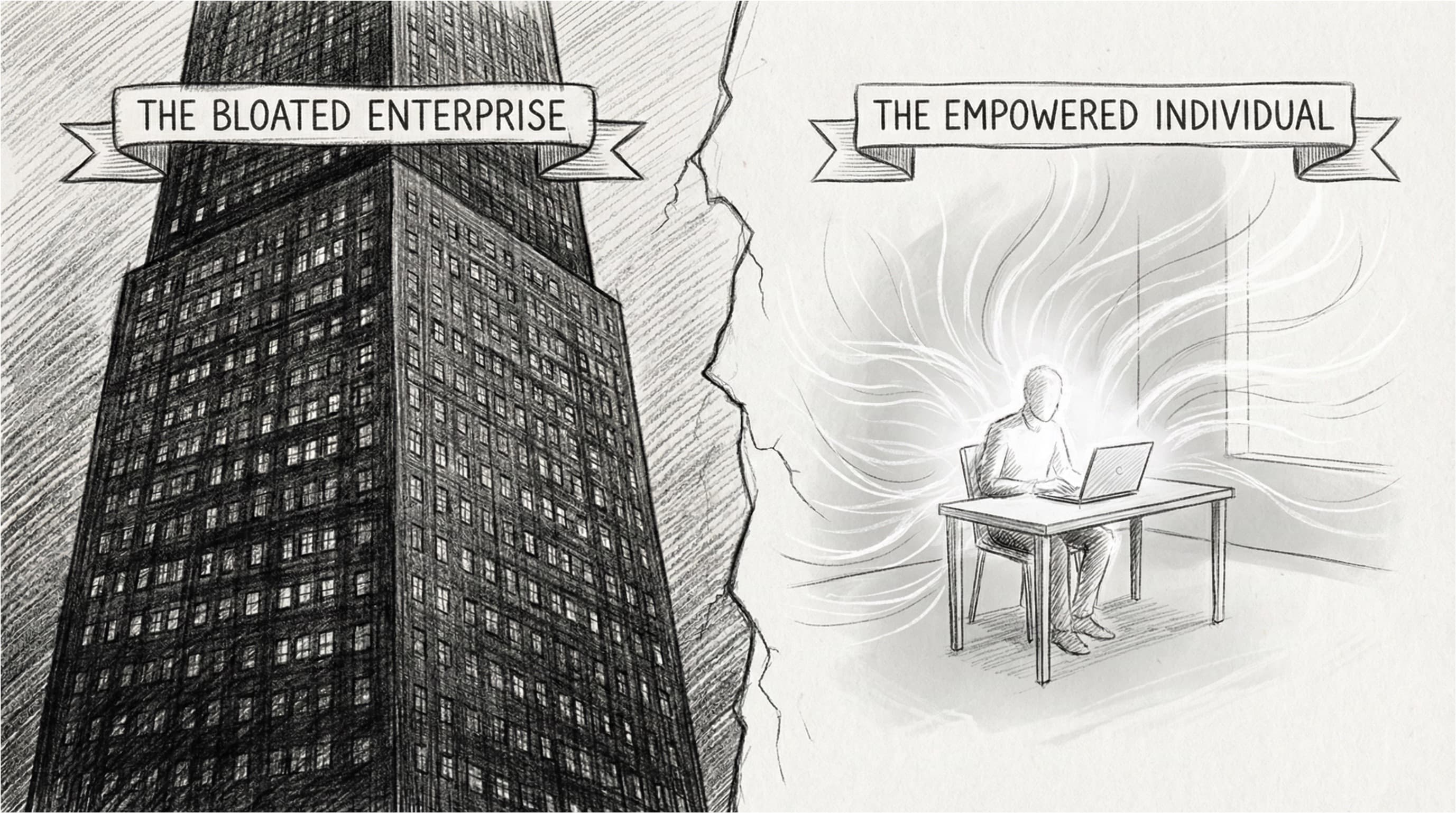
The businesses that sit out this restructuring cycle will spend the next decade watching their competitors do more with less, move faster, and operate at a level of capability that used to require organizations three times their size.
The first-mover advantage in AI isn't about the technology. It's about the organizational redesign.
And the redesign takes time.
Which means the people who started in 2023 are already years ahead.
The Pattern of AI Adoption
This isn't a new pattern.
In 1987, economist Robert Solow quipped, "You can see the computer age everywhere but in the productivity statistics."
Personal computers had been around since the early 1980s. Economists couldn't find the productivity gains for a decade.
Erik Brynjolfsson and Andrew McAfee later showed why: it took 15 to 20 years for companies to restructure around computers before the gains actually showed up.
The technology arrived. The organizational redesign didn't.
The gains weren't missing.
They were waiting.
The same dynamic played out a century earlier with electricity.
Historian Paul David documented this in 1990. Electric motors were invented in the 1870s. Factories didn't see the productivity transformation from electrification until the 1920s. Forty years later.
The problem wasn't the motor.
Factories built around steam power couldn't just plug in an electric motor and call it done. They had to redesign the entire floor plan, the entire workflow, the entire staffing model.
Once they did, productivity exploded.
But that took a generation.
AI requires the same restructuring. The gains come after the redesign. And the redesign takes time.
READ NEXT: The Invisible Leverage of Publishing in Public
What AI Adoption Critics Are Getting Wrong
Here's the part that bothers me: most of the loudest critics know this pattern exists. They just don't apply it honestly.
There are three kinds of AI skeptics, and understanding which one you're dealing with tells you everything.
The first type genuinely hasn't used it in any serious, sustained way.
They tried ChatGPT once, got something mediocre, and formed a permanent opinion. That's the equivalent of riding in a 1908 Ford Model N and concluding that automobiles will always be slower than horses.
The tool they evaluated bears almost no resemblance to what the tool is now. And they stopped looking.
The second type knows exactly what AI can do, and that's the problem.
Consultants, agencies, information brokers, anyone whose business model depends on owning expertise that clients can't easily access. AI doesn't make their knowledge worthless, but it narrows the gap significantly.
They're not wrong that AI threatens their margins. They're just calling it bad instead of adapting.
That's not analysis. That's self-preservation wearing the costume of analysis.
The third type is performing.
Tech hype is real, so skepticism has social currency right now. Saying "AI is overrated" sounds contrarian and smart in certain rooms.
The problem is that contrarianism applied indiscriminately is just as intellectually lazy as the hype it mocks.
Saying "it's complicated" is dodging the truth.
The AI First Strategy
I'm not writing this as a detached observer.
I built Rogue Risk as a human-optimized insurance agency before AI-first was a recognizable strategy. Every system, every workflow was built to put AI where AI belongs and humans where humans belong.
I built a company around this idea before this idea had a name. Someone acquired it.
I don't need a research report to tell me what I watched happen in my own P&L...
The returns are real.
They just don't look the way people expect them to look.
The 10x AI Mistake
The mistake everyone makes is assuming that 10x productivity means doing the same work 10 times faster.
That's not how it works.
The transformation is organizational.
AI handles 70 percent of the work that was never your actual job, so you can spend your time on the 30 percent that only you can do.
A one-person operation can now produce at the level that used to require a five-person team. A small company can compete with organizations twice its size. An individual can cut overhead that used to require outsourcing and build things that used to require agencies.
That doesn't show up in aggregate productivity statistics in year two.
It shows up in the P&Ls of specific companies, specific operators, specific individuals who figured out the restructuring early and built their workflow around it.
The book I'm writing, Easy Mode, is built around this exact idea.
AI doesn't create your edge. It protects it.
The 70 percent of work that was bleeding your best hours goes away, and what's left is the work you were actually built for.
That's where the compounding starts.
Every transformative technology followed the same arc:
Toy.
Distraction.
Threat.
Utility.
The people who called it a toy were wrong. The people who called it a threat were premature. The people who called it a utility were right, but they were late, and late meant they were building on top of what the early adopters had already built.
We are still, for most businesses, in the toy and distraction phase of that cycle.
That's not an insult. That's a calendar fact.
The structural shift is coming the same way electrification and commercial aviation did.
The people building seriously right now aren't seeing exponential returns because the technology is overhyped.
They're seeing early returns because they started before the restructuring became obvious.
That's always how it works. Every time. Without exception.
Calling the Wright Brothers a failure in 1905 didn't make you prescient.
It made you wrong in a way that aged badly.
Don't repeat that mistake.
This is the way.
Hanley.
P.S. If you want to operate in your Easy Mode and let AI handle the rest, start here: The Easy Mode Method