Key Takeaways
- →Your business should be your fastest-growing asset — never your only one.
- →Scale is a tool for one outcome: building something valuable enough to sell.
- →Secure the income first; then, and only then, go change the world.
Listen to the audio version of the podcast on Apple or Spotify.
The grass is always greener on the other side of scale.
...but underneath that grass is always shit.
Founders are constantly bombarded with the message that they must scale. We see the massive top-line revenue numbers, the huge teams, and the flashy exits, and we assume that is the only path to success.
We forget the math. A business doing $1 million at a 70% profit margin often beats a $10 million business at a 5% margin and a mountain of stress.
Building personal wealth starts with operating in reality, not chasing the vanity metrics of entrepreneur porn.
Carter Cofield and George Acheampong, the founders of Melanin Money, understand this better than anyone. They have built a massive platform by teaching entrepreneurs how to separate their personal financial security from the unpredictable swings of their business.
They argue that your business can be your fastest-growing asset, but it should never be your only asset.
If you are valuable to your business, your business is not valuable.
This is the exact trap that keeps founders working into their retirement years, holding an unsellable asset and zero personal liquidity.
Building personal wealth means taking chips off the table early and often. It means securing your own financial foundation so you can take bigger, calculated risks without the fear of losing your home.
Most founders get this backward. They pour every available dollar back into the business because the business feels like the safest bet they know. It is the thing they control.
The problem is concentration. When your business is your only asset, every decision carries the weight of your entire financial life.
You cannot fire the wrong client. You cannot pass on the bad deal. You cannot take the swing that might double the company, because a miss would wipe you out.
Carter and George flipped that. They built a personal balance sheet outside the firm so the firm could become a place to take risk, not a place to protect it.
That is the difference between an owner who plays scared and an owner who plays to win.
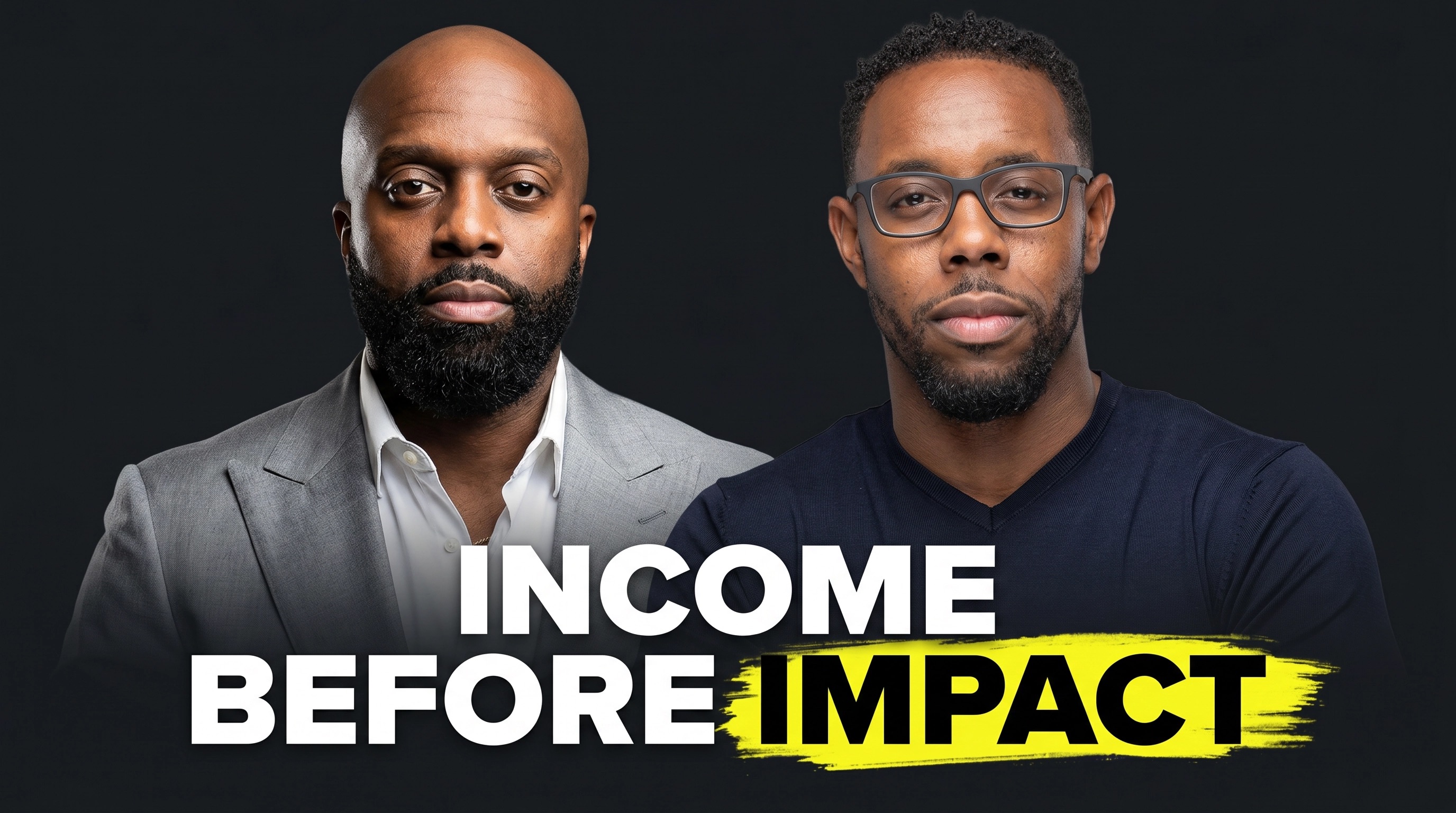
Connect with Carter Cofield and George Acheampong
Website: https://melaninmoney.com/
5-Day Wealth Workshop: https://joinwealthworkshop.com
George Acheampong Instagram: https://www.instagram.com/georgeacheampongjr/
Carter Cofield Instagram: https://www.instagram.com/cofield_advisor/
Melanin Money Instagram: https://www.instagram.com/_melaninmoney_/
The Four Phases of Business Growth
George breaks the entrepreneurial journey down into four distinct phases. Understanding where you are in this framework is critical to making the right decisions about capital allocation and personal wealth.
First is the Start Phase.
You are likely still working a job or funding the business with personal capital. You are fighting to reach breakeven. Every dollar goes into survival.
Second is the Growth Phase.
This is often the most profitable phase on a percentage basis. The business is working, the margins are high, and the operational drag is relatively low. This is where you must make a critical decision: Do you want to build a lifestyle business, or do you want to scale?
Third is the Lifestyle Phase.
If you choose not to scale, you optimize the business to support your desired life. You take heavy distributions. You attend your kids' games. You build personal wealth rapidly because the business exists solely to fund your life.
Fourth is the Scale Phase.
You only enter this phase if you plan to walk away from the business. Scaling requires massive reinvestment. It compresses margins. It demands a larger team and complex infrastructure. You should not scale unless you are building an asset to sell.
The lie we have been sold is that scale is the only honorable choice.
There is so much juice left to be squeezed in most businesses. But the thing that gets squeezed is you.
People choose to scale for the wrong reasons. A bigger number. A bigger team. A bigger story to tell at the dinner party. They never count the cost, and they pay a steep price for things they did not even know they wanted.
A lifestyle business with a 70 percent margin that lets you coach your kid's team is not a consolation prize. For most owners, it is the actual prize.
Scale is a tool for one outcome: building something valuable enough to sell so you can walk away. If you have no intention of walking away, you are signing up for the cost without the payoff.
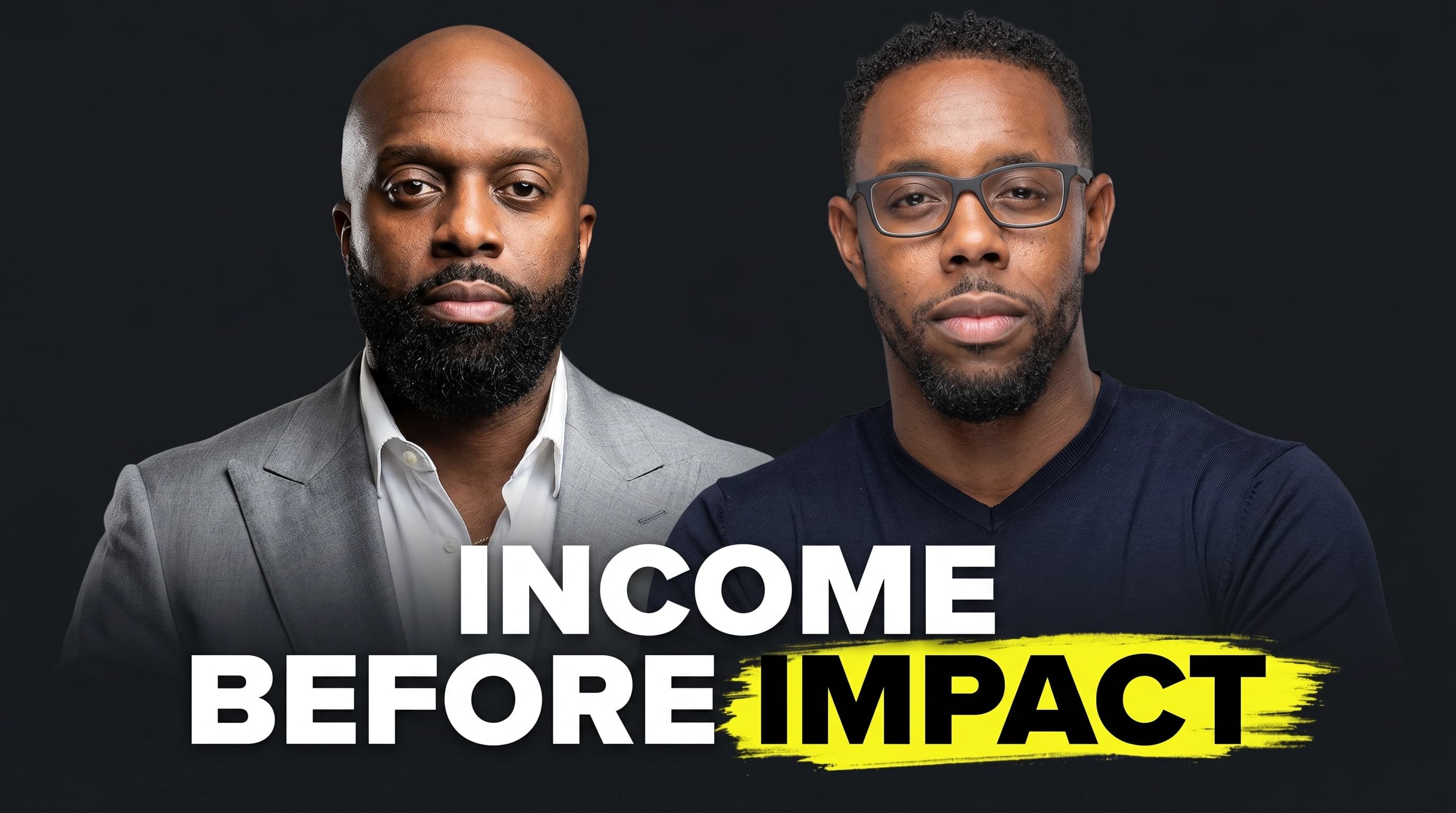
Income Before Impact
We live in an era where founders feel immense pressure to declare a massive, world-changing mission. If you are not saving the planet, the narrative suggests you are failing. This pressure causes founders to prioritize impact over their own financial security.
Carter and George flip this narrative. Trying to make an impact before you make an income is almost impossible if you want to be happy.
You must secure your own mask before helping the person next to you. Building personal wealth is the prerequisite to massive impact.
When your personal financial house is in order, you operate from abundance instead of fear. You stop viewing every prospect as a dollar sign and start viewing them as a human you can help. You stop saying yes to bad deals only to make payroll.
Secure the income. Build the wealth. Then, change the world.
WATCH NEXT: Why The Execution Gap Is Killing Your Business
Define Your Target to Stop Chasing
Entrepreneurs suffer from shiny object syndrome. We chase new marketing tactics, new software, and new business models because we lack a defined target. We do not know what "enough" looks like.
George uses the analogy of a drill bit. A billion drill bits were sold in 2011, but no one wanted a drill bit. They wanted the feeling of walking into a room and seeing beautiful artwork hung on the wall.
Money is only the hammer and the nails. Investments are the painting. The real goal is the desired lifestyle.
You must define exactly what you want your life to look like. Do you want a primary residence in your hometown and a vacation property? Do you want to retire your parents? Do you want to fully fund your kids' college?
Calculate the exact cost of that lifestyle. That number becomes your container. It becomes your measuring stick.
When a new opportunity shows up, you run it through one filter: does this move me toward my defined target, or is it a distraction?
If you do not define the target, you will chase forever.
Content as a Compounding Growth Engine
It is not the best who makes the most money. It is the most well-known.
We can all make a better burger than McDonald's, but they have sold a billion of them.
Carter and George built massive authority and a thriving advisory business on the back of content. They understand that people buy from you for what you know, but they also buy from you for who you are.
Content allows you to demonstrate both your expertise and your humanity. It acts as a salesperson working twenty-four hours a day, seven days a week. It never gets sick. It never asks for a raise.
More importantly, content acts as compounding interest. Every video, every podcast, and every article is a dollar invested in the content market. Over time, that investment compounds into an audience that trusts you. Brand is simply the promise that "I know them for this, and I can trust them for that."
When you build that trust, the algorithm works for you, and the inbound leads never stop.
Carter framed the money side without flinching. The more they earn outside the advisory firm through the podcast, the sponsorships, and the brand deals, the easier it becomes to reinvest in the firm itself.
Content stops being a marketing expense and becomes a second income stream that funds the first.
Most owners treat content like a chore they owe the algorithm. Carter and George treat it like an asset class. They showed up on a Saturday to publish when they could have been resting, because you never know which piece becomes the reason a stranger decides to trust you.
That is the whole game. You plant a thousand seeds and you have no idea which one becomes the tree.
Why the Facts Changing Should Change You
George said something that stuck with me. When the facts change, so do I.
We all operate from a worldview built on the information, the context, and the resources we had at a given moment. That worldview is not permanent. New information shows up. A better model arrives.
The willingness to change your filter is what separates people who grow from people who calcify.
The problem is ego. People hold their beliefs so tightly that being a truth seeker feels like a threat.
If I believed something last year and abandon it this year, does that make me a fraud? No. It makes me alive. I am not the same person I was last year, and neither are you.
Refusing to update is not integrity. It is fear wearing the costume of conviction.
George tied this back to solitude. Most people never get quiet enough to hear their own thoughts. They are flooded with noise from social media, from peers, from every direction, and they make decisions that were never theirs to begin with.
If you cannot answer why you want the thing you are chasing, that is the signal to challenge the belief.
Building personal wealth on a foundation of borrowed goals is how people get rich and stay miserable.
The Bottom Line
There is a fear underneath a lot of founder ambition, and Carter and George were honest about it.
Some success is driven by a healthy why, a clear picture of the life you want to build. Some success is driven by fear, a need to prove something, a terror of going backward to where you came from.
Fear can fuel an incredible run. It can also leave you standing on top of a mountain of money wondering why nothing feels like enough.
The work is figuring out which engine is running your business. The fear engine never lets you stop, and a business built to never stop is a business that owns you.
There is also a question worth sitting with about where all of this is heading.
As AI gets better at producing competent content, the value does not disappear. It moves. The expertise becomes a commodity. The human becomes the moat.
People will buy from you for what you know. But in a world drowning in machine-made answers, they will increasingly buy from you for who you are. The proof that you are a good operator, a good partner, a good father, the things a model cannot manufacture, becomes the reason someone chooses you over the infinite alternatives.
That is a strong argument for putting your real self into your content now, while it still surprises people.
Stop apologizing for wanting to secure your own financial future. Building personal wealth is not selfish. It is the foundation required to build a lasting business and make a genuine impact.
Take profits off the table. Define your target. And never scale a business you do not intend to sell.
I help founders & executives generating more than $10M in revenue find their Easy Mode. Start here: https://ryanhanley.com/subscribe
Listen to the audio version of the podcast: https://linktr.ee/ryan_hanley
Watch this episode on YouTube: https://youtube.com/ryanmhanley
This is the way.
Hanley.