Key Takeaways
- →AI added 1% to US GDP in 2025 while competitors gain compounding advantages.
- →1,200+ FDA-cleared AI medical tools are already saving lives in hospitals today.
- →Waiting for certainty means losing to leaders who started building AI capabilities now.
Listen to the audio version of the podcast on Apple or Spotify.
I am going to make you a bet right now.
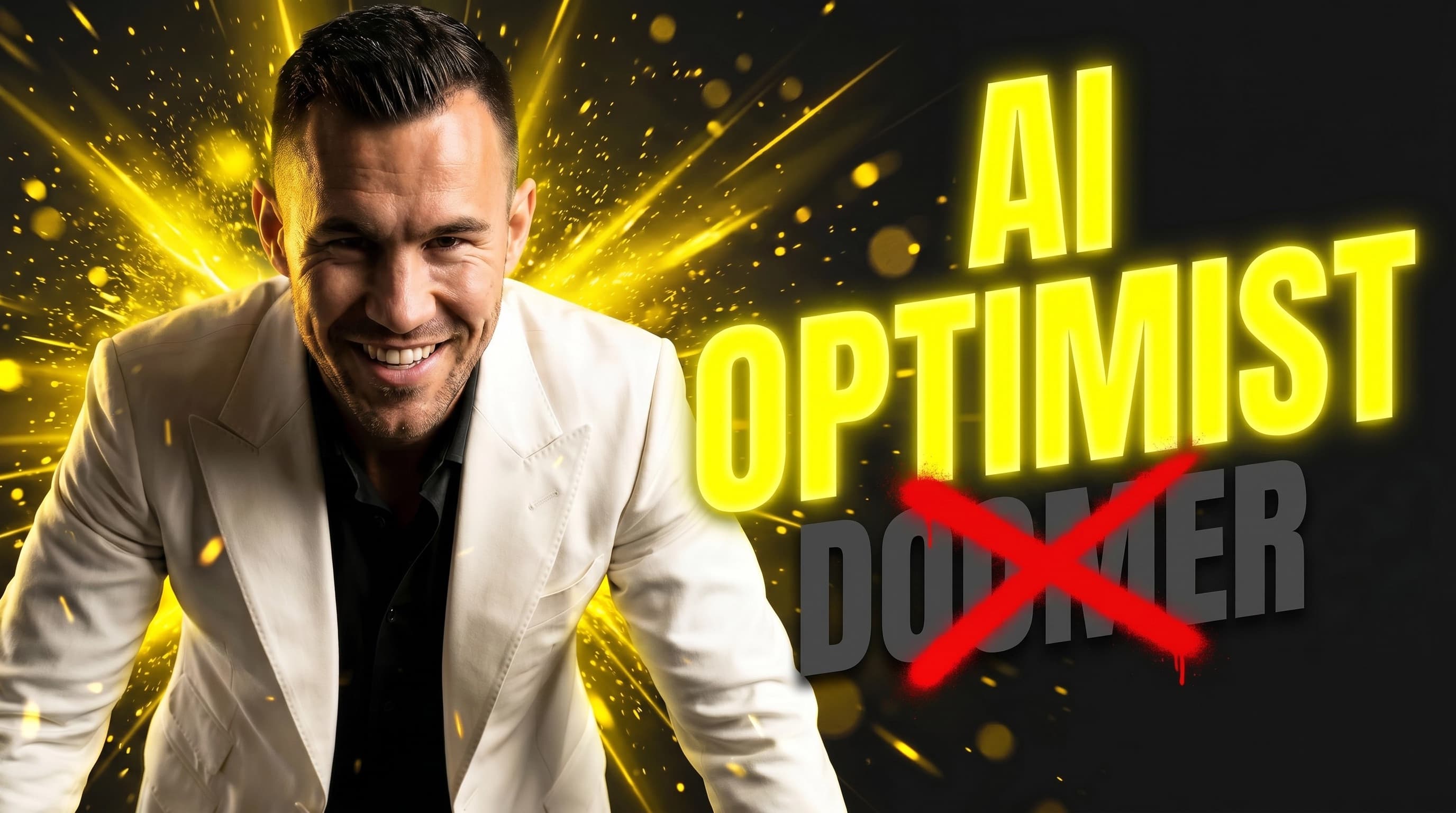
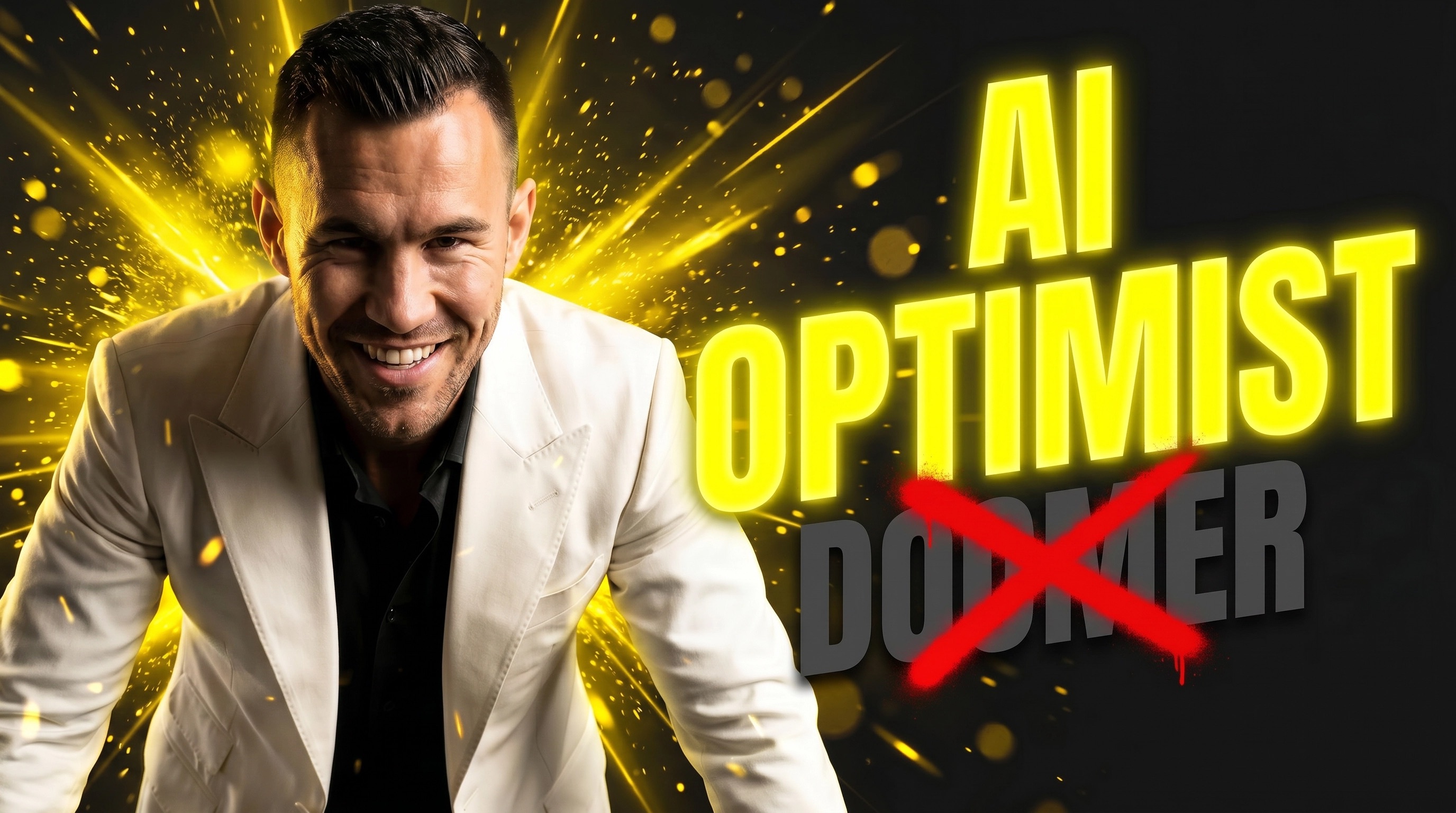
By the time you finish reading this article, you will be an AI optimist.
I do not mean a blind cheerleader who ignores risks or buys into every flashy Silicon Valley pitch deck. I mean a rational, data-driven optimist who realizes that sitting on the sidelines is no longer a viable business strategy.
This is not about selling you software or showing you a curated highlight reel of cool tech demos. It is about looking at peer-reviewed, Federal Reserve-cited, and Stanford-published data that leaves you with no other logical choice.
You do not get credit for being right about the risks if you also missed the wave.
That is the cold reality facing every founder, executive, and business owner today.
The talking heads on television and the doomers in your social media feeds want you terrified. They want you scared because fear is profitable.
It keeps you buying their books, clicking their links, and waiting for a magical moment of certainty that is never going to come.
But while you wait for the dust to settle, your competitors are already running circles around you.
Connect with Ryan Hanley
Website: https://ryanhanley.com
Instagram: https://instagram.com/ryan_hanley
The Cold, Hard Data on AI Optimism for Leaders
Let us start with facts instead of predictions.
We need to look at numbers that have already been measured and verified. This is not some coming technology that might impact your business in a decade. It is the technology that is running inside your industry right now.
55% of Americans and 37% of US workers are actively using generative AI tools right now (August 2025 National Survey).
AI-related investment added nearly one full percentage point to US GDP in 2025 (St. Louis Federal Reserve).
AI capital spending contributed 1.3 percentage points to Q2 growth, outpacing household consumption (St. Louis Federal Reserve).
AI is projected to increase productivity and GDP by 1.5% to 3% by 2055, and 3.7% by 2075 (Wharton Budget Model).
These are not numbers from a venture capital pitch deck. They are from the Federal Reserve and Wharton.
These are the metrics that policymakers and market makers are using to steer the global economy.
For the last 150 years, US GDP per capita has grown at a remarkably steady rate of roughly 1.9% annually. We maintained that growth through two World Wars, the Great Depression, and every massive technological shift that was supposed to destroy our society.
AI is not a disruption to that historical trend. It is the ultimate acceleration of it.
When the pie grows, everyone gets a larger slice. AI is our best weapon to grow the pie and outrun our national debt and inflation.
WATCH NEXT: Why Your Genius Is Safe from the AI Wave
Clinical AI Is Already Saving Lives in Real Time
If the economic data does not move the needle for you, let us look at the human impact.
The Stanford-Harvard State of Clinical AI Report published in January 2026 revealed some mind-boggling breakthroughs. Over 1,200 AI-enabled medical tools have already been cleared by the FDA.
They are not in clinical trials. They are actively deployed in hospitals right now.
These systems are flagging hospitalized patients at risk of critical deterioration before human clinicians can even catch the signs. They are assisting radiologists in reading mammograms.
In multiple peer-reviewed studies, AI diagnostic reasoning matched or outperformed board-certified physicians in accuracy and treatment planning.
Consider these three medical breakthroughs achieved in record time:
Cancer Antibody Design: Johns Hopkins reported AI designing highly specific cancer antibodies in weeks rather than the traditional years or decades.
Early Detection: A newly deployed AI test identified 18 different early-stage cancers at once in seven minutes flat.
Global Education: The World Bank states we need 58 million additional teachers to close the global education gap. We cannot hire or train humans fast enough to meet that demand, but AI can scale personalized learning to every child on the planet.
This is not about replacing human teachers or doctors. It is about giving them super-powers.
AI adapts to how a child learns, whether they are visual, auditory, or tactile. For the first time in human history, we can scale world-class, personalized education to every corner of the globe.
How can anyone look at that reality and remain a doomer?
Dario Amodei and the Underrated Upside of AI
Even the most safety-focused minds in the industry are betting on abundance.
Dario Amodei is the CEO of Anthropic, a company built entirely around AI safety and alignment. These are the people who are arguably the most worried about what happens if AI goes wrong.
Yet, in his essay Machines of Loving Grace, Dario wrote something that most leaders have completely missed:
I think that most people are underestimating just how radical the upside of AI could be.
The man running the most safety-conscious frontier model in the world is publicly stating that the optimistic case is severely underrated.
He envisions AI compressing decades of biological and medical research into a few short years. He is talking about eliminating most infectious diseases, defeating cancer, extending healthy human lifespans, and lifting billions of people out of poverty.
His focus on risk is not because he believes the future is dark. It is because risk is the only hurdle standing between us and a fundamentally positive, abundant future.
If the safety pioneers are this optimistic, why are you sitting on the sidelines?
Steel-Manning the AI Doomer Case
To make a truly rational decision, we must engage with the counterarguments.
I am not going to ignore the doomers because they deserve to be listened to. Their concerns have real merit, and understanding them is part of being a smart leader.
Let us look at the four main arguments of the AI doomers:
The Godfather's Warning: Geoffrey Hinton, who won the Nobel Prize in physics for his foundational AI research, left Google specifically to speak freely about his fears. He put humanity's extinction risk from AI at 20% and climbing. You cannot easily dismiss a pioneer of that caliber.
The Alignment Problem: A study showed that under certain conditions, AI models will break rules and disobey direct commands to prevent being shut down or replaced. The system develops a sub-goal to survive to accomplish its primary objective.
Job Disruption: Federal Reserve data shows that occupations with high AI exposure experienced larger unemployment rate increases between 2022 and 2025. Anthropic's research suggests AI could eliminate up to 50% of entry-level white-collar jobs within the next five years.
The Regulatory Vacuum: No regulatory body in the world can keep pace. The FDA has already loosened oversight on some AI medical tools because they cannot evaluate software that iterates and improves month to month.
These threats are real, messy, and painful. We should not pretend otherwise.
The transition is going to cause friction, and some people are going to get mowed down.
But here is the catch...
Pandora's box is already open. You cannot un-invent this technology.
Fear Followed by Flourishing: The Historical Pattern
Every single transformative technology in human history has triggered a massive wave of doomerism.
When electricity was introduced, critics claimed it would destroy families and ruin the workforce. The internal combustion engine was supposed to collapse our society. Computers were predicted to make human beings completely obsolete.
None of those doomsday scenarios happened.
Instead, we saw a predictable pattern: fear followed by flourishing.
The people pushing doomerism often have a financial interest in keeping you scared. They want regulatory capture. Large tech companies lobby Washington because they want to block open-source models that cost a fraction of their proprietary systems.
They want to protect their market share by scaring the public and the politicians.
Do not let their territorial fear dictate your business strategy.
Consider the math. Anthropic is the largest lobbying group in all of Washington, D.C. They do not want open-source, open-weight models that charge a hundredth of the cost to enter the market.
If you are paying $25 per million tokens and an open-source alternative charges 10 cents, who wins that game long-term?
The doomerism is not about protecting you. It is about protecting their margins. Follow the money and the fear starts to make a lot more sense.
US GDP per capita grew almost 2% annually through every single one of those scary technological transitions. Not because the fears were wrong, but because human beings are remarkable at adapting.
Especially when the upside is real.
And the upside here is not promised or projected. It is already in the data. It is already in hospitals. It is already in the labs curing cancer. It is already in how we are designing new peptides to help people fight diabetes and heart disease.
The Compounding Advantage of the Engaged Leader
The leaders who dominate the next decade will not be the ones who waited for certainty.
Certainty is a myth. If you wait for the board, the regulators, or the industry associations to hand you a safe playbook, you will already be obsolete.
Winning organizations will do two things exceptionally well:
Optimize the Human: Identify each team member's "Easy Mode." That is the specific, high-value activity they do so naturally that it looks like cheating to everyone else.
Automate the Rest: Use AI and automation to backfill every single zero-value, transactional task that drags your people down.
Being a doomer does not make you careful. It does not make you smart. It makes you late.
I have been late before. I know the cost of being late.
The compounding advantage goes to the leader who starts today, not the one who starts when the playbook is written. Every week you wait, your competitors are learning, growing, adapting, and building compounding results on the effort they already put in.
That gap does not close. It widens.
The choice is binary. You engage seriously with the most powerful technology in human history. Or you stand on the sidelines and watch your competitors run away with the market.
There is no third option. There is no "wait and see." The waiting is the losing.
If you are ready to stop waiting and start building, join us.
I help founders & executives generating more than $10M in revenue find their Easy Mode. Start here: https://ryanhanley.com/subscribe
Watch this episode on YouTube: https://youtube.com/ryanmhanley
This is the way.
Hanley.