Key Takeaways
- →Your self-image is your real ceiling — tactics can't rescue an identity committed to playing small.
- →Unchallenged beliefs are expensive — old conditioning runs the show until you name it and kill it.
- →Nobody should worry or win alone — isolation protects blind spots; accountability puts them under stadium lights.
Your strategy may not be the bottleneck. Your self-image might be.
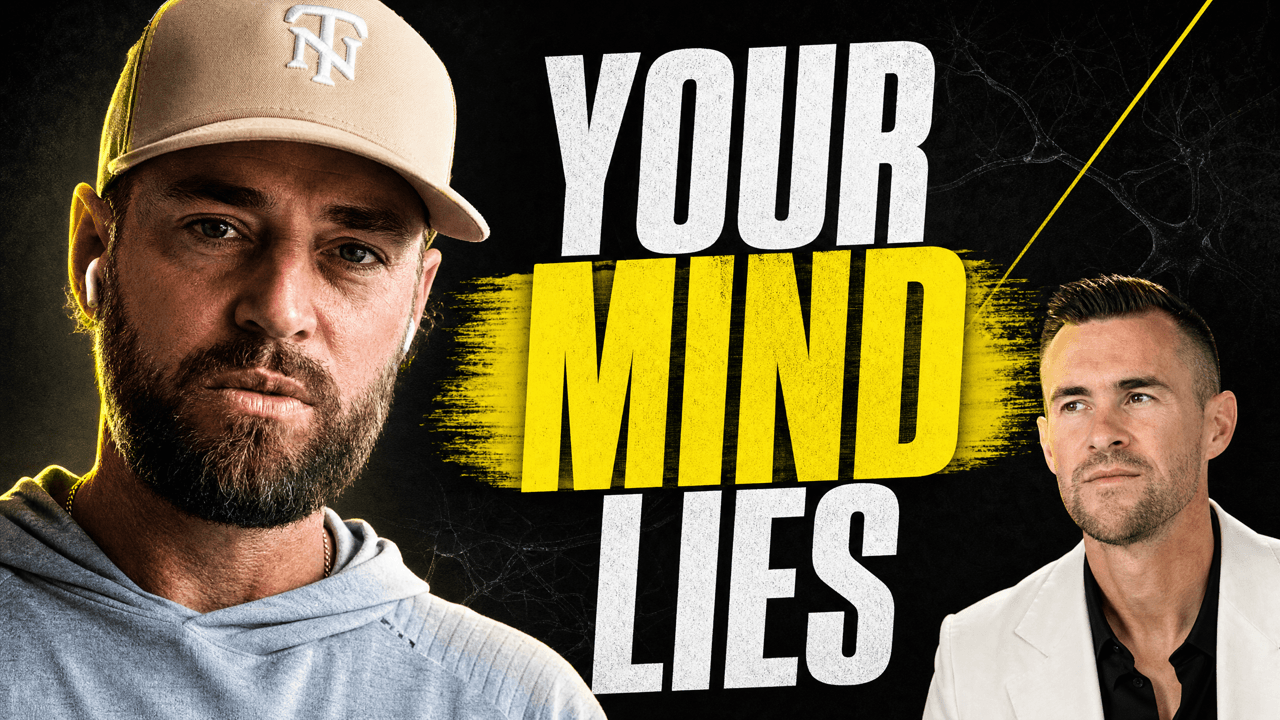
That is the uncomfortable premise behind my conversation with mental performance coach Collin Henderson.
Most companies train the craft. They train the offer, product, sales process, market, and operating system. Then pressure hits and the person responsible for executing all of it discovers that nobody trained the mind.
Mental performance training closes that gap. It gives leaders a way to examine the beliefs, labels, habits, relationships, and environments shaping their behavior before the next hard season exposes them.
Collin is the founder of Master Your Mindset, an author, and host of the Master Your Mindset podcast.
His work has taken him from Fortune 500 boardrooms to Division 1 locker rooms, including the UCLA women’s basketball program. He has seen the same truth in business and sports: Better tactics cannot rescue an identity committed to playing small.
His line was clean enough to build the conversation around:
You never outperform your self-image.
That sentence explains why capable people stall, why comfortable leaders become restless, and why adults who would hire a coach for their children refuse to ask for help themselves.

Connect with Collin Henderson
Website: https://www.thecollinhenderson.com/
LinkedIn: https://www.linkedin.com/in/collinhendersonmindset/
Instagram: https://www.instagram.com/collinhenderson/
Mental Performance Training Is Not Motivational Wallpaper
Collin broke performance into three areas: body, craft, and mind.
Leaders understand the body. Sleep, food, recovery, and energy affect performance. They understand craft even better. Companies spend money on product training, sales training, technical skills, management systems, and software.
The mind often gets whatever attention is left.
That is backward because the mind carries the other two into pressure. It decides what failure means. It decides whether uncertainty creates curiosity or panic. It decides whether criticism becomes useful information or a threat to identity.
Collin defines mindset as a conditioned set of beliefs that drives behavior. Some of those beliefs were chosen. Many were inherited from parents, coaches, teachers, peers, and painful experiences. A leader can spend decades obeying a sentence he never agreed to.
I am not smart enough.
People like me do not build companies like that.
If I ask for help, people will know I am struggling.
If I change direction, everyone will think I failed.
Those thoughts do not need to be accurate to be expensive. They need only to remain unchallenged.
Collin offered two questions that interrupt the pattern: “Is that thought true? Said by who?”
That is mental training in its most practical form. You catch the label, identify its source, and decide whether it deserves another day in charge. The goal is not to paste a positive slogan over a real problem. The goal is to stop treating old conditioning as current evidence.
Motivation can create a spike. Conditioning determines what happens when the spike disappears.
A keynote can make a room feel powerful for an hour. Monday morning still belongs to the systems, beliefs, and habits people carried into Friday afternoon. If the environment rewards panic, avoidance, and blame, the poster on the wall is losing that fight.
Mental performance training must become part of how a person and team operate. It belongs in preparation, reflection, coaching, language, standards, and recovery. You do not wait for the engine to seize before changing the oil.
Your Self-Image Becomes Your Operating Ceiling
The self-image conversation started with a question: Does performance create confidence, or can identity change before the scoreboard does?
Collin pointed to the idea behind Psycho-Cybernetics. A person may change something on the outside and remain miserable because the internal picture did not move. The same problem appears in leadership. A new title, revenue milestone, or acquisition can change the evidence without changing the identity interpreting it.
The founder still feels like the kid trying to prove he belongs.
The executive still hears criticism as rejection.
The owner still believes control is safer than trust, so every decision comes back through his office.
The business grows. The leader’s self-concept stays parked. Soon the company has a bigger engine and the same governor.
Self-image is not an excuse. It is a diagnostic.
If I keep avoiding a decision, I need to ask what making that decision would mean about me. If I refuse to delegate, I need to ask whether I believe my value comes from being needed. If I cannot receive feedback without defending myself, I need to ask which identity feels threatened.
This work requires humility. Collin called humility the foundation of change because no adjustment happens until a person admits his current interpretation may be incomplete.
That is not weakness. It is accuracy.
The strongest leaders I know do not need to protect every past opinion. They care more about getting it right than being right. They can examine the story, keep what is true, and burn what is not.
This is also why language matters. Words become instructions. Say “I am terrible at conflict” often enough and your brain starts collecting proof. A more honest sentence might be, “I have avoided conflict, and I can train this skill.” One label closes the case. The other opens a door.
The point is not to lie to yourself. The point is to stop turning a behavior into a permanent identity.
The Comfortable Middle Is More Dangerous Than Failure
Failure gets attention. The comfortable middle rarely does.
I am talking about the person whose life looks good from the road. The salary is solid. The house is fine. The title has weight. Nothing hurts enough to force change.
Inside, the engine is idling.
He is bored, restless, and quietly pissed off. He knows there is more in him, but reaching for it would put comfort, reputation, and certainty at risk. So he numbs the signal and calls the arrangement gratitude.
Gratitude matters. So does telling the truth.
Collin described this group as the middle of the bell curve. They are not in enough pain to demand a rescue. They are not hungry enough to chase a reinvention. If you coach, lead, or love someone in that position, force is the wrong tool.
I have to respect your right to be average.
That is the contrarian line of the conversation.
Adults have agency. You cannot install ambition in another person. You cannot drag a leader toward a life he refuses to claim. You can create context, build connection, ask better questions, and tell the truth without flinching. The decision still belongs to him.
Collin’s coaching order is useful:
Context before content. Connect before you correct.
Advice without context becomes noise. Correction without connection creates resistance. A leader who wants movement must first understand what the person wants, what the person fears, and what staying stuck is protecting.
The questions matter more than the speech.
What do you want?
What is stopping you?
Where does your mind go when nobody needs anything from you?
When did the work itself last feel rewarding?
What are you afraid you will lose if you change?
These are not comfortable questions. Good. Comfort built the cage.
The middle is dangerous because it can consume a lifetime without creating a dramatic crisis. There is no explosion. There is only a slow trade: possibility for predictability, year after year.
WATCH NEXT: How the Autonomous Digital Economy Will Redefine Your Business
Nobody Should Worry or Win Alone
Adults are weird about help.
We expect our kids to have teachers. We expect athletes to have coaches, trainers, and film rooms. We expect elite teams to study performance from every angle. Then a grown man reaches a certain title and decides needing counsel would expose him as a fraud.
Nonsense.
I have gone to therapy every other week for years. A mentor once told me to treat it as a standing life expense. Some people were surprised I would say that publicly. Their reaction told me how much work remains around the idea of asking for help.
Collin’s line was better:
You don’t need to be sick to get better.
Therapy, coaching, and accountability are not emergency rooms reserved for collapse. They can be maintenance, preparation, and honest reflection. Waiting until the wheels come off is not strength. It is delayed responsibility.
I saw the same principle in business.
When I launched a national digital commercial insurance agency, an accountability partner met with me every other Wednesday. That relationship forced me to define the next move, build systems, report progress, and confront the gaps between what I said mattered and what I completed.
The meeting was not magic. The structure was.
Another person could see the excuses I had learned to hide from myself. He could ask why the promised work was not done. He could remind me of the standard when emotion tried to renegotiate it.
Collin calls adult mentorship an underused performance tool. He is right. Peer pressure works in both directions. A weak environment can normalize drift. A demanding environment can make disciplined action feel ordinary.
This does not mean collecting famous contacts or sneaking into expensive rooms for a photo. Proximity can come through a coach, an accountability partner, a peer group, books, interviews, or the deliberate study of people whose behavior matches the standard you want.
The key is not access. It is exposure plus action.
You have to let better thinking challenge your defaults. You have to bring the idea back into your calendar, decisions, and behavior. Otherwise, proximity becomes entertainment.
“Nobody should worry or win alone” is not a soft slogan. It is a performance standard. Isolation protects blind spots. Accountability puts them under stadium lights.
Ownership Turns Insight Into Movement
The late part of our conversation centered on a question leaders face with employees, partners, friends, and clients: Can you help someone who does not want to change?
Sometimes a person will not move before rock bottom. Sometimes timing, pain, or proximity creates an opening. Collin’s advice was to resist the urge to bury the person in facts. Ask questions that make avoidance harder.
Start with an honest rating. How fulfilled are you? How close are you to your potential? Where does your mind go in idle moments? What would need attention if you stopped pretending everything was fine?
Then ask the ownership question:
“What are you doing for that?”
It is a brutal little sentence because it separates desire from behavior.
I want better health. What are you doing for that?
I want a stronger marriage. What are you doing for that?
I want a company that can run without me. What are you doing for that?
I want more meaningful work. What are you doing for that?
The question does not deny circumstance. It finds the part still under your control.
That is where movement begins.
Collin also connected performance to flow, gratitude, service, and the design of challenge. Too little challenge creates boredom. Too much can create panic. Growth lives in the stretch between them, where the task demands more without making action feel impossible.
Leaders need to design that stretch on purpose. The comfortable founder may need a goal that risks embarrassment. The overwhelmed executive may need a smaller target and a calmer nervous system. The isolated owner may need one honest person in the room.
The answer is not always quitting the job or torching the company. Work can fund purpose without becoming your entire identity. Coaching a team, serving a community, building something creative, or becoming more present at home may carry the meaning your title cannot.
That distinction matters because comparison has become an industrial machine. A leader can have the life he once prayed for and feel poor after ten minutes watching strangers pose beside rented Lamborghinis. If he cannot define enough for himself, somebody else’s highlight reel will do it for him.
Reality must come before reinvention.
What do you value?
What do you already have?
What is missing?
What part of the gap belongs to courage, skill, environment, or action?
Collin closes his work through The Oz Method, a framework that uses the characters and journey of The Wizard of Oz to explain influence, empathy, courage, heart, learning, and process. The symbols are memorable, but the deeper point matches the full conversation: Change needs a target, a path, companions, and the courage to keep walking when certainty disappears.
You do not need another identity built for applause. You need one strong enough to tell the truth under pressure.
Listen to the audio version: https://linktr.ee/ryan_hanley
Watch the conversation on YouTube: https://youtube.com/ryanmhanley
Start finding your Easy Mode: https://ryanhanley.com/subscribe
This is the way.
Hanley.